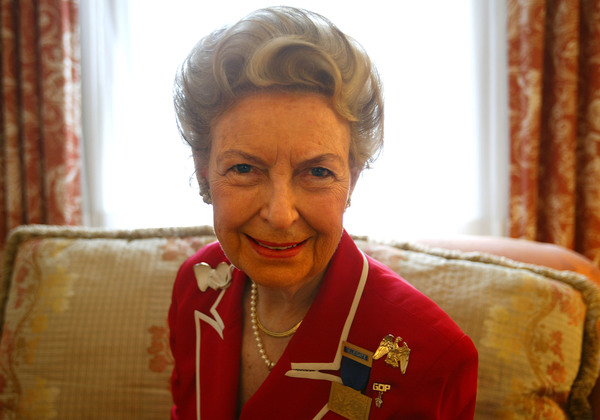
Phyllis Schlafly, the political activist who galvanized grass-roots conservatives in the 1970s to help defeat the Equal Rights Amendment and effectively push the Republican Party to the right in ensuing decades, has died. She was 92.
Known as "the first lady of anti-feminism," Schlafly died Monday of natural causes. Her death was confirmed by Ryan Hite, a spokesman for the St. Louis-based Eagle Forum. Hite said Schlafly was in the presence of family when she died at her home there.
Schlafly had been a standard bearer for the conservative branch of the Republican Party for decades, writing the influential book "A Choice Not an Echo" to help Barry Goldwater secure his party's presidential nomination in 1964.
Beginning in 1972, she led opposition to the ERA _ a 52-word constitutional measure that guaranteed equal rights under the law regardless of gender _ arguing that it would mark the end of the traditional family.
"She was an important figure who was the first to plug in to the power of the female conservative vote in modern times," said Donald Critchlow, a history professor at St. Louis University and author of the 2005 political biography, "Phyllis Schlafly and Grassroots Conservatism: A Woman's Crusade."
"Her importance wasn't fully seen until the ascendancy of the right that began with the election of Ronald Reagan as president," he said.
The campaign to pass the ERA was led by the National Organization for Women, which made the amendment central to its mission after it formed in 1966. The feminists' argument was mainly economic: The ERA would require that laws determining child support and job opportunities be designed without regard to gender.
Opponents said the ERA would have granted more power to Congress and the federal courts and cause women to lose privileges and protections, such as exemption from compulsory military service and combat duty and economic support from husbands for themselves and their children.
With Schlafly's entrance, the debate became more about the changing role of women in society than about equality. Her army of volunteers brimmed with stay-at-home mothers, and she contended that the amendment would deprive a woman of the fundamental right to stay home and care for her children.
"Phyllis Schlafly courageously and single-handedly took on the issue of the Equal Rights Amendment when no one else in the country was opposing it," James C. Dobson, chairman and founder of Focus on the Family, told the St. Louis Dispatch in 2005. "In so doing, she essentially launched the pro-family, pro-life movement."
Her calmly expressed, unshakable conviction that the amendment was a threat to a woman's financial security and traditional motherhood drove pro-ERA audiences crazy.
"The only way to debate Phyllis Schlafly is to jump up and down and shout 'Liar, liar, liar!' " one feminist told Newsweek in 1977. (The magazine branded Schlafly "the first lady of anti-feminism" in 1979.)
During the 10-year battle over the amendment, feminist leader Betty Friedan famously hissed at Schlafly during a debate, "I'd like to burn you at the stake." Chicago columnist Mike Royko dubbed her "a national nag." And a political activist smashed a pie in her face, injuring her eye.
Through it all, Schlafly remained impeccably groomed and seemingly unflappable.
"You have to keep your sense of humor," she told the Los Angeles Times in 1996.
When Schlafly and her troops entered the fray, 30 states had already ratified the ERA. Within a year, the amendment _ first introduced in Congress in 1923 _ started losing steam. It ended up three states short of the 38 needed for ratification and was defeated in 1982.
"Would the ERA have passed without Phyllis? That's the $64,000 question," Karen DeCrow, president of NOW in the mid-1970s who debated Schlafly at least 50 times, told the Times in 2005. "Bing-bing-bing, the states were ratifying it before she got involved. If she hadn't, then bing-bing-bing, we might have had three more states."
By the turn of the century, some feminists and historians said they felt history had passed Schlafly by because many of the changes contained in the ERA happened over time anyway. Her emotionally charged argument against the amendment included warnings that it would force women to serve in combat zones, cause unisex restrooms to proliferate and allow gays to marry.
Schlafly saw the ERA as an unnecessary crutch for "a bunch of bitter women seeking a constitutional cure for their personal problems." Women who blamed sexism for their failures were just looking for excuses, she said.
"The claim that American women are downtrodden and unfairly treated is the fraud of the century," she wrote in her 1977 book "The Power of the Positive Woman." ("Don't call me Ms.," she repeatedly said. "To me, it means misery.")
"If you're willing to work hard, there's no barrier you can't jump," she said, offering herself as Exhibit A.
Critics said that though Schlafly presented herself as a traditional homemaker, she was tough and aggressive. She often traveled, had a full-time housekeeper and a personal assistant, and a resume that most feminists would envy.
"People quoted me for years for saying, 'If I had a daughter I would want her to be a "housewife" just like Phyllis Schlafly.' I still believe that," said DeCrow, who preferred Schlafly above other debating partners because she was "very sharp and kept to her time limits."
Schlafly was credited with inspiring a new generation of conservative women, including author and columnist Ann Coulter, who wrote the foreword for Schlafly's 2003 book, "Feminist Fantasies."
Schlafly's first brush with fame came in 1964 when she self-published her first book, "A Choice Not an Echo," written to win votes for Goldwater. Three million copies were sold, mainly to Goldwater workers who bought in bulk.
"The book was a clear articulation of the Republican right's view of (GOP) convention history," Critchlow wrote.
She told how "from 1936 through 1960 the Republican presidential nominee was selected by a small group of secret kingmakers who dictated the choice of the Republican presidential nominee just as completely as the Paris dressmakers control the lengths of women's skirts."
In the book, Schlafly claimed that Eastern internationalists _ the Nelson Rockefeller wing of the party _ had forced their candidates on the party for years.
"This was strong medicine, even for a campaign book intended to stir up the Republican grass-roots," Critchlow wrote, yet "it proved remarkably successful in its goal."
Phyllis McAlpin Stewart was born Aug. 15, 1924, in St. Louis, the elder of two daughters of John and Odile Stewart. Her mother worked for 25 years as the head librarian at the St. Louis Art Museum.
After a year at Maryville College of the Sacred Heart in St. Louis, Schlafly transferred to Washington University, also in St. Louis, and paid for her education by testing rifles and machine guns on the night shift at a World War II munitions plant.
She earned her bachelor's degree in political science in 1944 and received a master's degree in government from Radcliffe College a year later. Years later, when Schlafly found her authority repeatedly challenged during ERA debates because she wasn't a lawyer, she attended Washington University "in her spare time" and graduated with a law degree in 1978.
In 1949, she married Fred Schlafly, a fellow Roman Catholic and conservative 15 years her senior. The couple moved to the industrial city of Alton, Ill., and she became a self-described homemaker. Between 1950 and 1964, she had six children and kept them out of school until second grade so she could teach them how to read.
When her first child was a toddler, she plunged into the first of two unsuccessful campaigns for Congress and became a fixture as a delegate and behind-the-scenes platform player at Republican national conventions beginning in the 1950s.
In later years, Schlafly cited 1964, the year she turned 40 and wrote her first book, as the most productive of her life.
Pregnant with her sixth child, she began collaborating that year with Adm. Chester Ward on "The Gravediggers," the first of five books they wrote on the Soviet military threat. (The partnership endured until Ward's death in 1978.)
She also ran the Illinois Federation of Republican Women, successfully ran for vice president of the National Federation of Republican Women, won a contested race to be a delegate to the Republican National Convention, made dozens of speeches for Goldwater and had the baby Nov. 16, 1964 _ 13 days after her candidate was crushed at the polls by President Lyndon Johnson.
In "Phyllis Schlafly: The Sweetheart of the Silent Majority," author Carol Felsenthal argued that Schlafly "was obviously 'liberated' decades before the word got hackneyed. She never, ever allowed her sex to stand between her and her goal. And that perhaps, is one reason for her unrelenting disdain for 'libbers.' "
At the start of the ERA fight, she founded the St. Louis-based Eagle Forum, which became an influential conservative group that she ran with a firm hand. She took no salary.
At the 1992 GOP convention in Houston, Schlafly supported the party's platform, which condemned same-sex marriage and gay civil rights. Soon after, a New York gay magazine outed her oldest child, John, then a 41-year-old lawyer who helped run the Eagle Forum.
"I love my son," she told the New York Post in a reaction story at the time. "But all my children are adults and lead their own lives."
Her children grew up to be achievers _ three lawyers, an orthopedic surgeon, a mathematician and a businesswoman _ and conservatives.
In 2008, she offered a firm defense of the choice of Alaska Gov. Sarah Palin as John McCain's running mate on the Republican ticket.
"People who don't have children, or who only have one or two, don't comprehend what it's like to have five," said Schlafly, then 84, on the floor of the convention in St. Paul, Minn.
"I had six children," she said. "I ran for Congress. An organized mother puts it all together. The time-management mother uses the older ones to help with the younger ones. You should read that old book 'Cheaper by the Dozen.' "
Her husband died in 1993.