Unique pay ponds such as one built at a cafe and another at an old public bathhouse are attracting throngs of customers.
The cafe features tanks filled with thousands of fish, while the now-defunct public bathhouse was remade into a fishing facility, with customers dropping their lines into baths converted into fish ponds.
"It's so fun, I'm really getting into this," said a customer at Catch & Eat, the cafe in Musashino, Tokyo, where diners can catch fish from the tanks.
"Shoot, I lost it," another grumbled. Both shouts of joy and sighs of disappointment echoed throughout the fishing area.
Thousands of fish about 10 centimeters long swim in the tank ponds, including honmoroko willow shiner and young ayu sweetfish. On weekends, the cafe attracts about 150 customers, including families, who come to savor their catches, which are cooked and served at the cafe.
Many customers become so engrossed in fishing, doing their utmost to prevent hooked fish from escaping, that they neglect their drinks.
"It's difficult to catch fish. That's why it's so fun," said Erika Suzuki, 9, a third-year elementary school student from Suginami Ward, Tokyo, who attentively watched surface of the pond while speaking.
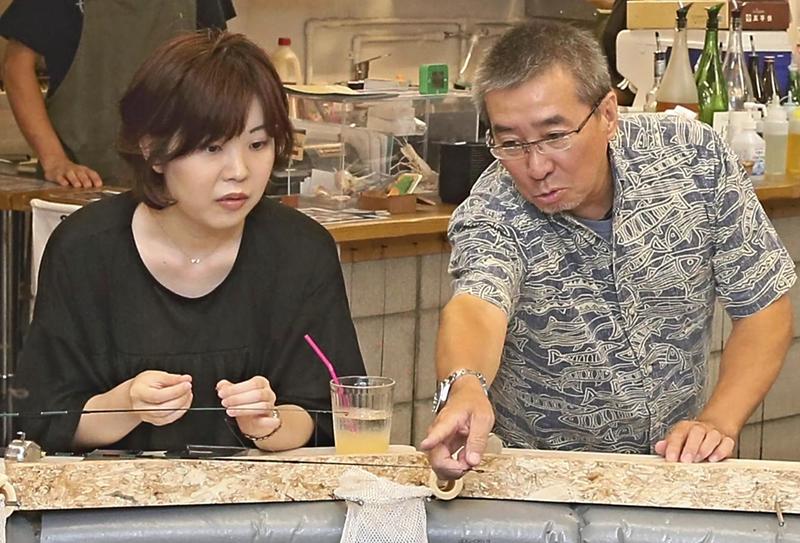
The cafe is run by Yoshikazu Yamaguchi, a 61-year-old architect who has had a passion for fishing since childhood. Twice a month, Yamaguchi takes a cruiser out to Tokyo Bay to go fishing. His inspiration for the cafe came from a similarly styled pay pond he visited in Thailand, which made him think the concept "would definitely be popular in Japan." Now that the cafe attracts many customers, Yamaguchi hopes his establishment will help people take an interest in fishing.
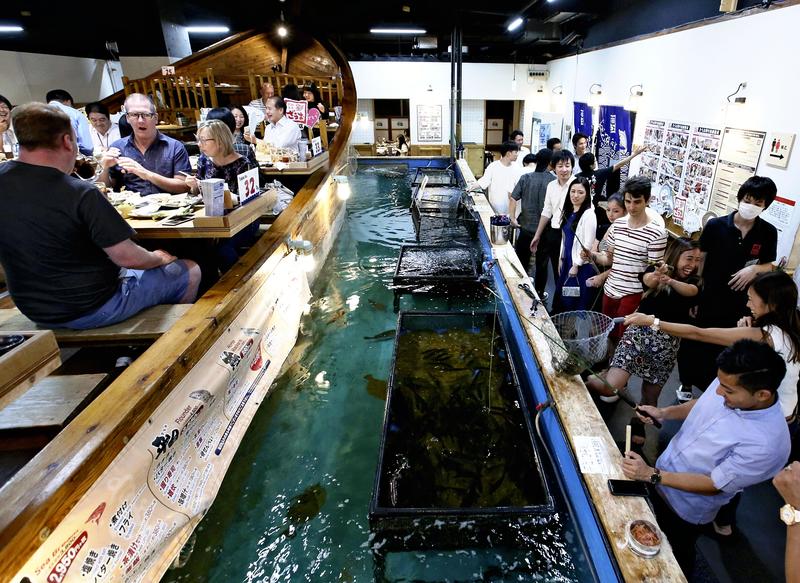
Fishing Restaurant Zauo, an izakaya pub in Shinjuku Ward, Tokyo, also allows customers to catch fish at the restaurant and this has helped it gain popularity among foreign visitors. Fish such as flounder and red sea bream are simmered or prepared using such methods as ikezukuri, in which the fish is served as sashimi while still alive.
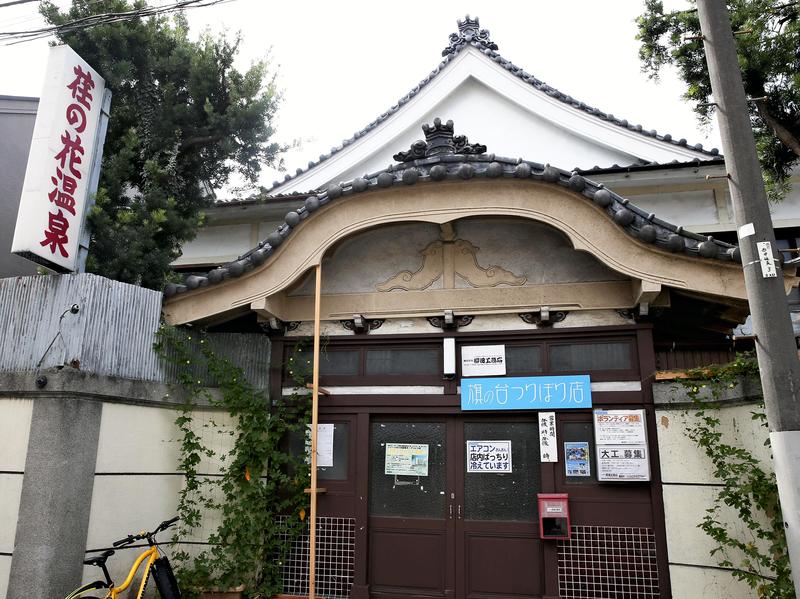
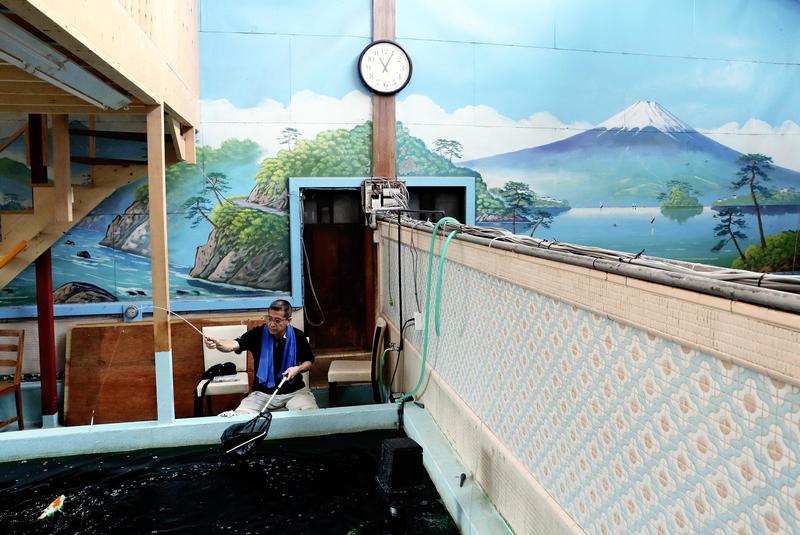
Ideal for its waterproof qualities, the old public bathhouse is another unique pay pond establishment. At Hatanodai Tsuriboriten (Hatanodai pay pond) located in Shinagawa Ward, Tokyo, fish swim in tanks built in areas that were previously bathhouse washing spaces.
Hisamitsu Yanagida, 47, who owns a local builder's office, renovated and converted the public bathhouse that closed about 20 years ago into a pay pond. The building's high ceiling built in the miyazukuri style creates a spacious atmosphere, while a wood bandai front desk and wooden floor help visitors recall the Showa era (1926-1989). "I can get a sense of what it used to be like," said a regular customer.
"I want this to be a place where anyone can relax, as if they were at a public bathhouse," said Yanagida.
CAPTIONS
Yomiuri Shimbun photos
Foreign tourists try their hand at fishing at Fishing Restaurant Zauo in Shinjuku Ward, Tokyo, on Sept. 19.
Customers fish in ponds at Catch & Eat in Musashino, Tokyo, on Sept. 8. Customers can eat the fish that they caught at the cafe as tempura or deep fried, among other methods of preparation.
Catch & Eat cafe operator Yoshikazu Yamaguchi, right, offers tips on fishing to a customer. Even beginners can enjoy fishing as they can receive advice.
A regular customer fishes at Hatanodai Tsuriboriten in Shinagawa Ward, Tokyo, on Sept. 9. A mural of Mt. Fuji painted in a style traditional to Japanese public bathhouses can be seen in the background, while the partition between the male and female baths remains intact.
An exterior image of Hatanodai Tsuriboriten taken on Sept. 9 captures the building's imposing atmosphere, which has not changed since it was a public bathhouse. A nameboard for the bathhouse remains at the gate.
Read more from The Japan News at https://japannews.yomiuri.co.jp/