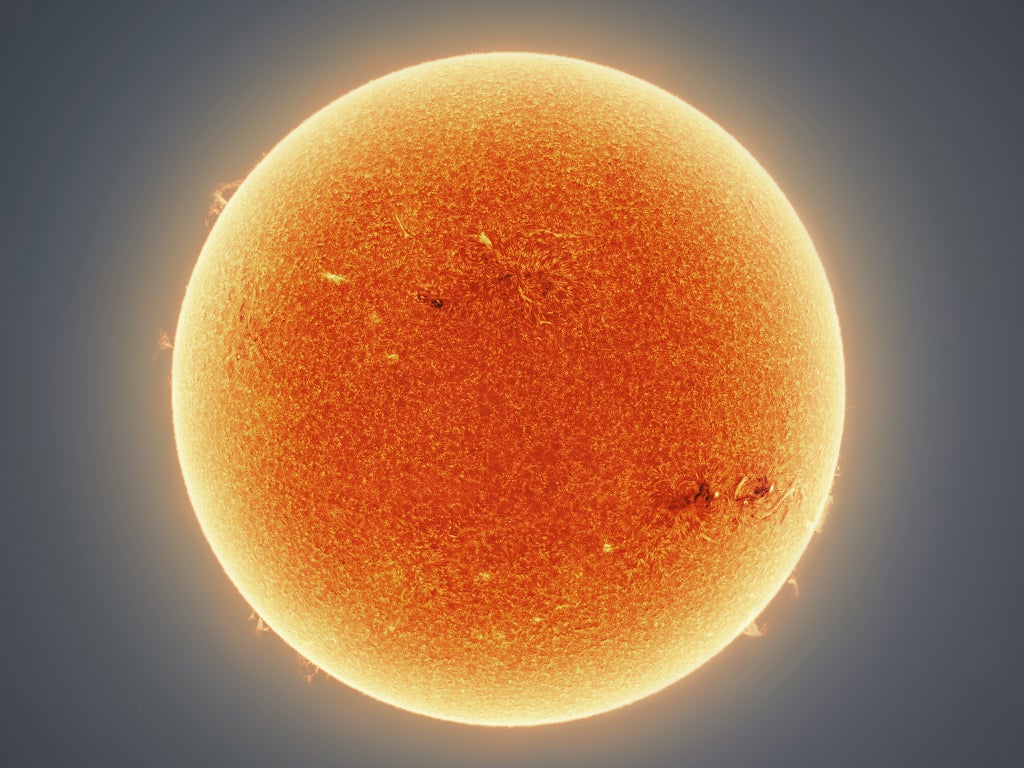
An astrophotographer has taken an astonishingly detailed photo of the Sun using 150,000 images of the flaming ball of gas.
Andrew McCarthy layered hundreds of thousands of images “with extreme magnificent [sic] using a modified telescope”.
The full image has a resolution of 300 megapixels, 30 times greater than the resolution of most photos taken with standard smartphones.
Despite being captured at such a high resolution, the photo is not entirely accurate. The dark spots on the Sun are high intensity areas and in reality are bright white - however, the photographic process itself inverts the colours, making them appear black.
McCarthy used a modified telescope with two filters to capture the image, both to ensure that the telescope did not ignite and to protect himself from blindness when looking at the Sun.
The Sun, a celestial object of huge power that is 330,000 times the size of Earth, has been releasing wave after wave of plasma creating small geomagnetic storms that have been striking our planet.
These storms create the aurora in the northerly parts of our planet, but have some potentially devastating effects as well: in the worst case scenario, a geomagnetic superstorm could plunge the world into an “internet apocalypse”.
This is because long-distance optical fibre lines and submarine cables, which make up the infrastructure of the internet, are vulnerable to the currents produced on the surface of the Earth’s crust by these superstorms.
Mordern technology has developed in a period of relative inactivity from the Sun, but the current solar cycle has the potential to be one of the strongest on record. The current ones are so powerful, and are moving so quickly, that they are actually ‘cannibalising’ the weaker ones that have come before.
The Sun, while being constantly inflamed, could have actually been the source of water on Earth.
“An existing theory is that water was carried to Earth in the final stages of its formation on C-type asteroids, however previous testing of the isotopic ‘fingerprint’ of these asteroids found they, on average, didn’t match with the water found on Earth meaning there was at least one other unaccounted for source,” Phil Bland, a professor at Curtin University, said last month.