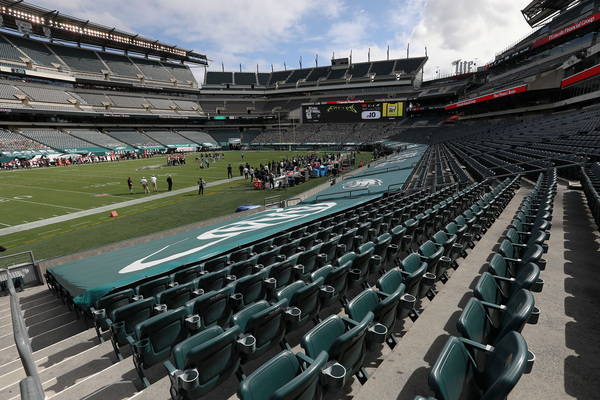
PHILADELPHIA _ Philadelphia will loosen its coronavirus restrictions to allow crowds of up to 7,500 people at the city's largest outdoor venues, a step that will put thousands of Eagles fans back in the stands at Lincoln Financial Field for Sunday's game against the Baltimore Ravens.
The new limits, which also increase the indoor gathering limit to a maximum of 250 people, vary based on the size of a venue and will take effect Friday. The city rules are more restrictive than new state guidance that Gov. Tom Wolf issued last week _ but the 7,500-person maximum outdoor crowd limit is the same for both the city and state.
The Eagles immediately announced ticket sales for fans Tuesday but said tailgating would be prohibited. Temple University said family of players and coaches would be permitted to attend Saturday's game at Lincoln Financial Field, and tickets would be sold for future games.
Masks and social distancing will be required at all gatherings, and venues must tape or block off seats to prevent attendees from sitting less than six feet away from anyone outside their own household, city officials said.
Tuesday's announcement came as new cases of COVID-19 in Philadelphia and statewide continue to increase. The city reported an average of 158 new confirmed cases per day for the week that ended Saturday, and 4.5% of people who were tested had positive results. Those numbers represent increases from the previous week, and the highest case counts since mid-July, according to city data sorted by date of testing.
Farley said two-thirds of recent cases are in people between the ages of 20 and 49, and clusters have been found in college students as well as in Northeast and South Philadelphia neighborhoods.
As the Eagles get ready to sell tickets, the city is also preparing for a potential second wave of the virus as winter weather arrives, including opening an alternate care site for nursing home residents who have COVID-19.
Health Commissioner Thomas Farley warned that the city would enact stricter event limits again if there is evidence of the coronavirus spreading at events or if cases continue to increase.
"Especially with the cooler weather and the dryer weather, if the virus is spreading more, we may have to go to a much more restrictive mode," he said.
Farley warned against residents holding indoor social gatherings of any kind _ especially weddings, bridal showers, and funerals, where people do not generally wear masks and tend to hug friends and family members.
The city's new restrictions vary based on the size of a venue and whether it is indoors or outdoors. An indoor theater with 300 seats, for example, could have up to 10% capacity, or 30 people. And an outdoor stadium with 10,000 seats could host a maximum of 15% capacity, or 1,500 people.
The limits include participants or athletes, staff, and spectators. For the Eagles, that means between 5,500 and 6,000 fans would be permitted to attend each game, the team said.
The regulations apply even if they lead to crowds of less than 25 people _ the city's existing limit for indoor events. An indoor space that typically holds 150 people, for example, can only host a group of 15. Farley cited rising case counts and evidence of increased transmission indoors as the reasons for that limit.
For most live theater venues, the capacity limit would make a production nearly impossible, said Bryan Buttler, publicist for the Wilma Theater and the Arden Theatre, which both remain closed but are screening productions virtually.
"There is no human way that with that 10% capacity maximum... that it would make any sense for any small-size theater to try to do something," Buttler said. "Let's say a small, mid-size theater fits 300 ... (Getting) the actors, the production staff, the staff in the building _ that's 30 people to begin with."
Kenney acknowledged that the new rules may be difficult for struggling indoor venues.
"Despite the fact that we'd like to be more easy going with the indoor events, the indoor events are where people get sick," he said. "We cannot in good conscience put people in a facility we know is going to give them more of a chance to get sick."
Philadelphia officials had delayed an announcement on crowd sizes after Wolf issued his guidance, citing a need to review the guidelines and consult health experts. Officials have said they need to take extra precautions in Philadelphia because it is the largest and most densely-populated city in the state _ and the hardest hit by the coronavirus.
Under the state's new rules, fans were present at Heinz Field in Pittsburgh when the Eagles played the Steelers on Sunday. There were about 5,000 fans in the 68,400-seat stadium, according to the Steelers. The Philadelphia Union were also allowed to welcome 2,775 fans back into their Chester stadium that can hold 18,000.
Lincoln Financial Field seats more than 69,000 fans, which means 7,500 fans would fill just 9% of its seats.
Kenney said he trusts the Eagles to enforce mask wearing and social distancing.
"It's in the Eagles' best interest to have this go off without a hitch and I'm confident they can do that," he said.
The mayor said he hopes fans will inspire the team to play well, but he does not plan to attend a game.
"I'll be very happy to sit at home and watch with a big screen with all my food and beverages," Kenney said. "I know if I went to a game somebody would take my picture and it would become fodder for social media, so I will stay home."
Kenney also announced Tuesday that the city will still have a holiday tree at City Hall, and will soon announce virtual and outdoor, socially distant events for the holiday season.
City health officials will also keep a close eye on the spread of the coronavirus. While he cited no specific metric that would trigger a need to restrict more activities, he said it will be important to watch the rate of cases in residents older than 60.
"If those cases are rising substantially, that says that we're likely to have an increase in deaths and that's what we care about the most," he said.
For outdoor venues in Philadelphia, crowds can be:
_ 20% of maximum occupancy for venues that hold up to 2,000 people
_ 15% of maximum occupancy for venues that hold between 2,000 and 10,000 people
_ 15% of maximum occupancy for venues that hold more than 10,000 people, with a cap of 7,500 people
_ 67 per 1,000 square feet for venues with no seating or an undefined occupancy limit, with a cap of 7,500 people
At indoor events, crowds can be:
_ 10% of maximum occupancy for a venue that holds up to 2,000 people
_ 10% of maximum occupancy for venues that hold more than 2,000 people, with a cap of 250 people
_ 10 people per square foot for venues with no seating or an undefined maximum, with a cap of 250 people
Until Friday, events remain capped at 25 people indoors and 250 people outdoors.