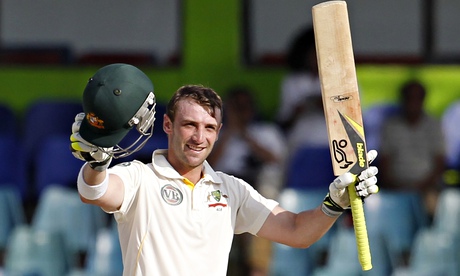
The International Cricket Council has offered its deepest condolences to the family of Phillip Hughes and will wait until next week before considering the potential ramifications of the batsman’s death, as tributes poured in for the Australian.
The cricketing world reacted in shock on Thursday after Hughes, 25, died two days after being hit on the back of the neck by a bouncer in a Sheffield Shield game while playing for South Australia at the Sydney Cricket Ground. A tearful Michael Clarke read a statement out on behalf of Hughes’s family while messages of shock and support reverberated across the globe.
Helmet manufacturers said the incident could change their design processes, with more emphasis on protection of the neck. The issue of the bouncer rule was also discussed. Sean Abbott, the bowler, has yet to speak publicly but received widespread messages of support.
Cricket Australia said on Friday morning that it will immediately launch a review into safety protocols and protection for players.
“Statistics say it is clearly a freak incident, but one freak incident is one freak incident too many, so that of course puts us in a position of looking into that,” James Sutherland, CA’s chief executive said.
“We will immediately, in consultation with the manufacturers and the other safety providers or regulators, look into it to make sure that these things are addressed and improved, and it’s a matter of interest not just for us here in Australia, but for cricketers all over the world.”
Flags flew at half mast across the world, from Lord’s to the SCG, and the England and Wales Cricket Board said Hughes “would be missed throughout the world”. The second day of a Test between Pakistan and New Zealand was postponed while a tour match between India and a Cricket Australia XI was cancelled. Australia and India are due to begin a four-Test series in Brisbane next Thursday.
Sachin Tendulkar said it was a “sad day for cricket” while the Australian prime minister, Tony Abbott, described the incident as a “shocking aberration”.
Clarke, the Australia captain, read out a statement on behalf of Hughes’s parents, Virginia and Greg, and siblings Megan and Jason. He said: “We’re devastated by the loss of our much-loved son and brother, Phillip. It’s been a very difficult few days.
“We appreciate all the support we have received from family, friends, players, Cricket Australia and the general public.
“Cricket was Phillip’s life and we as a family shared that love of the game with him. We would like to thank all the medical and nursing staff at St Vincent’s Hospital and Cricket New South Wales medical staff for their great efforts with Phillip. We love you.”
Hughes, who played 25 Tests for Australia and was pushing for a recall to the team, was wearing a helmet when Abbott’s delivery struck him on the neck. Manufacturers stated that the incident, which caused an artery to tear, would affect their future designs while the former England captain Nasser Hussain called for new methods to protect players.
Hussain said: “You have to think about ways of improving the helmet all the time, balancing protection with being able to move and see the ball. Putting bits on the neck … is an area we’ve never thought about. We were always told to protect the temple but were never really concerned about the neck.”
The ICC recently introduced new regulations regarding helmet safety after it commissioned a medical report that identified certain weaknesses in relation to the traditional design.
The report, which resulted in a new standard coming into effect in June, focused on the metal grille of the helmet that protects the face. However, manufacturers said Hughes’s death could affect how the back of the neck is protected.
Peter Wright, the managing director of Gunn & Moore, said: “The back of the neck is an extraordinarily difficult place to protect because lightness makes it easier to avoid the ball in the first place.
“We’ll certainly look at it and take advice from neurosurgeons as to the vital parts that you do need to protect. What you need as a batsman is to not have to move your head too much to get out the way of the ball. It’s something that will be on our mind. There are issues that need to be resolved but parents don’t need to be concerned that the current helmets don’t stop injuries.”
Nick Wilton, who works with the design team at Gray-Nicolls, said: “I’m sure this will change things in the future. The difficulty with the back of the head is that the batsman needs full ability to move to avoid the ball. But it will definitely refocus our development going forward.”
The former ICC chief, Jagmohan Dalmiya, has called on the game’s administrators to make sure such an incident never happens again. He said: “If we are still struggling with the quality of protective gear, that’s a very sad thing on the part of the administrators.”