Seldom has there been such unanimity in the cricket world, albeit in the aftermath of the game’s most tragic week. The sport is united in sorrow and the outpouring of grief and sympathy around the globe has been conspicuously genuine. No doubt that would have applied whoever was the victim of such a terrible accident but somehow it was especially the case for Phillip Hughes. Here was the archetypal, country boy Aussie, who evoked shades of that old New South Wales favourite Doug Walters (minus much of the booze and the fags).
Like Walters, Hughes batted in a homespun way, which did not pay much attention to the MCC coaching manual. He suggested innocence and humility, which was peculiarly endearing to onlookers from near and far. He gave the impression he was never happier than with a bat in his hand. His unorthodox style brought him to the forefront of a cricket-loving public in Australia but all the peripheral, so-called benefits of success in sport, the thrill of instant recognition, the celebrity and all those glitzy sponsorship deals, were for shallower types. He just loved the cricket.
This unanimity has stretched to cricketers’ reactions of what the implications might be of Hughes’s death. Everyone agrees the unrelenting pursuit of a safer game should continue in earnest. Alastair Cook expressed that view in Colombo; James Sutherland, the chief executive of Cricket Australia, said: “One freak incident is one freak incident too many.”
However, most also acknowledge that in theory it has never been safer to play the game. Batsmen and close fielders have never been so well-protected. Even so, there will now be feverish activity to ensure the back of the head is better guarded by the helmet without restricting the ability of the batsman to move quickly.
The dinosaurs – for want of a better word, since I can recall taking guard in this manner at the start of my career – remember when all the protection available was the badge on the peak of a flimsy cap. Some of the cricketing huddles in Colombo have been recalling famous narrow escapes we once laughed about, such as Keith Fletcher, of Essex and England, receiving a flyer from Jeff Thomson on his cap badge in Sydney on the 1974-75 tour and the ball ricocheting out to cover. Fletcher survived, albeit with confidence shattered and a headache.
Early in 1976 Dennis Amiss was hit on the head by Michael Holding at Lord’s, which prompted him to remodel his technique and a year later to stride to the crease in a shiny white helmet; his first one looked as if it had been stolen from a motorcyclist but it did not take long for Amiss’s peers to swap their chuckles for an inquiry about where they might acquire something similar.
There is, however, one disturbing consequence of the improvement in protection in this era. Over the past three decades batsmen may have gradually acquired a false sense of security from the belief their helmet offers absolute protection. In turn, this has led to a change in the approach and technique of batsmen.
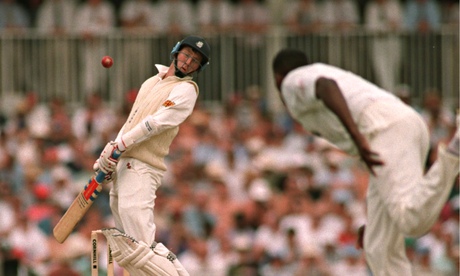
Until the late 70s the top priority for just about every batsman, whether a No1 or a No11, was to ensure he was not going to be hit on the head when facing fast bowlers. Next on the list was scoring runs. Various techniques were evolved; the opening batsman might concentrate on learning how to duck and sway from the short ball, while keeping an eye on it. In time this might dissuade fast bowlers from wasting their energy. No11s with no batting pretensions would take a cruder option by retreating swiftly towards square leg, and who can blame them? In that era it was always a mighty disturbing experience for a batsman to be hit on the head but it did not happen very often.
The evolution of the helmet has gradually changed batting techniques. The ball striking the batsman on the head, protected by a helmet, has become far more commonplace. The frequent reaction from those involved has been a shrug of the shoulders, quite possibly a leg bye, with the game resuming after a brief check that there are no ill effects.
Batsmen gradually became more fearless; the hook or pull off the front foot was now a business shot for most first-class batsmen, not just for the minor geniuses upwards. Now it is conceivable that players and coaches might rethink the best way to bat with greater emphasis on avoiding being hit on the head.
Should captains/pacemen/administrators rethink how bowlers operate? The idea of banning the bouncer has been tossed around the airwaves. Once again there is unanimity within the cricket world. Apart from being almost impossible to put into practice, such a move would diminish the game and change it beyond recognition: it would be as anaemic as rugby without the tackling.
The short ball will remain a legitimate tactic for fast bowlers. And so it should be. Imagine an Ashes series in which Mitchell Johnson or Stuart Broad does not feel entitled to bowl a bouncer? In the immediate aftermath of the tragedy there may be some hesitancy among the fast bowling fraternity about employing the short-pitched delivery. This is understandable. As Peter Lever, the Lancashire and England fast bowler of the 70s, who once felled Ewen Chatfield with a bouncer, so graphically described in the Guardian, there are agonies to endure for fast bowlers who hit batsmen. This is why all cricketers are united in sympathy for Sean Abbott as well as the Hughes family this weekend.
This hesitancy will not last long. The game has to retain its aggression and that sliver of fear for those taking guard.
This is a vital ingredient, unlike the petty posturing, often mistaken as aggression, when mindless abuse is exchanged between international cricketers – and subsequently copied by youngsters in the park. It would be a bonus if, amid the new cricketing unanimity, they all decided to dispense with that.