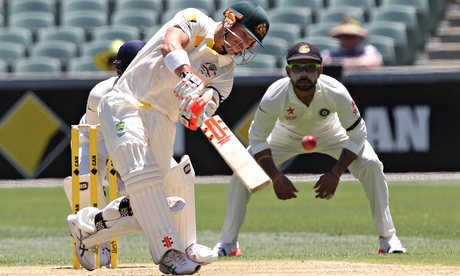
Beneath an azure sky, cricket, and Australian cricket in particular, returned to normality, or at least as close to normality as it will ever be in what have been abnormal times. In Adelaide, David Warner bulldozed his way on to the field, powered his first ball through the covers and biffed himself a typical hundred against India, full of swash and buckle and emotion; and Michael Clarke’s back went. There were bouncers bowled too, the first of them, from Varun Aaron, as slippery as it gets and snorting past the head of Warner, who jerked out of the way at the last moment.
Meanwhile, at the Sydney Cricket Ground, a young cricketer got back in the saddle. There was a measure of catharsis in the air.
Warner it had been who cradled the head of the fallen Phillip Hughes and then held his hand as he was taken off the field on a stretcher: he would have felt the spirit of Hughes with him every step of the way. At one stage he found himself unbeaten on 63, the score that will forever be associated with Hughes, saying that he found it “ weird” and that he could not wait to move on from it.
Cricketers can be a superstitious lot and 63 not out might become the game’s equivalent of the poker-playing Wild Bill Hickock’s “dead man’s hand”, the aces and eights he was holding when murdered in Deadwood a century and a half ago. Who would dare declare an innings with a batsman on that score?
Clarke was only three runs short of that mark when his back went into spasm and he was forced to retire hurt. Those extra runs would surely have been too much to bear, given that the career of the Australian captain must be in some jeopardy given his history of severe back injury. That he was playing at all is an indication not just of his stubborn determination to participate in a match that means so much, but of the understanding of those who select the side given that his fitness was always in doubt.
Throughout the past couple of weeks, his stature has risen immeasurably, so that he has emerged not just as the captain of the national cricket team, but a leader of the nation. He was applauded all the way to the crease.
Australians have not always been unanimous in taking him to heart, but they have someone in which to be proud. The main focus may have been on Adelaide, but back at the SCG, scene of the tragedy, Sean Abbott too was returning to the game. Abbott had bowled the fateful delivery, and would have been inconsolable.
But the compassion and support he has received has been immense. It was courageous of him to attend the funeral. Now he was back playing and bowling for New South Wales against Queensland, something many thought might be beyond him for a while: his fifth ball was a bouncer.
And so the world and cricket moves on. Time heals. But the death of Hughes has offered an opportunity for those involved in the game, from the very highest levels down to grassroots, to take stock, a period of introspection. Cricket is a game that challenges in many ways. It tests temperament; it requires the fitness and mental strength to concentrate for six hours, often in high heat and humidity, or to bowl long spells; it places techniques under scrutiny; it demands courage. It is a game that should be played hard, with no quarter asked or given.
Cricket is not a game to be sanitised. Players get angry and emotional. Batsmen tend to show their feelings off the field, to the general amusement of bowlers, rather than on it, where they have to be in control of themselves. For bowlers, the reverse applies, their aggression channelled into their business. Words are spoken. None of this is new, none of it has changed and neither should it.
But beyond that the game has taken on an ugly face, so that words are no longer spoken in the heat of the moment but as a calculated tactic, with a player’s perceived susceptibility to what is frequently nothing less than snarling abuse discussed and planned beforehand. It is not always overt, but is insidious, even if the players themselves have now become inured to it. Look, though, at the manner in which this kind of behaviour has permeated down even to junior levels and see the damage that is done by such an example. It is unedifying and not fogeyish to say so.
There is a perception that such behaviour makes a player somehow tougher, but really it is just bullying. Gideon Haigh has pointed out the fallacy in the observation that when Clarke told Jimmy Anderson to “get ready for a broken fucking arm”, he somehow grew as a captain and man. Actually, Haigh argues, it diminished him, something placed firmly in perspective by his recent actions. Much the same applies, for example, to Anderson, whose continuous stream of invective would not challenge Dorothy Parker for a place in a book of quotations.
There is an argument that says that if Anderson does not stand up to those that direct stuff at his team, who will? It is a sad standpoint, for if it has validity, then we have a merry-go-round from which no one would wish to jump first. Someone has to blink, and it would be good to think that from the tragedy of Hughes’s death, the lead might now come from Australia and India. Hopefully, where they might go, others would follow.