RGB Mini LED is the TV industry’s big push for 2026.
That doesn’t necessarily mean it’s about to become the best or most popular display technology – but it is the one being marketed most aggressively, with some brands even positioning it as an OLED killer.
I’ve now seen a fair few RGB Mini LED TVs in action, and I’m not yet convinced. The headline benefits – higher brightness and greater colour volume – are fairly clear, but they don’t obviously outweigh OLED’s core advantage: self-emissive pixels.
As I recently reported, LG says “OLED is still king” – though given that its business is deeply tied to OLED panel production, that stance isn’t exactly surprising.
More interesting, then, is the view from Philips.
Danny Tack, Senior Director of Product Strategy and Planning at Philips, which is launching its own RGB Mini LED TV this year, puts it plainly: “We think OLED still is better.”
That aligns with what I’ve seen so far – and Tack boils the difference down to one simple point:
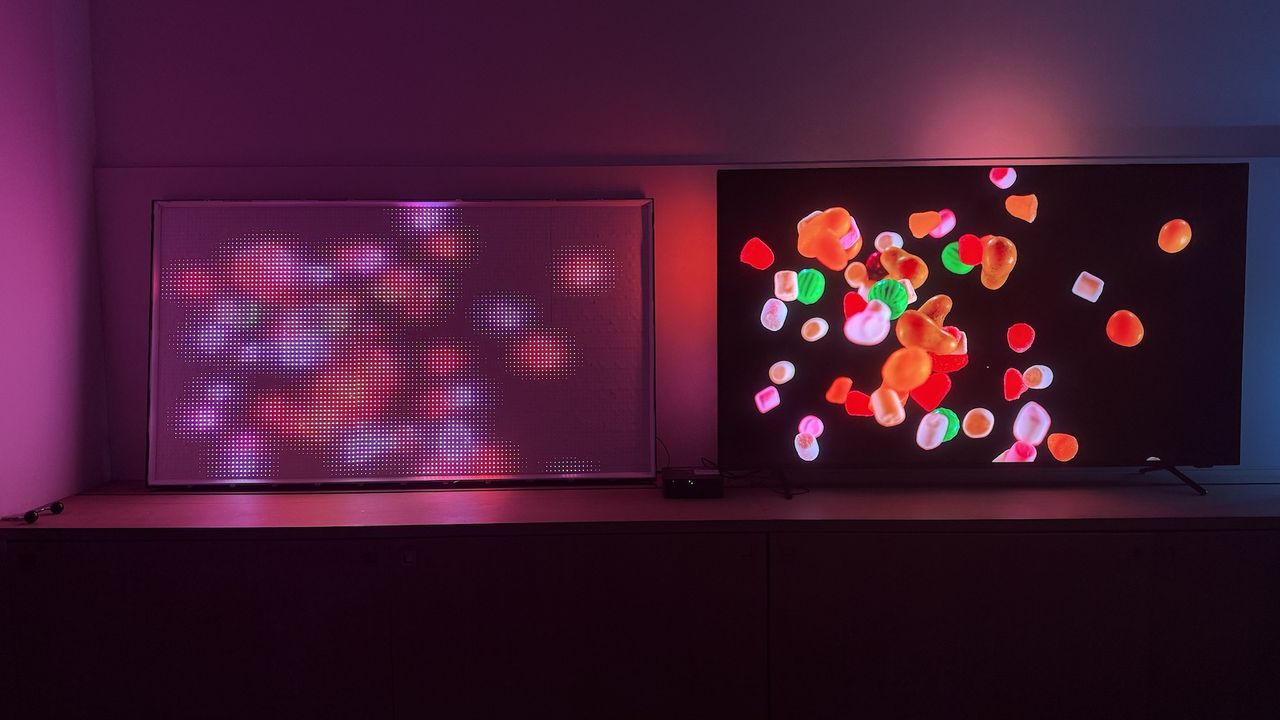
“This [Philips’ MLED981 RGB Mini LED TV] has 11,520 zones, but OLED has, like, 8.2 million zones – because every pixel is a zone. [That means] we can still have much deeper black, more accurate black.
“Although [the MLED981] is pretty good, pretty well tuned, and there are so many [dimming] segments, there will still be, here and there, a danger of a halo, and a border of the dimming zone.”
That’s the crux of it. Even with thousands of dimming zones, Mini LED still can’t match OLED’s pixel-level precision – so issues such as blooming and imperfect blacks don’t disappear entirely.
Philips is a particularly useful voice in this debate because it produces TVs across all major panel technologies. And Tack, in particular, has a reputation for prioritising picture quality over all else.
So why launch an RGB Mini LED TV at all?
As with LG, the answer is largely about size and price. As Tack explains, the MLED981 is aimed at “somebody who wants a big screen size, good picture quality, and a more affordable price – the bigger the screen size, the more affordable Mini LED is over an OLED.”
Accordingly, Philips is (at least initially) launching the MLED981 only as an 85-inch model – the size at which OLED prices rise sharply and become truly out of reach for most buyers.
Mini LED also still has two notable advantages: brightness and colour volume.
“You could say also in terms of full-screen brightness, Mini LED is better than OLED – 800 nits versus OLED, which is now reaching 450 nits – so under bright conditions, this might be a better offer,” Tack says.
“Colours [are also] a bit more intense, but then again, at an angle, compared to OLED, less so. There are lots of pros and cons.”
In other words, RGB Mini LED absolutely has its place – particularly if it’s a very big, very bright, and relatively affordable TV that you’re after.
But on balance, Philips’ view is clear – and it’s one I share: right now, OLED remains the benchmark for overall picture quality.
Could RGB Mini LED overtake it? Possibly – perhaps even this year. Sony, in particular, is talking a big game with its True RGB technology.
For now, though, OLED remains the TV technology to beat.
MORE:
Here's why I think the Philips OLED951 could be the TV of the year
These are all of the best TVs you can buy right now