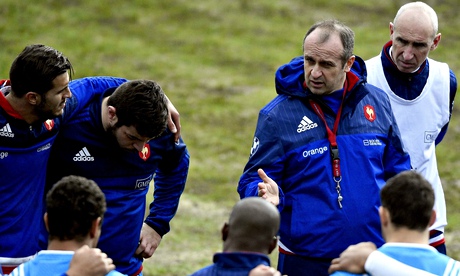
Will the real France please stand up? Or have Les Bleus stooped so low that nobody would be able to tell? A team that used to make rugby union different with, in Brian Moore’s words, its brutal beauty, has become boringly boorish. All muscle and little menace.
France play Wales in Paris on Saturday, a fixture they have not won since 2011. They have not beaten Ireland in the past four attempts and their last success over England at Twickenham in the Six Nations was in 2005. They have lost on their last two trips to Rome. Only against Scotland do they prosper.
They have yet to finish in the top half of the Six Nations table in the Philippe Saint-André era and after starting with their customary victory over Scotland – although outscored on tries 1-0 – they lost in Dublin, stirring themselves only after the match appeared to be lost. They scored the only try of the game but a side that used to be known for its flair and ability to make something out of nothing through instinctive brilliance plays as if programmed to eliminate risk – stereotypical England in blue (or, as it turned out, red).
When Bernard Laporte took over as France’s head coach after the 1999 World Cup, he made discipline a priority. The introduction of the Heineken Cup four years before had exposed French clubs to wider scrutiny and the laissez-faire approach of referees in the domestic leagues, where violence was a regular part of matches. Long bans in Europe did not prove a deterrent.
At one point Laporte dropped the second row Fabien Pelous for an act of foul play to encourage the others and, gradually, France under him became less flammable, less volatile and more consistent: Les Bleus won four Six Nations titles under Laporte but the country he used as his model, England, knocked them out of the World Cup in 2003 and 2007 at the semi-final stage.
France lost timidly on each occasion they were England without a Jonny Wilkinson – and offered a marked contrast to the swashbuckling of their comeback in the 1999 semi-final against New Zealand at Twickenham when they played as only France then could seem to do – forwards and backs running from everywhere, looking for space rather than contact and off-loading with abandon.
That approach has not been exiled from France – Bordeaux-Bègles, for example, are not afraid to run from their own line (a club Laporte once captained) – but Saint-André, who spent his formative coaching years in the Premiership with Gloucester and Sale, is following Laporte, who succeeded him at Toulon.
France have played 34 Tests under Saint-André, winning 14, losing 18 and twice drawing with Ireland. Nine of the victories have come in matches against Scotland, Italy, Samoa, Tonga and Fiji. They have beaten Argentina twice and lost twice, recorded two victories over Australia and pipped England in last year’s Six Nations. If he has been more consistent in selection this season, so has his gameplan changed little: the focal point in midfield has been the big, burly bruiser Mathieu Bastareaud rather than the mercurial Wesley Fofana, one of two likely survivors on Saturday from Saint-André’s first team in February 2012.
Wales are not unfazed by confrontation and if the old adage that you never knew what to expect from France rarely applies today, there have been mixed messages from their coaches this week about what they think lies in wait. On Monday, Shaun Edwards said he thought Les Bleus were unfairly portrayed as a one-dimensional team, citing statistics to show they off-loaded and passed more than most: it was true in their matches against Scotland and Ireland but they only made five clean breaks in total.
The Wales head coach, Warren Gatland, said the following day that there was pressure on France to play more rugby and he was happy to add to it. “They have probably been at times relatively conservative in the way they have played,” he noted. “I think they will go and express themselves a bit more and potentially throw the ball around.” That theme was taken up by the Wales captain, Sam Warburton: “I don’t think they have played much rugby but it could change against us,” he said. “We have to be prepared for a few different gameplans.”
Laporte was accused of sucking the soul out of the national side and a team that used to be known for its joie de vivre has become largely joyless to watch, although five changes from the side that lost to Ireland, four behind, indicate a change of approach. The difference, however, can only be made by the players casting off the straitjackets.
Now that the Premiership clubs and Twickenham have developed a partnership that gives the national head coach access to his players, France stand alone in tier-one rugby in having a volatile relationship between country and clubs. There is an agreement in place but few Top 14 owners have a reputation for diplomacy.
When Saint-André took over from Marc Lièvremont, following a World Cup campaign that went from farce to final, he said that players had to accept that the France team was the window to French rugby. They had an obligation to ensure that the image was good but where France again differs from others is that its league system is deep-rooted, stretching back to the time when France did not have an international side: the first final of what is now the Top 14 was played in 1892, 13 years before Les Bleus played their first Test match.
French rugby’s heartland is in the south, not Paris, and the club game drives the sport there. The Top 14 is financially strong and in no way reliant on the French Rugby Federation which, in a desire to boost its own turnover, is planning to build a ground in the south-west of Paris, which it would own, rather than continue to play at the Stade de France for a rental fee and no day-to-day income.
The Stade de France has not been the fortress the Parc des Princes was. There was a period after Les Bleus moved to the latter in the early 1970s when they lost a championship match at home on average every five years. Under Saint-André they have been beaten in front of their own supporters in the Six Nations every year.
“Allez la France!” was the cry at the Parc des Princes and it reverberated around the concrete stadium. It has been more a case of arrêtez in recent years, more spills than thrills.
When he recalled the wing Teddy Thomas, a player in the French mould of old, after dropping him for missing team meetings, Saint-André remarked: “He is a match-winner: you do not buy this in Tesco, you are born with it.” So why not let it flow?
• This is an extract taken from the Breakdown, the Guardian’s weekly rugby union email. To sign up, click here.