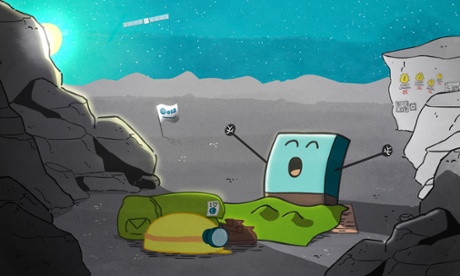
Somewhere in the shadows of comet 67P, the Philae lander has woken up. The news arrived late on Saturday when an 85 second burst of communications was relayed to Earth by ESA’s Rosetta mothership. A further three ten-second bursts were received on Sunday.
Analysing that information shows that Philae has 24 Watts of power available, and this is enough to start performing science. “The lander is ready for operations,” said DLR Philae Project Manager Dr. Stephan Ulamec in the ESA blog post announcing the revival.
It has been seven months since the probe went into enforced hibernation because an awkward landing left it bouncing across the comet before it finally came to rest on its side in the shadows. Now the comet is closer to the Sun, more light is hitting the solar panels.
Philae carries 10 science instruments and teams across Europe must now be champing at the bit to perform more experiments. In the normal run of things, they would have had to wait for another comet landing mission. As Ian Wright, Open University, principal investigator on Philae’s Ptolemy Instrument, pointed out to me recently, such a mission would have been at least 20 years into the future because of the time it takes to plan, build and test such a highly technical mission.
Now, we can short-cut these two decades of waiting and get back to work immediately, testing all the hypotheses that have sprung from the data collected by Philae during its original 60 hours of operation in November last year.
There is much to investigate. It is now confirmed that Philae’s target is a primordial comet, having survived almost completely untouched since the formation of our solar system 4.6 billion years ago. It contains the chemical building blocks of life that would have been present in the interstellar cloud that collapsed to form our planet.
In the original mission scenario, Philae would have anchored itself to the comet’s surface in broad daylight. It would have worked for weeks or months, until it overheated in March due to the comet’s approach to the sun.
However, two failures occurred during the landing which caused Philae to bounce to its shady destination. A thruster designed to press the lander to the comet did not fire, and the harpoons designed to then anchor it to the ground failed to trigger.
Ironically, these failures may have turned the mission into something more valuable for advancing science because the enforced hibernation has let scientists work on the collected data, analysing it and developing ways to test their conclusions if Philae did wake up.
Before the new round of science can begin, however, there are some issues to investigate. The first is that although Philae is awake, and almost certainly has been since last week, it is not communicating well with Rosetta.
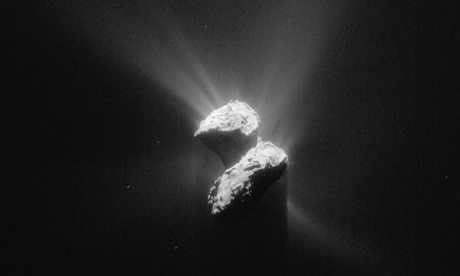
The 85-second burst fell in a 2-hour communications window that, in principle, Philae could have filled with machine chatter. A similar story holds for the three ten-second bursts on Sunday. So operators must work now to understand why Philae is being so shy.
Even if the communications link can be firmed up so that commands can be uploaded and the science data downloaded, we may still lose our ability to talk to the lander in a few weeks. Power will not be the issue: visibility will.
The comet makes its closest approach to the sun on 13 August. Around this time, the outgassing and activity on the comet may grow so fierce that Rosetta is forced to retreat to a safe distance, making communication with Philae difficult or impossible.
After closest approach, Rosetta could creep closer again and re-establish communication.
Whatever happens next, this weekend’s revival only adds an uplifting new twist to this inspirational tale of ambition and achievement.
Occasionally, space missions succeed far beyond our original expectations, repeatedly making headlines and capturing the public imagination in the process. Two previous missions to do this were Voyager 2, which successfully visited all four giant planets of our solar system between 1979 and 1989, and the Hubble Space Telescope, which began with a faulty mirror yet celebrated its 25th anniversary of remarkable discoveries this year.
Similarly, the revival of Philae, and the hoped-for second science phase, places the Rosetta mission in the top-most echelons of space achievement.
Stuart Clark is the author of The Unknown Universe (Head of Zeus). Find him on Twitter.