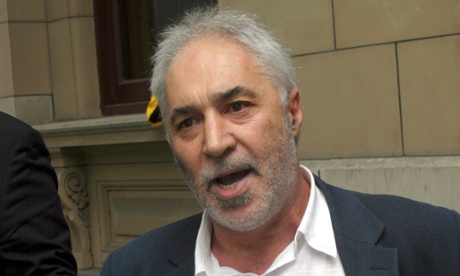
The family violence campaigner, sports commentator and former independent federal MP, Phil Cleary, says his “obsession” with a need for diversity in politics prompted him to stand for Victoria’s upper house at this month’s state election.
His party, Voice for the West, was about speaking up for people “west of the Yarra” at a time when the Coalition and Labor had been focusing on marginal seats such as Bentleigh, Carrum, Mordialloc and Frankston, he said.
“We’re so uncritical as a society at the moment, we can’t get substantial public debate going because we have one political narrative playing out in federal and state politics, and that’s the narrative of the major parties,” Cleary said.
“But when you go into communities, people are speaking very differently from the politicians about the Middle East, about security issues. And those people know the Middle East card, the refugee card and the law and order card are being used to camouflage discussions about real issues.”
Cleary was elected to federal parliament as the member for Wills in 1992 and re-elected in 1993. The Victorian election on 29 November will be his second attempt at state politics. In 2010 he contested the seat of Brunswick as an independent.
Cleary coaches junior AFL in Brunswick West, where many of the players are Muslims. That experience had given him an understanding of how political debate left the Muslim community feeling scrutinised and targeted, he said.
“Muslims are Australian like us, they have the same aspirations as us, they endure the same problems as us, but now they endure added problems, like having to explain away their religion and where they are from,” he said.
“I’m sick of them having to justify themselves and the way they practice their religion, and that they have to apologise every time something happens. Politicians have created a myth that a group who takes up arms in the Middle East is driven by Islam because they throw out religious imagery, but that’s nonsense.
“The Middle East conflict is about economy resources, and power – not religion. Let’s have a real discussion about that and stop creating myths.”
Cleary said state and federal politics needed progressive, dissident voices to challenge legislation, revive public debate and tackle what it means to be Australian.
“The best we can do is roll out the Palmer Uniter party and Jacqui Lambie, who has become one of the great dissident voices of federal politics,” Cleary said.
“We need better than that, we need more diverse discussions in political life, and if we can elect alternatives to the major parties, community voices will be heard.”
Cleary has campaigned against family violence since his sister was murdered by her former partner in 1987. It was an issue still at the top of his agenda, he said. Cleary agrees with Labor that a royal commission is needed to address systemic issues, particularly in the court system.
“This has nothing to do with sentencing,” Cleary said. “It is about how you talk about the killing of women in the courtroom. This is a fundamental question that has reached a critical point in this state and I don’t want to see family violence become the plaything of the two major parties.”
He hopes strong recommendations will come from the inquest into the death of 11-year-old Luke Batty, who was murdered by his father in February. But he doesn’t believe the inquest will be enough.
“The Luke Batty inquest has drawn many people in, largely because he was an innocent child, and everyone can embrace an innocent child,” Cleary said.
“But if it was a murdered woman we were talking about, it would not get the same attention, because society still views women as somehow complicit in the violence, and their character always seem to get besmirched in the court process.
“Women have a right to leave relationships and unfortunately this has made some of them more vulnerable than ever because of an underbelly of men who can’t accept women being independent from them. And they’re the men who kill.”
The 2009 Victorian Australian of the Year, Dr Berhan Ahmed, will lead the party and will stand for the upper house in the western metropolitan region. Voice for the West believes several lower house seats can be won with a primary vote of 10-15% and independent and minor party preferences, which would force a distribution of Liberal preferences.