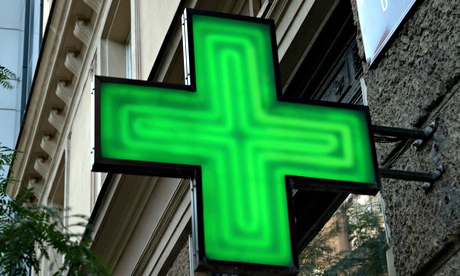
With the health and social care system creaking alarmingly under winter pressures, there is one group of NHS professionals who would positively welcome more people flooding through their doors. High-street pharmacists say they could play a key role in easing problems at A&E departments and GP surgeries – if only they were allowed.
Just one in 100 calls to the NHS 111 non-emergency helpline results in the caller being referred to their local pharmacist, according to the Pharmacy Voice trade body. Yet studies suggest that up to 20% of a GP’s time is spent dealing with coughs and colds and other minor illnesses that could be treated by a pharmacist.
There are more than 11,000 community pharmacies in England alone, visited by 1.6 million people a day. An estimated 96% of the population can get to a pharmacy within 20 minutes on foot or by public transport. While some areas may be “under-doctored”, hardly any are “under-pharmacied”.
We’ve been talking for decades about the potential for pharmacists to play a much bigger role in healthcare and there have been highly encouraging pilot and piecemeal schemes. The so-called New Medicine Service, introduced in 2011, has shown that follow-up by pharmacists can improve by 10% the number of people who take as prescribed a drug dispensed for a long-term condition. Yet when it comes to making general progress, something always seems to stand in the way.
This was the vexing theme when the great and good of the pharmacy world gathered for the annual University College London School of Pharmacy lecture, given this year by the chief executive of Pharmacy Voice, Professor Rob Darracott. He rehearsed the case for a bigger role, and lamented the lack of progress towards grasping it, but then went on to spell out some home truths. The pharmacy profession had not helped itself with weak and confused leadership, Darracott said. It had “drifted away” from patients and needed to reconnect. If it was honest, it would admit it didn’t have the greatest track record in demonstrating the effectiveness of its interventions. “We need to show that we can work together across the sector, moving on from endless pilots to delivering at scale.”
In response, and in the same confessional spirit, Professor David Haslam, chair of Nice (the National Institute for Health and Care Excellence), and a former GP, recalled serving on a working group in 2001 that had looked at how GPs and pharmacists might better collaborate to unleash the latter’s “phenomenal potential”. He said: “What happened? Nothing. We are not working together. We need to understand where this block is.”
Part of the block undoubtedly lies in money. Pharmacists quite reasonably want remuneration for any enhanced role and this, in the current fiscal climate, would have to come from the existing pot. Competition between GPs and pharmacies for flu vaccination payments this winter has already triggered what Darracott describes as “something like a running war across the country”.
Other health professionals suspect pharmacists of simply wanting to get patients into their premises to sell them unnecessary medication, toothpaste and perfume. As a 1986 inquiry by the Nuffield Foundation into realising the wider role put it rather more delicately, there is “a clash between the promotion of what is professional and the requirements of running a business”.
Is all this insurmountable? In current, critical circumstances, surely not. Darracott says the pharmacy profession has never been so well placed to seize the initiative. He is calling on NHS England to get 24 key people around the table to thrash out a solution that would help realise the “radical upgrade in prevention and public health” envisaged in its own Five Year Forward View.
If just one or two of every 100 people now queuing at A&E went instead to their local pharmacy, it could make all the difference.