Suddenly spending a lot of time at home due to the coronavirus outbreak seems to have inspired many people to get a pet. At the same time, there are dogs and cats being abandoned by their owners due to financial difficulties, prompting concerns about people acting simply at their own convenience.
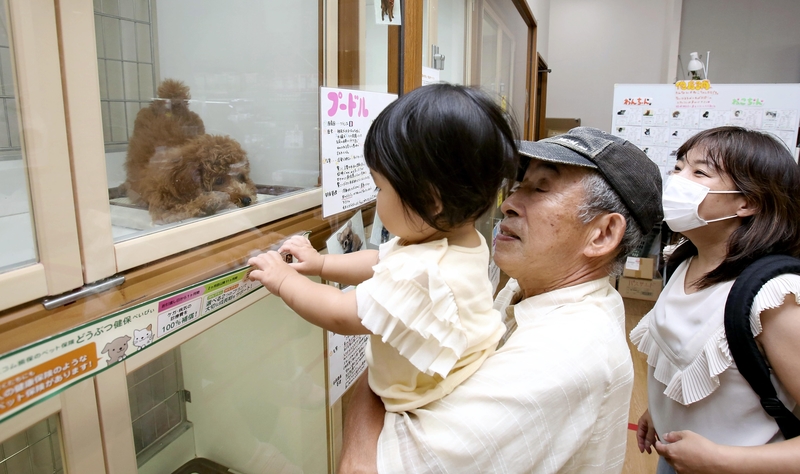
On Sept. 15, a family was gazing at a Shiba Inu puppy frolicking in its cage and a toy poodle sleeping peacefully at Pet Kazoku's Inagioshidate Store in Tokyo.
"I came here because I don't go out so often these days, but I spend more time home alone with my child. I thought having a pet would be comforting," said a 40-year-old woman from Chofu, Tokyo, who visited the shop with her 1-year-old daughter.
Japan Pet Communications Co., which operates four shops including this store, said its sales between June and July increased by 30% to 40% compared with a normal year.
"Many people buy 6- to 7-month-old dogs that are usually left over, and half of the cages are sometimes empty," the store's manager said.
According to leading pet insurance company Anicom Holdings, Inc., the number of new contracts from April to June increased 33% from the same period last year to 53,456, a record high for the quarter. Many of the new policyholders are said to be first-time pet owners.
On the other hand, there are also many people now giving up their pets due to conditions out of their control.
In early August, Tokyo-based Neko Ken, a nonprofit organization that protects or finds home for cats, took back two felines that were given a new home a few years ago. The cats' owner recently visited the group and told them, "The novel coronavirus has left me with no work, and I cannot afford to keep them anymore."
Between April and June, the Tokyo branch of the Hiroshima Prefecture-based nonprofit organization Inu Neko Jouto Center handled 15 such cases, in which pet owners asked the branch to take in puppies that they bought recently at shops, as they couldn't care for them anymore.
"Owners are responsible for keeping their pets until they die," the center's chairman said. "We urge would-be owners to think well about whether they can fulfill that role."
Animal welfare centers run by local governments, and nonprofit organizations that protect dogs and cats hold seminars on proper animal husbandry, send staff to visit homes and assess economic conditions before transferring animals to new owners.
At pet shops, however, there are no such screenings, so anyone can buy an animal easily. The number of neglected pets is feared to increase if the recession continues, or if people start going out more often after the outbreak is contained.
"Some dogs and cats live nearly 20 years, so instead of getting a pet impulsively, you should start with a plan that takes into account lifestyle changes and future costs," said Nippon Veterinary and Life Science University Prof. Mina Mizukoshi. "It is also necessary to find a place that would take in your pets when you are no longer able to keep them."
-- Killifish, reptiles also popular
Amid the pandemic, killifish and reptiles have gained popularity as choices for pets.
At the Tokyo Medaka Ryutsu Center, sales of killifish rose 50% in April from the previous month, and have been doing well since then. Many of its customers are raising killifish for the first time. The most popular ones sell for around 500 yen each.
"Seeing killifish swimming elegantly may help relieve stress," the center's representative said.
Reptiles are popular, too. Rep Japan Ltd., a shop based in Shizuoka Prefecture that imports and wholesales living creatures, saw their sales increase 1.5-fold from April. Small tortoises and lizards are popular.
"One of the reasons for the reptile boom is that you can keep them in a small space without worrying about their noise or smell," the shop's spokesperson said.
One problem now facing these some shops is the decline in imports of foreign creatures due to the outbreak-related reduction of flights carrying cargo.
Hercules no Sato, an insect dealer in Kanagawa Prefecture, used to import beetles and stag beetles from Indonesia once a month, but has only received two shipments since February. Sales have also dropped to less than half of last year.
"There are more customers than usual, but there are no items to sell," the shop's owner said.
Concerned about the coronavirus? Look for information and contact numbers here if you suspect you have contracted the virus and are exhibiting symptoms.
PLEASE NOTEThe Japan News is providing this story for free to help all readers keep informed about the coronavirus.
Read more from The Japan News at https://japannews.yomiuri.co.jp/