
Suddenly the Russians are back. Peter Svidler, aged 39, the seven-time Russian champion, and Sergey Karjakin, aged 25, and formerly at 12 the youngest ever grandmaster, are halfway through their four-game final of the 128-player, $160,000 World Chess Cup at Baku after all the better fancied westerners were eliminated. Svidler leads 2-0 after Karjakin blundered badly in a drawn position in game two.
This is an event where the semi-finals matter more than the final. Svidler and Karjakin both qualify for the eight-player 2016 Candidates, whose winner takes the ultimate jackpot of a multi-million dollar title match with the reigning champion, Magnus Carlsen.
In recent years the heirs to the once all-conquering Soviet empire have frequently stumbled. They lost the individual world title, while Russian elite squads in the 160-nation Olympiad and the world team championship have been outpaced by Ukraine, the small Caucasian republics Armenia and Azerbaijan and, most recently, in 2014-15 by China.
Just a few weeks ago a fresh humiliation loomed, of a Candidates with no Russian for the first time since the current elimination system began in 1948.
Now there is new hope for Moscow. Russia could even have a third GM in the Candidates because the Siberian oil town Khanty-Mansiysk is the favourite to win the bidding process in the next few weeks, to host the tournament and to nominate a wild card as the eighth candidate. If that happens, expect the former champion Vlad Kramnik or the top-10 GM Alex Grischuk to play. All this would add up to an unexpected obstacle for the United States, whose two candidates Hikaru Nakamura and Fabiano Caruana are the favourites to become Carlsen’s 2016 challenger.
Svidler made an impressive start to the final World Cup match on Thursday, crushing Karjakin in 29 moves. His King’s Indian Attack used to be a Bobby Fischer favourite but the US legend preferred to play 9 e5 and go for the black king rather than swap central pawns.
Karjakin’s troubles began with 15...Rf7? (Qd7) allowing Svidler’s strong 16 d4! push. Black should have kept the b file closed since as played 20 Qb3! increased the pressure. After White’s 22 Rec1! anticipated the blunder Qe6? losing material, Karjakin’s game collapsed, and at the end White was two bishops ahead.
Peter Svidler v Sergey Karjakin
1 Nf3 Nf6 2 g3 d5 3 Bg2 e6 4 O-O Be7 5 d3 O-O 6 Nbd2 c5 7 e4 Nc6 8 Re1 b5 9 exd5 Nxd5 10 Ne4 Bb7 11 c3 a6 12 a4 b4 13 Bg5 f6 14 Bd2 e5 15 Rc1 Rf7? 16 d4! bxc3? 17 bxc3 cxd4 18 cxd4 Nxd4 19 Nxd4 exd4 20 Qb3! Rb8 21 Rb1 Qd7 22 Rec1! Qe6? 23 Nc5 Bxc5 24 Rxc5 Rd8 25 Ba5 Rd6 26 Qc4 Nc3 27 Rxb7 Qe1+ 28 Bf1 Ne2+ 29 Qxe2 1-0
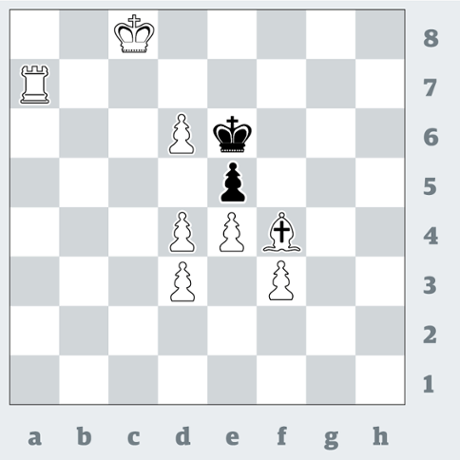
3410 (by Otto Wurzburg): Not 1 dxe5? or 1 Bxe5? stalemate draw. So 1 d7! If Kd6 2 d8N and 3 Rd7 mate. If Kf7 2 d8Q+ Kg6 3 Qg5 mate. If exd4 2 d8R Kf6 3 Rd6 mate. If exf4 2 d8B Kd6 3 Ra6 mate.






.jpg?w=600)



