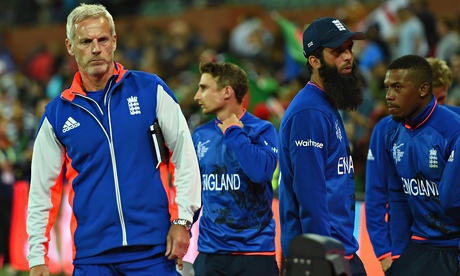
It was a soggy, sorry end to Peter Moores’ time as the head coach of England. He had been dutiful to the last, insisting he flew straight to Ireland from the Caribbean when the opportunity was there to go home. That he went to a coastal town near Dublin was not a last-ditch attempt to save a job, for that decision will already have been decided, perhaps even before the Test defeat in Barbados. He went because he cares and it is his job. People can accuse Moores of all sorts of things but a lack of diligence or enthusiasm would not count among them.
Muddy, murky Malahide will have seen the death rattle of his international career, the second time it has been cut short. The first time around, when he succeeded Duncan Fletcher, it was said the old lags in the side, used to the previous coach’s manner and ways, could not take Moores’ in-your-face challenging methods, something that most notoriously manifested itself when he insisted on a full-on training session right after a one-day international as a demonstration of physical and mental intent. In essence, he was attempting to impose the same disciplines and structures on a group of experienced international cricketers as he did with the young players at Sussex. He read it wrong.
The second time around, the scenario was different. There cannot have been a bigger hospital pass handed on in England cricket than the 5-0 Ashes whitewash and its repercussions that preceded his reappointment. At the time a personal view was that it was a good appointment in that he would have learned from the previous experience and not make that mistake again. In other words, his overall methods were sound. And Moores did change, to his detriment it may seem, for where the restructuring of the side with the introduction of new players probably demanded a deal more of how he had been before, he treated them as he should have done those first time around. For all that, ask the players themselves, most of them, and they will speak highly of his unflagging energy and support, and attention to detail: they like him a lot, and why should they not for when it comes to cricket he is a caring, decent, passionate man.
With the Test team, there is no question the rebuilding process is seeing results, an upward curve if a shallow one. Anyone who thought there would ever be a quick fix to replace one of the best teams the country has ever possessed is delusional: this is not football where a new team can be bought.
The series loss to Sri Lanka was as close to being the reverse as another six inches of carry on a slip catch from the last ball of the first Test, and the survival of two more deliveries in the second would show. India were then overwhelmed and West Indies largely dominated until England were themselves overpowered on the third and final day in Bridgetown. Three Test defeats in 10 matches, one in each series played under him, is not earth shattering but not disastrous for a developing side starting from the level they had.
One-day cricket is a different matter, however, and this will have done for him: a lack of recognition from both Moores and his captain of the demands of a game that has developed almost exponentially in the last five years; the stubborn persistence with, and backing for, Alastair Cook as a player and captain until it was too late; and a World Cup campaign based on an antediluvian strategy that was doomed from the start. The result, 11 wins against 19 defeats, is something that may make Andrew Strauss think strongly about appointing a separate one-day coach, or at least specialist, who can then be seconded to the T20 franchises to look and learn.
In his last press conference in Barbados, Moores already seemed resigned to what might happen. He wanted to continue to develop young players, his real forte, but could see the race might be run. And there was just a hint of anger at the way he has been portrayed, lampooned as a techno-geek. He felt maligned. “I get frustrated when people say things about me that aren’t true,” he said then. “When people say about laptops, well it couldn’t be further from the truth. I don’t want people to feel sorry for me but it’s not fact and it’s not right. It’s not how I operate as a coach. If you ask any player I deal with, they’ll tell you that. A coach’s CV is his players.
“If the players think you can coach, you can coach. If the players think you can’t, then you can’t. Of course results count. But the emergence of teams and players – and I’ve built teams at Sussex and Lancashire, I’ve been through this three or four times at county and international level – is never a straightforward curve. It goes up and down. You invest in people you feel can go on and become special players.
“I have had 32 years in the game. I started coaching when I was 22. I coached all the way through as a player. I’ve coached eight-year-olds and 75-year-olds. That’s what I do. That’s my living. It’s part of what I love to do and I won’t change that. The danger of labels is that you just see one thread.”
It has not worked out, but no one could have tried harder.