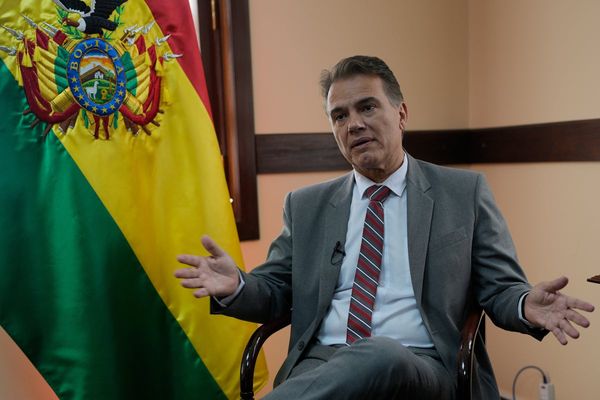
Peter Dutton has indicated Australia will refuse to take any asylum seekers back from Manus Island, even if the Papua New Guinea supreme court orders their transfer after a ruling that detention in the country is illegal.
The full bench of the supreme court ruled on Tuesday in favour of a challenge by the former PNG opposition leader Belden Namah, finding the Australian-run immigration detention and processing centre to be in breach of the country’s constitution and migration law.
The PNG government has not said how it plans to respond to the ruling.
Ben Lomai, a PNG lawyer who is still running a similar court case on behalf of about 300 asylum seekers, has said he will make an application to the court for all detainees to be sent back to Australia and paid compensation.
However, the immigration minister told the ABC on Wednesday that any ruling in Lomai’s favour would have little bearing on Australia.
“The findings of the high court here is not binding on people in PNG and the findings of the supreme court in PNG aren’t binding on the Australian government,” he told AM.
“[In] terms of the impact on Australia, our policy is not going to change. The option of coming to Australia is not open and it will not open in the future.”
Australia’s role was repeatedly noted in the court ruling but Dutton has distanced the government from it and on Tuesday afternoon he said the ruling was “a matter for the PNG government”.
He said the Australian government was waiting to see what PNG would do next.
“They’re taking legal advice at the moment and once we get that advice from PNG we’ll have an understanding of what it is they’re going to do in relation to the detention centre, which obviously is within their sovereign responsibility,” he told AM.
“We’ve had an ongoing dialogue and obviously the government has looked at every possible scenario and outcome and we’ve looked at that in terms of our strategy and our approach for a long period of time. We’ve had many conversations including myself with [foreign affairs minister Rimbink] Pato ... and we’ll have further discussions once legal advice is available.”
The excoriating ruling from the supreme court said more than 800 men were held “against their will” in a centre “enclosed with razor wire and manned by security guards” and that this incarceration was in breach of their human rights.
It ordered both national governments to take immediate action to free the men from detention.
Because of the nature of the Manus Island centre – it sits within a naval base – it is unlikely the doors could be opened to allow detainees free movement, as was done on Nauru in response to an Australian high court challenge.
Dutton said the men would either settle in PNG if they have been granted refugee status, return to their country of origin, or settle in a third country.
“There is obviously negotiations under way with a number of countries and we need to make sure at the same time that we have these discussions about arrangements that may be entered into, that it doesn’t create a pull factor to recommence,” he said, noting “cordial discussions” with Indonesia, Nauru and Malaysia.
Labor’s immigration spokesman, Richard Marles, accused Dutton and his predecessor, Scott Morrison, of failing to engage with the PNG government to ensure processing of refugee claims was progressing on time.
He said the centre, set up by the former Labor government, was “never intended to serve as a punitive place of indefinite detention”.
Namah told PNG media he was “thankful” for the ruling.
“I dedicate these victories to my children, the children of Papua New Guinea and our people,” he told the Post Courier. “It was for their future that I fought these cases.”
The ruling made international headlines, including the front pages of Australian and PNG newspapers. The New York Times noted the recent attempts to resettle refugees in PNG had seen “little success”.
Since some men were moved from the centre into the community, several have reported becoming homeless, being attacked and at least six have attempted to return to the detention centre for shelter and security.
Manus MP Ron Knight, who has been a vocal advocate for his constituents, told Guardian Australia what happened next should not negate the promises made to them by the Australian and PNG government.
“We’d expect the two national governments involved would do what they promised us,” he said. “If it has to be closed down it has to be closed down but we still need our roads fixed.”