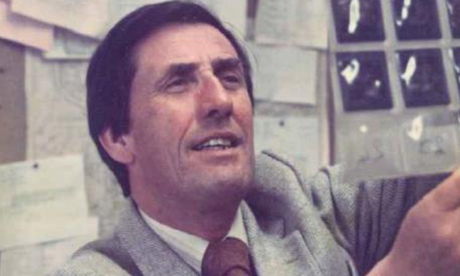
My husband, Peter Brown, who has died aged 88, was a West Country journalist whose career took him from reporting village news in the Forest of Dean to covering some of the biggest stories in the country as a BBC political correspondent based in Bristol.
He was born in a hillside cottage in Longhope on the northern edge of the Forest of Dean in Gloucestershire. His father, Albert, was a wood turner who died when Peter was eight, after which his mother, Gladys (nee Jones), took a job at the local Gloster Aircraft factory, where she stayed for the rest of her working life. In many ways Peter’s childhood was similar to that of the author Laurie Lee, who was brought up in Slad, about 40 miles to the south-east. He had two grandmothers living at either end of the village and was sent on errands between them. He also sat beneath the church organ to blow the bellows for sixpence.
When he was 11, the village school was visited by a representative of Lord Wandsworth College, a private school in Hook, Hampshire, that offered a generous endowment scheme for “half orphans”. When the representative asked if anyone would like to go to his school, Peter instinctively shot up his hand. So it came about that his teenage years, which coincided with the second world war, passed at a boarding school far from home – where he (and his younger brother, David) ached for the hills and vales of Gloucestershire.
At school Peter had once told his headteacher that he wanted to be a journalist, eliciting the sour reply that “all you’ll need is a dirty mac and the ability to hold your beer”. But he was not put off, and after national service in India and the far east he returned to Longhope, where he began sending off village news, at a penny a line, to the Dean Forest Mercury in Cinderford. He taught himself shorthand and the Mercury eventually gave him a job that involved cycling around the local area picking up football results and snippets of news. He was helped to buy a Norton motorbike, which he paid for in instalments taken from his wages.
In 1952 he was headhunted by a coterie of reporters on the Hereford Times who were (quite legally) running a lucrative lineage pool, supplying news to the national papers. We met at a press ball at the city’s Shire Hall when I was working at the paper and were married for 59 years. He also became press officer to the Clun Forest Sheep Breeders Society and began contributing to BBC Midland radio and, occasionally, regional television.
In 1963 the Hereford Times was bought up by the News of the World, and Peter decided to move on. He became a news assistant at BBC Bristol, and by 1970 had risen to be its industrial and political correspondent, covering an area that ranged from Brighton in the east to the Isles of Scilly in the west. With Tony Benn as the MP for Bristol South East, Chris Patten as MP for Bath, and Concorde being developed in Filton, south Gloucestershire, it was an interesting job – and one he absolutely loved. He retired in 1985 after making, alongside all his regular news reports, more than 20 half-hour regional programmes, as well as half-hour presentations for every party conference he went to.
Peter is survived by me, our children, Vicki, Cathy and James; and by four grandchildren. Our son Will predeceased him in 2010.