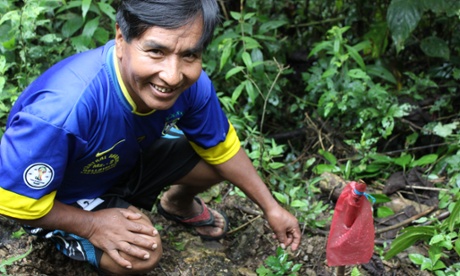
Farming Arabica coffee cherries on a mountain slope in southern Peru is a remote and isolated existence.
Imagine this. You are four hours hike to the nearest village. The sparsely-populated village itself is a perilous 10 hour drive from the nearest town. To grow the cherished red coffee fruits you need to feed the plants with balanced, nourishing, organic fertiliser. But access to the fertiliser is difficult. This means the plants are not as well-nourished as they need to be in order to withstand attacks from insects, fungus and bacteria, all trying to claim their share of the delicate fruit.
One result of this is that, in 2012, the infamous coffee leaf rust – the fungal disease that destroys leaves, stops cherries growing and eventually kills trees - struck Central and parts of South America which had so far been spared.
The coffee farmers of the San Juan del Oro cooperative in the Puno region in south Peru were hit badly, enduring a 70% loss in production. This year’s harvest saw some families harvesting 100-150kg per hectare compared with 500-750kg per hectare before the epidemic began.
Another problem for these farmers is water supply. The cherries need to be pulped and fermented using water from nearby streams. At harvest time, speed is vital. For decades, farmers diverted this precious resource to their farm through dug out trenches and homemade wooden channels. Some of the water leaked and was lost but this wasn’t a problem because enough water was flowing. There was enough water - produced by the mighty Andes mountain range - for family life too, even during the dry season.
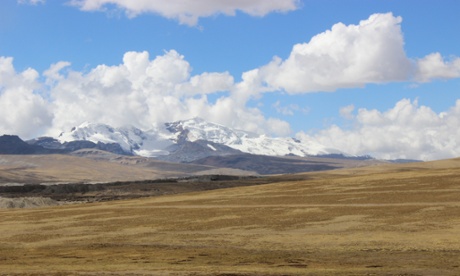
Times have changed. The climate has changed. Rainfall is more unpredictable. There are longer dry seasons which, together with heavy downpours, cause soil erosion. The cooperative is adapting to new weather patterns such as water shortages and soil erosion, in order to save the future of their farms.
Twin is a development-through-trade NGO working with 33 producer organisations representing 300,000 coffee, cocoa and nut smallholders in 17 countries across Latin America, Africa and Asia. Part of our work is to help deliver environmental sustainability for smallholder farmers and help strengthen their organisations.
To increase the resilience of the farms and of the local environment for San Juan del Oro farmers, Twin and the cooperative developed a two year programme targeting 146 coffee families to improve water management and soil conservation.
All the actors involved in the supply chain of the cooperative’s coffee gave their support. This includes Fairtrade buyers such as Matthew Algie, retailer Marks & Spencer and the Fairtrade Foundation, through its Deepening Impact programme.
As Hazel Culley, sustainability manager for food at M&S explains, “Peru is a really important sourcing country for M&S coffee. We want to ensure that this supply chain is fit for the future and here to supply superb quality coffee in decades to come. It is essential that the farmers understand how to adapt to the impacts of climate change in order to protect their livelihoods and futures.” She believes the project is particularly exciting as it involves the whole supply chain, from farmer to retailer.
Buyers Matthew Algie agree. Ewan Reid, technical director, says, “This is about developing local solutions for sustainable agricultural methods in the face of climate change in a difficult landscape; producing some of the best coffee in Peru. It will mean a more positive outlook for farmers, for us and our customers in the future.”
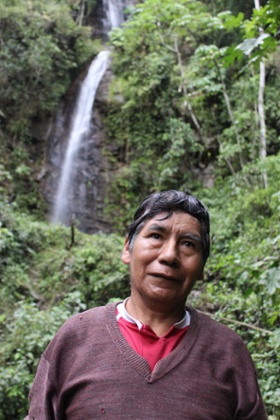
By delivering long stretches of pipes to connect and channel water efficiently to the farms and providing tanks to accumulate water and provide for families during droughts, the project has managed to secure access for all of these families. Water intervention is seen as critical in order to safeguard coffee production here, especially as temperatures are expected to rise by around 2C over the next 50 years.
More than 3000 native trees have been planted and placed strategically to ensure stability on slopes and to provide a canopy of shade so the right micro-climate is present for years to come.
Farmers have collected local seedand built their own tree nurseries. These are steps towards a more secure future.
Yet more needs to be done in other key areas of work, such as increasing access to climate information and developing early warning systems to allow the farmers and cooperative to prepare for extreme weather in the future, improving soil fertility to guarantee heathy coffee trees and, of course, selling coffee from this remote region by raising its profile to UK customers. Arabica coffee is a sensitive crop which needs special care to keep its quality and its future strong.
Climate change is a reality for farmers every year. Through Twin’s work with supply chains we can channel private investment to make the kind of differences described here for San Juan del Oro. What is needed on top of this is an ambitious, global agreement and policy framework on climate change mitigation and adaptation. This is paramount in achieving the Sustainable Development Goals. Let’s hope that the upcoming Paris 2015 United Nations Framework Conference on Climate Change will bring to Peruvian coffee families and other smallholder farmers around the world the recognition, support and resources they need to adapt to today’s fast changing environment.
Content on this page is paid for and provided by Fairtrade Foundation, sponsor of the spotlight on commodities series