The Environmental Protection Authority has given the green light to plans for an underground railway connecting Perth airport to the CBD, clearing the way for the project to go ahead despite funding concerns.
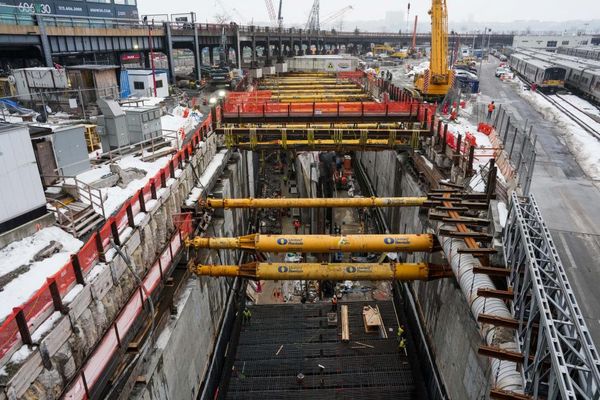
The $2bn Perth airport link involves the construction of three stations including one under a consolidated airport terminal. An 8km-long, twin-rail tunnel will run to the airport from the existing line at Bayswater and terminate at Forrestfield.
In a report, released on Monday, the EPA says the potential impact of the proposal, which includes the clearing of 13 hectares of bushland, 1.6 hectares of which is threatened coastal plain scrubland, were “unlikely to have a significant effect on the environment and can be adequately managed”.
The recommendation will be formally put to the environment minister, Albert Jacob, after a two-week public comment period.
The assessment does not include the section of rail or underground station to be built on commonwealth-owned airport land.
Construction of the tunnel, which is expected to involve the excavation of 770,000 cubic metres of soil, will begin next year, with the first train to run in 2020.
The Barnett government’s decision to go ahead with the project despite a significant hit to state revenue and a budget predicting a $2.7bn deficit has prompted criticism, including from within the Liberal party. Former transport minister turned rogue backbencher, Rob Johnson, has said the project could not be substantiated and should be dropped to curb capital works spending.
He also said a reduction in the fly-in fly-out workforce would reduce demand for the service.
The Chamber of Commerce and Industry WA has also raised concerns about the business case of the rail link. It said the cost/benefit analysis for the link and that for the shelved MAX light rail project should be released.
Both projects were Liberal election promises in 2013 and described at the time as “fully funded – fully costed”.

But documents obtained under freedom of information laws and published online by the West Australian – following a two-year long legal battle with the Barnett government, which objected to the release of emails produced during the caretaker period – show that promise relied heavily on the expected support of the federal government’s nation building program.
Five days before the state election, the heavily redacted documents show, the message from Barnett’s office was “we don’t expect feds to play hardball” with infrastructure funding. That hope was scuttled when the Abbott government was elected in September and bypassed funding urban rail projects in favour of more roads.
The prime minister, Tony Abbott, reaffirmed his position on public transport funding in April this year, telling 3AW in Melbourne that, “we do not fund urban rail projects”.
Lack of commonwealth funds saw the $1.8bn MAX light rail project put on hold in late 2013, and Barnett this year refused to commit to the project being finished by its new deadline of 2022. Legislation to approve the 22km light rail project is yet to go before parliament.
The transport minister, Dean Nalder, told the ABC in March that the project could be deferred for 15-20 years in favour of express buses to the northern suburbs.
Greens Senator Scott Ludlam has said the light rail project should take priority over the airport rail link, because it will used by more people.
The Barnett government’s own estimated patronage numbers – again included in the documents obtained by the West Australian – predict the light rail will carry 35,000 daily passengers by 2031, compared with 16-17,000 for the airport rail link.
“It’s a very expensive capital works project, the patronage numbers are uncertain and a lot more Perth residents would benefit from the Perth light rail project,” Ludlam told the ABC.
“We know that the numbers for the MAX light rail project stacked up and that with private sector funding we could actually get that project back on the tracks very quickly.”