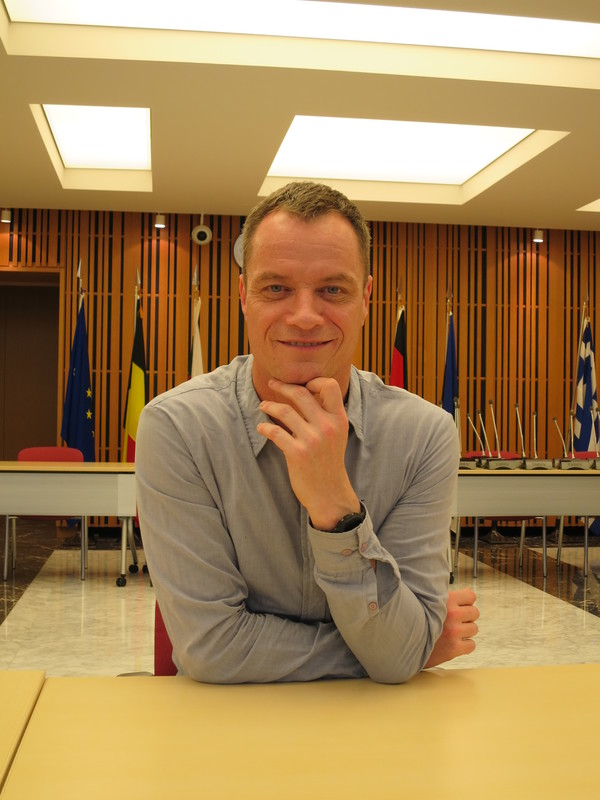
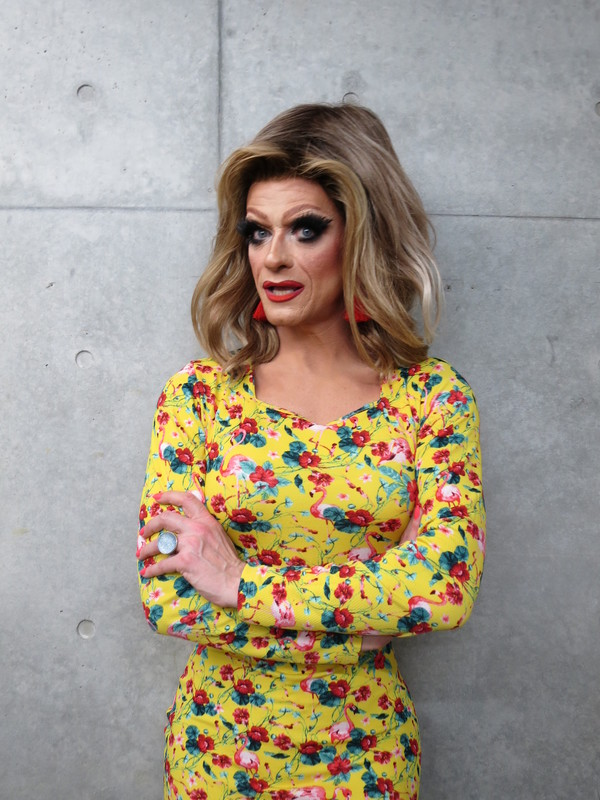
In 2015, Ireland became the first country in the world to legalize same-sex marriage by popular vote. The once deeply Catholic and conservative nation has transformed itself into a country that embraces the rights of LGBT individuals. Irish activist Rory O'Neill spoke to The Japan News recently about the path to the marriage equality referendum, and his unique involvement in the "Yes" campaign as the drag performer Panti Bliss.
The Japan News: You lived in Tokyo in the early '90s. What was life in the city like back then?
Rory O'Neill: I'd been a college student in the '80s when Dublin was gray and grim, and there was no work. It wasn't fun. And, homosexuality was a criminal offense. At the time, you were having your bubble economy and I thought, oh, you can get work in Japan. I got a boat from Shanghai to Kobe and I had never even heard of Kobe. I didn't know what Kobe was.
Arriving here then, it felt like arriving in the future. It was so different -- so built-up, so huge and so technologically advanced seeming. Of course in Ireland at that time we had automatic doors, but most doors were not, whereas I remember in Kobe every single door opened.
At that time everybody in Japan had fax machines. I remember thinking that was so amazing. So I got a fax machine for my apartment in Tokyo, but then I thought, well who do I know in Ireland who has a fax machine -- like nobody. I had one friend who worked in an office, and they had a fax machine. So I would send him long faxes.
Q: As a gay person, did you feel liberated in Japan compared to Ireland, where homosexuality was still a criminal offense?
A: Yes I did. You don't have the concept of sin like we do. That was always our hang-up. Whereas in Japan that isn't a problem, it's the social aspects -- living a gay life and not marrying an OL, all that stuff. But also, there are allowances made for a gaijin [foreigner] here, that they don't have to conform in the way that a Japanese person does. So of course I felt totally free here, and it was very liberating for me.
Path to historic change
Q: Ireland became the world's first country to legalize same-sex marriage by popular vote in 2015, and now you have Leo Varadkar, an openly gay prime minister. Could you tell me what made these changes possible?
A: There's a few factors at play. One is that the power of the church is decimated. There were all of these terrible scandals in the church. Ireland has sort of the typical scandals -- sexual abuse and all that -- that lots of countries with the Catholic Church have had, but then we also had our own specifically Irish ones like mother and baby homes, where if you're a teenage girl you got sent to these homes if you were pregnant and a lot of those women never came back out. They were basically locked away for life, in a way.
I always say my mother is a very good example. She is 83. She's always been deeply Catholic -- she'd go to Mass every day if she can, she would clean the church every Tuesday with the other old ladies. And she still does most of that, but now when she gets together with her old friend, they would sort of laugh and say they have their own version of Catholicism. They take what they want -- they like the ceremony, and the rituals and the Mass and all that stuff -- and they use those because personally they feel Catholic, but they don't care at all what the bishop says now. She thinks, well, we've learned over the last 20 years that half the things he says are not true.
Especially when it comes to personal relationships and sexuality, my mother's attitude would be, well you're a celibate man, you've never been married, you've never had a girlfriend, what would you know about sex or sexuality or parenting or any of those things.
I think my mother's very typical now -- I think most Irish people still feel culturally Catholic. When you made your first holy communion it was very important to a child, when you get married most Irish people still want to get married in a church. If somebody dies, we know what to do. There's a system in place, and the system is still Catholic, but the religious aspect is much less important. That's peculiar to Ireland. What we say in Ireland is that everybody is now an a la carte Catholic -- they just choose the bits they like, and they leave the bits they don't like.
Then also I think there's the fact that Ireland is so small. I can meet any Irish person and if you give us five minutes we'll find somebody we know in common. Over time, since the 1980s, Irish gay people came out and people got to know us as real people. It's very easy to hold prejudices against people that you don't know. If you don't know any gay people but somebody tells you on YouTube that they're crazy and they eat babies or whatever, you might believe that. But if you know Tom your next-door neighbor, or Mary who teaches your kids at school, as real people, it's very difficult to hold prejudices against them because you think of them as people. Even if you're an old lady in a tiny village, that old lady will still know gay people.
When it came to the marriage equality referendum, every old lady who went and voted was thinking in their head, oh, you know Tom who works at Tesco or 7-11, or Peter and his lovely boyfriend. So when they were voting they were thinking of these people that they know and not someone's idea about society.
Q: How would you describe present-day Ireland?
A: I always say my project was about making Irishness more inclusive because when I was younger I always felt a little excluded from Irishness. I felt that people were suspicious of me in Ireland because at the time to be an Irish boy there were always these boxes you were supposed to tick -- you had to like football, you had to like U2, all these things, and I didn't tick any of these boxes, and that always annoyed me. I used to feel a bit like Protestants sometimes feel in Ireland, that people sometimes don't really consider them to be totally Irish either. That was always my project -- to make Irishness more open, or to make the definition of Irishness more elastic so that it could stretch around someone like me.
And slowly that did happen, and the day of the referendum results it really felt like that project is finished, and that everyone agrees you can be me, you can be a gay guy or a drag queen, and still be totally Irish. I think the referendum really sealed that, and said, yes, actually Irishness is not a rigid concept. It's much more elastic now, and you can be all sorts of people and still be fully Irish.
Japan's course for future
Q: I'd like to ask you about the recent "unproductive" comment (see below) by a Japanese lawmaker. What are your thoughts on this?
A: An Irish politician couldn't say that because an Irish politician would know a lot of gay people and know that, well, lots of them do have kids. They see them as people. Whereas I suspect that Sugita-san doesn't know any gay people.
Even the fact that the publisher had to admit that there were prejudicial comments and suspend the publication shocks me and shows that there has been quite a bit of change in Japan, because that magazine could have done that no problem 15 years ago.
One thing that is interesting to me is, and one of the reasons that I didn't like her comment, is it's treating people only as economic units. It didn't matter to her about their lives and their relations. It just meant that she didn't feel that they were productive. That also annoys me because what these people never understand is that gay people are productive and that they're an asset to a society. Gay people have a lot of talents and energies and things that they're good at to contribute, but repressed societies don't allow them to contribute their full talents. Even though I don't like it when people view everybody only as an economic unit, because I don't think that's the full picture of anybody, at the same time it's not even a good argument because if you want to see them as economic units only the real argument is to say let them be openly gay and be happy and feel fulfilled because they have talents and energies and things to contribute. They can only do that when they're living as fully realized adults.
Q: Slowly though, Japan is taking steps to improve the life of LGBT individuals. What is your advice for the next step Japan should take?
A: There's two ways of doing things -- one is to legislate from the top, and that definitely helps. It suggests or normalizes certain things. But it's not necessarily the best way always.
Much better generally is to do it from the ground-up, to change the culture and the legislation follows. Ireland did a mixture of those things -- homosexuality was decriminalized in 1993 because the EU basically forced us to. That was legislation first, but that definitely helped by, for example, allowing gay bars to be officially there and open and visible, and visibility helps. But much more profound were things like the referendum where it came from the bottom-up, with society changing first and then legislation following. That was made possible by personalizing it. It's the same thing as I mentioned before with every Irish person knowing gay people. That is how you change a society. The bigger the country, of course, it's harder to do.
In Ireland's referendum campaign the focus was always on telling your personal story. All of the campaign stuff, all of the ads were about getting ordinary people to tell their stories. Every country's different in the best way to do that, but that is the essential, main plank of how to change people's attitudes to gay people -- by introducing them to real gay people.
Q: In Japan, we have many popular gay and drag entertainers on TV. Is it possible for entertainment to play a role in realizing a society without unthinking homophobia?
A: Yes, I do think it has a role. I think Japan has always had that thing where it has transgender talents and all that stuff. That hasn't really translated in a way. It's always been sort of a weird dichotomy. Our soap operas tend to be a lot different than the ones here. They're much more real, set in poor regular working communities. That definitely did help, but they are portraying real people in real situations. I think the difference is that here in general they're presented as rarefied creatures of entertainment, they're almost unreal. They only exist in the crazy, colorful, noisy world of Japanese TV. In entertainment around the world there's always a space for the exotic, and that doesn't necessarily translate.
But to answer your question, I do think it has a role and it can play a big role, and I think we can definitely see that it played a big role in our culture. I have used entertainment very much to present a more serious message in a more palatable way. It's something I've done a lot of.
Activist as storyteller
Q: You call yourself an "accidental activist." Could you explain that?
A: Sometimes when people describe me as an activist I feel a bit guilty about that because I feel like I did not join Amnesty International, I did not decide this is going to be my life's project. I've known other activists who've gone through a lot of difficulty in their lives, or they've gone to Moscow and got beaten up, and then they've dedicated their lives to it. But I'm an entertainer first, that's what I was doing, but along the way in my life -- I'm also kind of stubborn -- I say I want to do that, and then somebody says you can't do that because you're gay, and so I get annoyed about that and I'm forced to be an activist to change this thing. But I'm actually changing it for me, and the fact that it helped other people was almost accidental. I was an entertainer who was forced to be an activist sometimes. That's why I say I'm an accidental activist.
Irish people talk a lot, you know that. When we're in school we can name every poet, we can name every writer, all our bridges are named after writers, all of our famous things. There's a big literary tradition, and writers and storytellers are very well respected.
We have "seanchai," the old tradition of the old guy at the pub who tells stories, and that's essentially what I do for a living. I may dress it up differently, but all I'm doing is telling stories, and I think that definitely comes from being Irish. I am essentially a seanchai.
-- This interview was conducted on Oct. 4 by Japan News Staff Writer Atsuko Matsumoto.
-- Rory O'Neill / Activist and drag performer
Originally from Ballinrobe in Ireland's County Mayo, Rory O'Neill gained fame as the drag performer Panti Bliss. He triggered a national debate about homophobia with a TV appearance as himself in 2014. A subsequent speech made by Panti, his alter ego, gained support at home and abroad, making Panti an icon for the "Yes" campaign for Ireland's marriage equality referendum in 2015. He lived in Japan from 1990 to 1995.
-- "Unproductive" comment
A monthly magazine carried a column in July by Liberal Democratic Party lawmaker Mio Sugita in which she wrote: "LGBT couples don't produce children. In other words, they are unproductive." It drew criticism, but the magazine ran an additional feature to support her comment, fueling more controversy. The publisher last month admitted there were aberrant statements in the additional feature and suspended -- effectively discontinued -- publication of the magazine.
Read more from The Japan News at https://japannews.yomiuri.co.jp/