Persecuted Rohingya Muslims flee violence in Myanmar
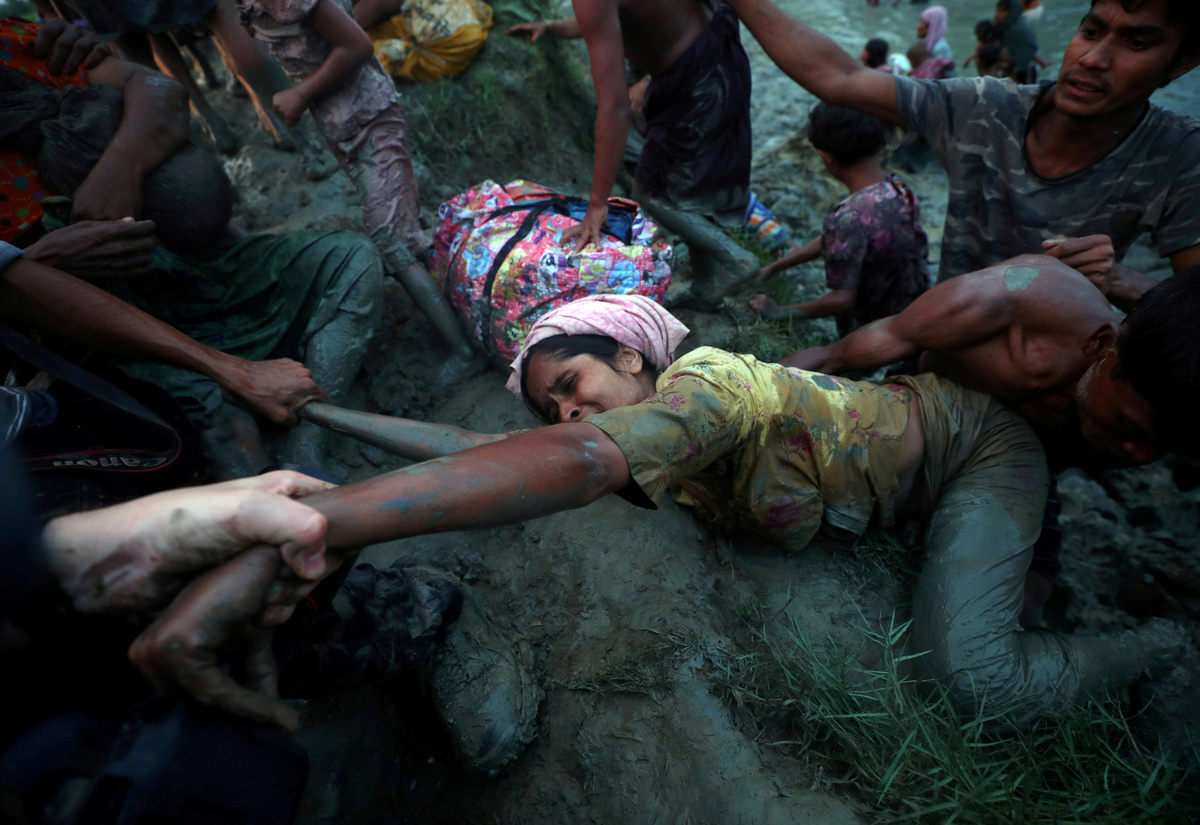
Photographers help a Rohingya refugee to come out of Naf River as they cross the Myanmar-Bangladesh border in Palong Khali, near Cox's Bazar, Bangladesh, November 1, 2017. Hannah McKay: "We were standing, looking out over paddy fields and grasslands - lots of water and one thin path leading to the border with Myanmar. In the distance we could see a huge group of people. But they weren't moving. It was 4 p.m. in the afternoon with only two hours of daylight left. So we decided to move towards them. It took us about an hour along the muddy path, meeting border guards and persuading them to let us pass. Then we saw thousands of refugees just sitting there, with more Bangladeshi border guards telling us to go back. We could see something was going on behind the crowd. So we waited for an opportunity to move closer, and that's when we saw them. The crowd was sitting on a riverbank and behind them, about three metres below, in the river itself, there were just hundreds of refugees coming across every minute. It was non-stop. There was no end to the people. People carrying babies. Elderly people being escorted through the water and mud, more than knee-deep. And we were just photographing everyone coming towards us. Then this woman appeared. She got to the point where she needed to get up to the footpath where we were. But she was exhausted. Two refugee men on her level were trying to push her up, which was when we reached out to help. Reuters photographer, Adnan Abidi, took a hand. Another photographer took another and I got her leg when she got within range. It was a case of dragging her. She lay there for a few minutes. I have no idea what happened to her. You are there trying to do your job with a camera in your hand. And then your heart overrules your head." REUTERS/Hannah McKay
(Reuters) - Attacks by Rohingya Muslim insurgents on the Myanmar security forces in Rakhine State triggered a response by the army and Buddhist vigilantes so brutal a senior U.N. official denounced it as a textbook example of ethnic cleansing.
Days, weeks and months after the Aug. 25 violence, more than 600,000 Rohingya fled to Muslim Bangladesh, trekking over mountains and through forests and rice fields inundated by monsoon rain.
Many of the refugees were traumatized, exhausted and hungry, some wounded by bullets, knives or clubs, many with burns. Many women said they had been raped.
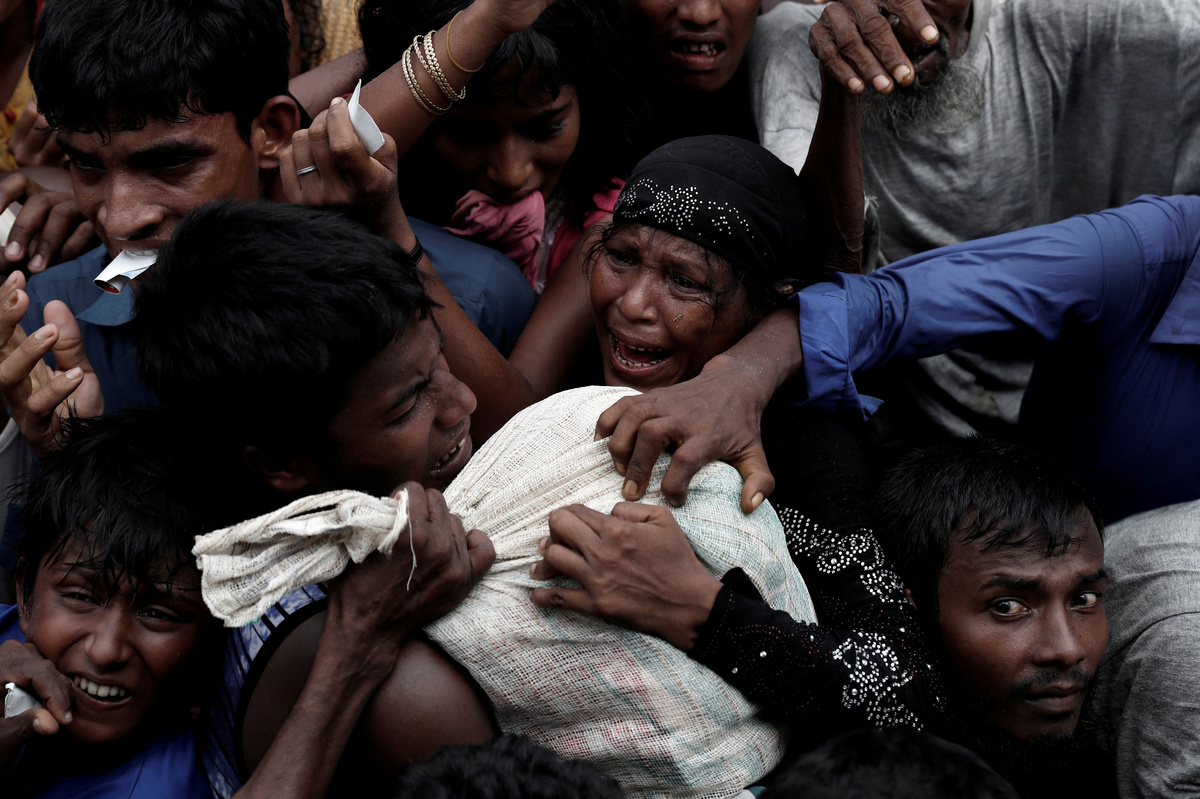
Rohingya refugees scuffle as they wait to receive aid in Cox's Bazar, Bangladesh September 24, 2017. Reuters photographer Cathal McNaughton: "This image sums up the first days of aid relief perfectly. Chaos. Pure desperation on people's faces as they fight for a bag of aid. Very often, they had no idea what it contained." REUTERS/Cathal McNaughton
All of the refugees brought accounts of a campaign of murderous violence and arson by the Myanmar security forces and Buddhist civilians that they believed was aimed at driving them out of the country.
Mostly Buddhist Myanmar denies the accusations.
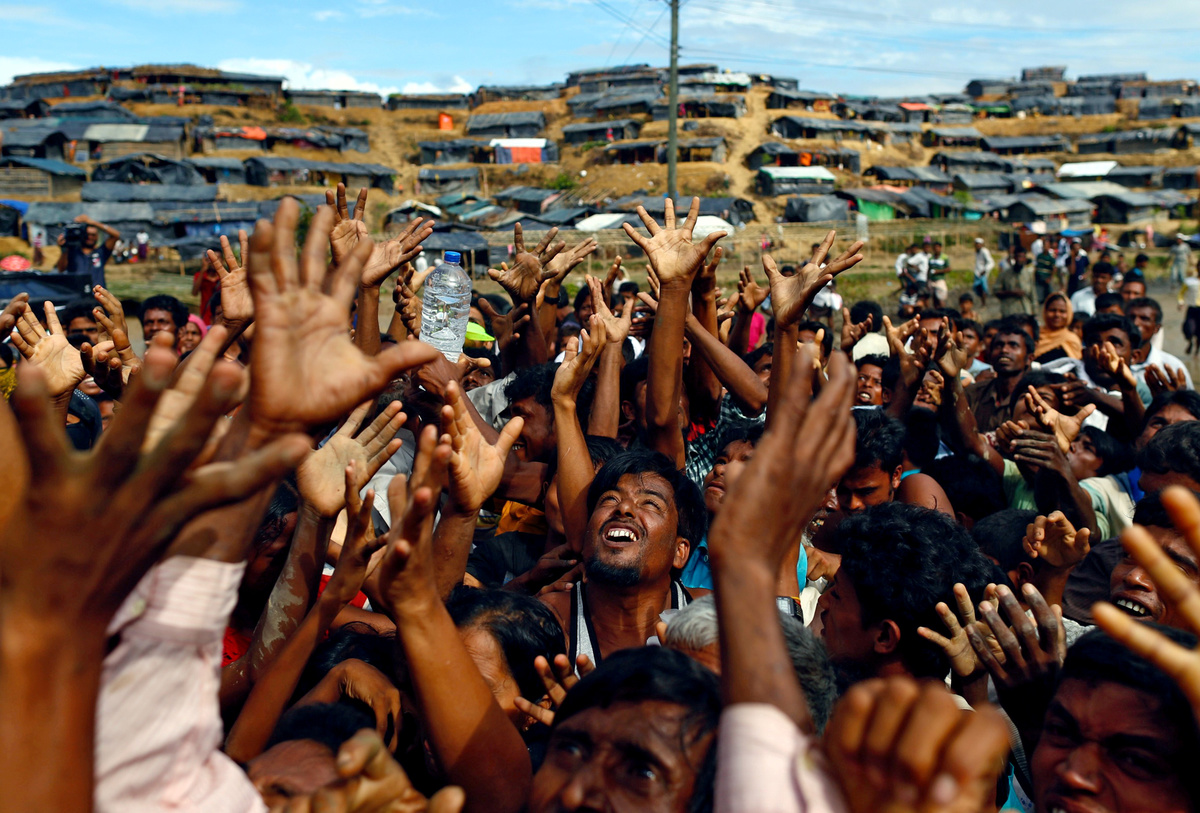
Rohingya refugees stretch their hands to receive aid distributed by local organisations at Balukhali makeshift refugee camp in Cox's Bazar, Bangladesh, September 14, 2017. Reuters photographer Danish Siddiqui: "I was going past one of the refugee camps when I stopped to photograph this aid distribution along a road. As the aid distribution got a bit chaotic, volunteers started throwing water bottles from the truck towards the refugees. I placed myself to get the newly made camp in the background as it showed how newly arrived Rohingyas living in these small makeshift shelters were in desperate need of aid." REUTERS/Danish Siddiqui
(Click on http://reut.rs/2jc8rZe to view a photo essay on the Rohingya refugee crisis.)
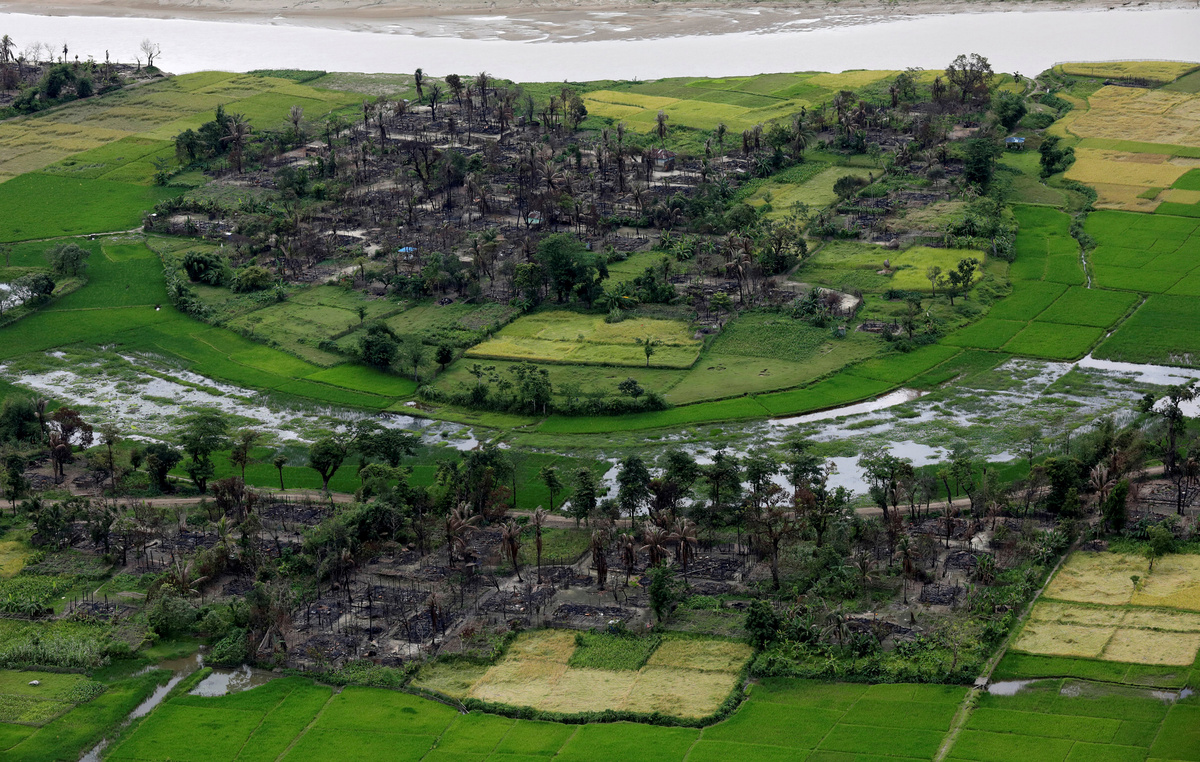
Myanmar says the rebels responsible for the Aug. 25 attacks on about 30 security posts and an army camp - the Arakan Rohingya Salvation Army - are terrorists and it is they who unleashed most of the violence and arson that reduced hundreds of Rohingya villages nestled in emerald-green rice fields to ash.
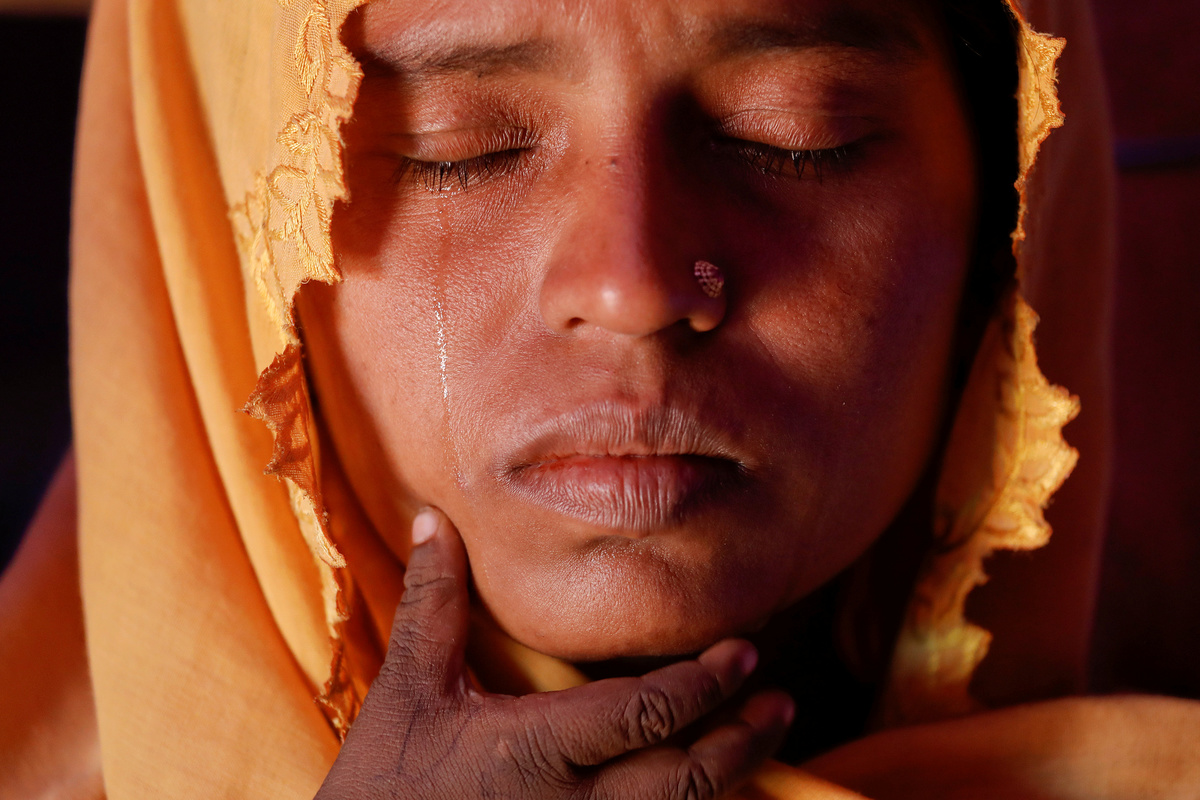
Roshid Jan, a Rohingya refugee who said she is not sure of her age, cries holding her son Muhammad Gyab at their shelter at the camp for widows and orphans inside the Balukhali camp near Cox's Bazar, Bangladesh, December 5, 2017. Roshid Jan, who walked for 10 days with her five children to Bangladesh after soldiers burnt their village, wept when she spoke about her missing husband. The religious leader in their Phansi village in Myanmar's Rakhine state was accused of being a member of the Rohingya militants and arrested 11 months ago, she said. She had not seen him or heard about his fate since then. Now she lives with her five children and more than 230 others at camp for Rohingya widows and orphans. Reuters photographer Damir Sagolj: "Three hills away from the nearest road, in a dusty valley of Balukhali refugee camp, a patchwork of densely packed red tents hides an ocean of grief and pain. Some call it a red camp for its color, others a long camp because of its shape but it's best known for those who found shelter there. "This is a widows camp," its unofficial and energetic leader explained after I introduced myself. In about 50 tents, over 230 women and children live. There are no men. As I was listening the stories of widows and orphans this camp shelters, I realized it's difficult to imagine a place with more sorrow than this. The camp seemed like a place in which the whole Rohingya tragedy is condensed." REUTERS/Damir Sagolj
The Rohingya have long faced discrimination and repression in Rakhine State where bad blood with ethnic Rakhine Buddhists, stemming from violence by both sides, goes back generations.
Rohingya are not regarded as an indigenous ethnic minority in Myanmar - the government even refuses to recognise the term "Rohingya", instead labelling them illegal immigrants from Bangladesh. Most have been denied citizenship under a law that links nationality to ethnicity.
They have long lived under apartheid-like conditions, with little access to even the limited opportunities in education and employment open to their Buddhist neighbours in one of Myanmar's poorest regions.
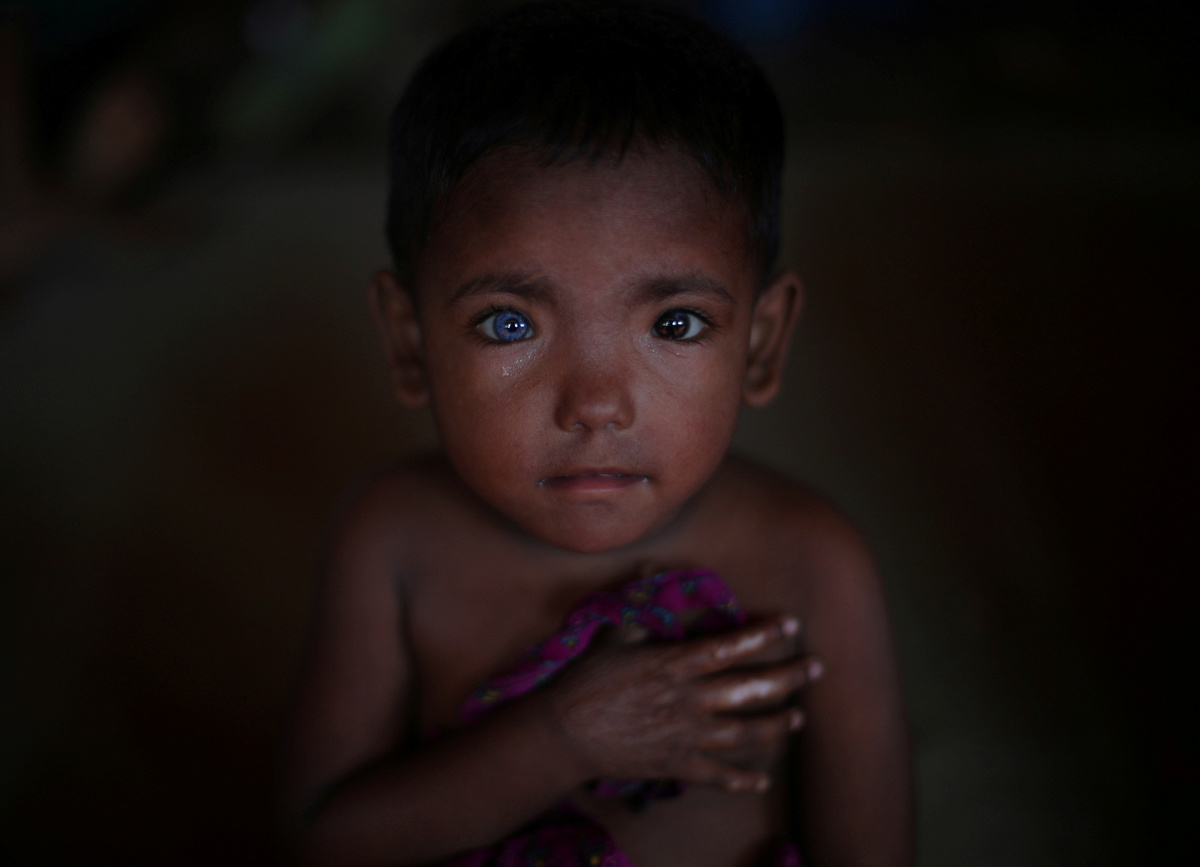
Hosne Ara, 4, a Rohingya refugee who fled Myanmar two months ago, listens to children singing at a children's centre in Kutupalong refugee camp near Cox's Bazar, Bangladesh, November 5, 2017. Reuters photographer Hannah McKay: "I was in a centre for children photographing them singing. I could feel somebody watching me and when I turned round this little girl with extraordinary eyes was smiling at me. When I lifted my camera to take her picture she stopped smiling, as I lowered it she smiled again. It became a bit of a game and we were giggling with each other." REUTERS/Hannah McKay
About one million Rohingya were believed to have been living in Rakhine State before the latest violence. Bangladesh was already home to 400,000 of them who had fled earlier repression.
The new arrivals, many landing by boat after being ferried across a border river, crammed into the existing refugee camps in the Cox's Bazar district, many camping out in the rain - lucky ones able to string up a piece of plastic - beside muddy tracks.
Bangladesh, one of the world’s poorest and most crowded countries, initially said the Rohingya were not welcome and ordered border guards to push them back.
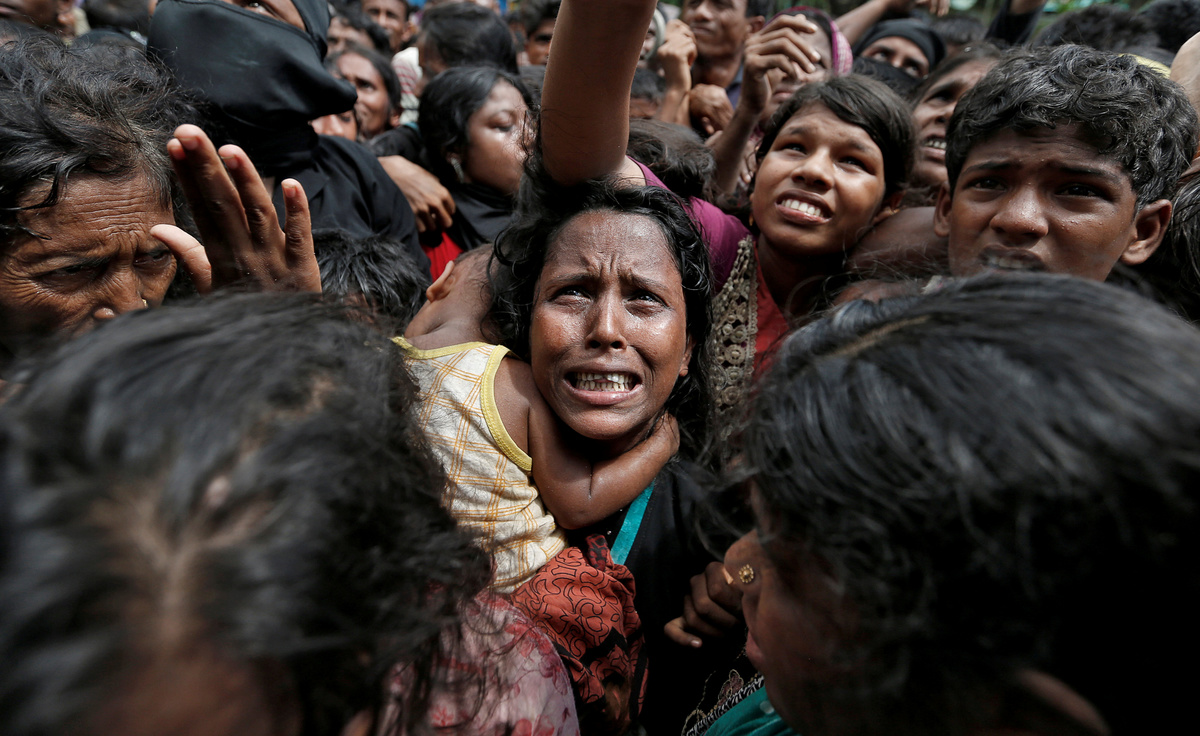
A woman reacts as Rohingya refugees wait to receive aid in Cox's Bazar, Bangladesh, September 21, 2017. Reuters photographer Cathal McNaughton: "What this photo doesn't convey is the deafening noise. The woman with the child was making a moaning sound which was piercing. Everyone was shouting at the relief teams to get their attention." REUTERS/Cathal McNaughton
But it quickly changed its stand in the face of the scale of the exodus and began gearing up, with the help of U.N. and other aid agencies, to cope with the fastest-developing refugee crisis the world had seen in years.
The crisis has raised grave doubts about Myanmar's transition from military-ruled pariah to budding democracy, and about the commitment to human rights of the democracy leader who struggled to end nearly 50 years of harsh military rule - Aung San Suu Kyi.
The generals remain in full charge of security under a constitution they drafted, even though Suu Kyi runs the government.
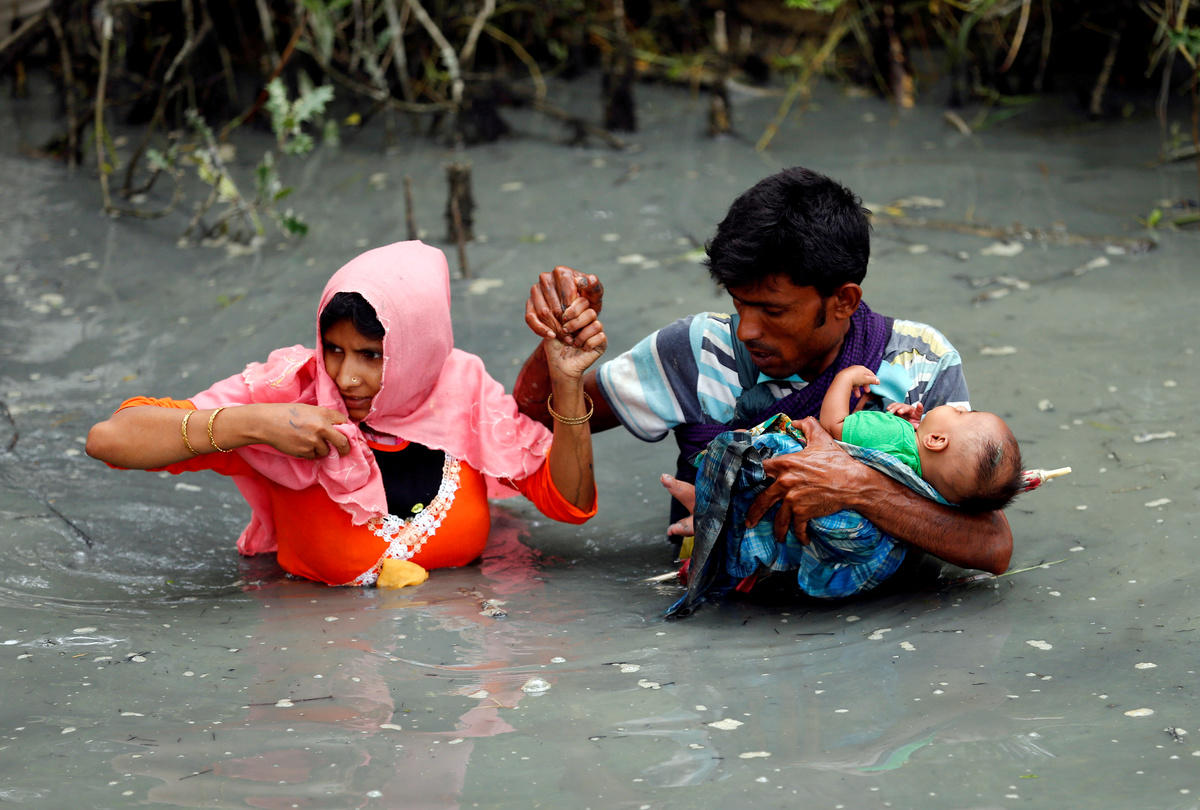
Rohingya refugees carry their child as they walk through water after crossing the border by boat through the Naf River in Teknaf, Bangladesh, September 7, 2017. Reuters photographer Mohammad Ponir Hossain: "I walked around for an hour on the muddy and very slippery path to get to the river bank. When I reached it I heard the sound of people who had arrived by boats. Because of the mangroves I couldn't see them properly. After some time I saw more than hundred people come out of the mangroves and start walking into the water with children, elderly people and their belongings. Due to low tide boats were unable to reach to the dry land. This Rohingya couple with a child had to get off the boat into a mangrove first; then walk through the water to reach dry land." REUTERS/Mohammad Ponir Hossain
Analysts say Suu Kyi has to avoid angering the army and alienating supporters by being seen to take the side of a Muslim minority that enjoys little sympathy in a country that has seen a surge of Buddhist nationalism.
Nevertheless, the failure of the Nobel peace laureate to speak out forcefully in defence of the Rohingya would seem to have irreparably damaged her reputation overseas.
The international community is demanding that the Rohingya be allowed to go home in safety, and Bangladesh and Myanmar have begun talks on repatriation, but huge doubts remain about the Rohingya ever being able to return in peace to rebuild their homes and till their fields.
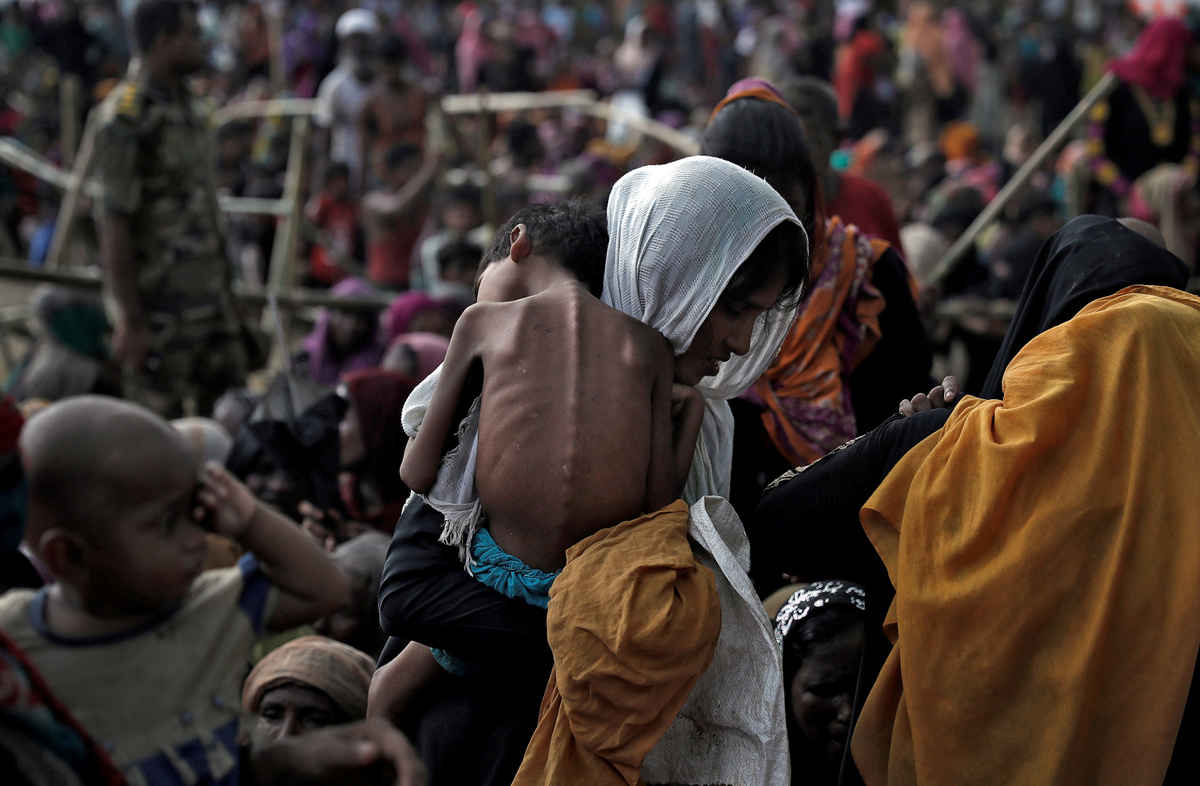
A woman carries her ill child in a refugee camp at Cox's Bazar, Bangladesh, September 26, 2017. Reuters photographer Cathal McNaughton: "She had been waiting since sunrise on aid to arrive. The temperature and humidity was pretty unbearable as there was no shelter. On top of this she was carrying her seriously ill child. Eventually she couldn't wait any longer, unprotected from the elements she made her way back to her shelter, empty handed." REUTERS/Cathal McNaughton
(Writing by Robert Birsel)
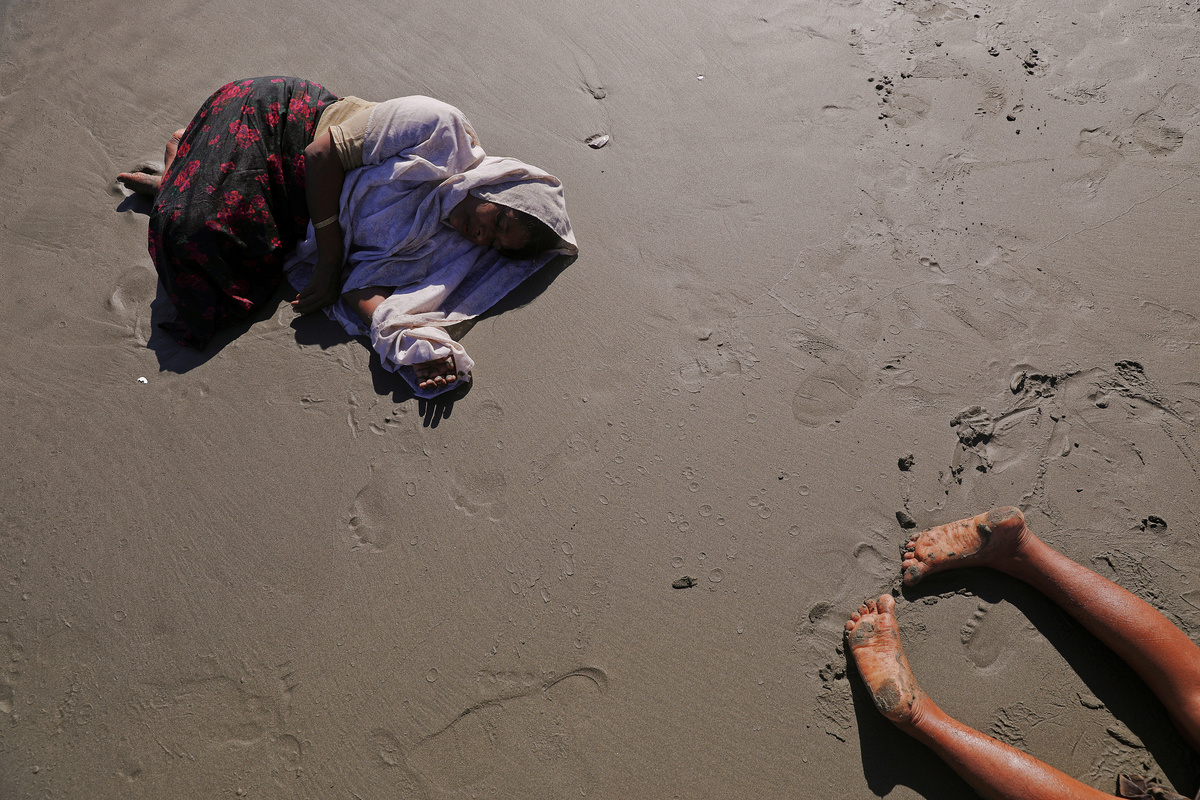
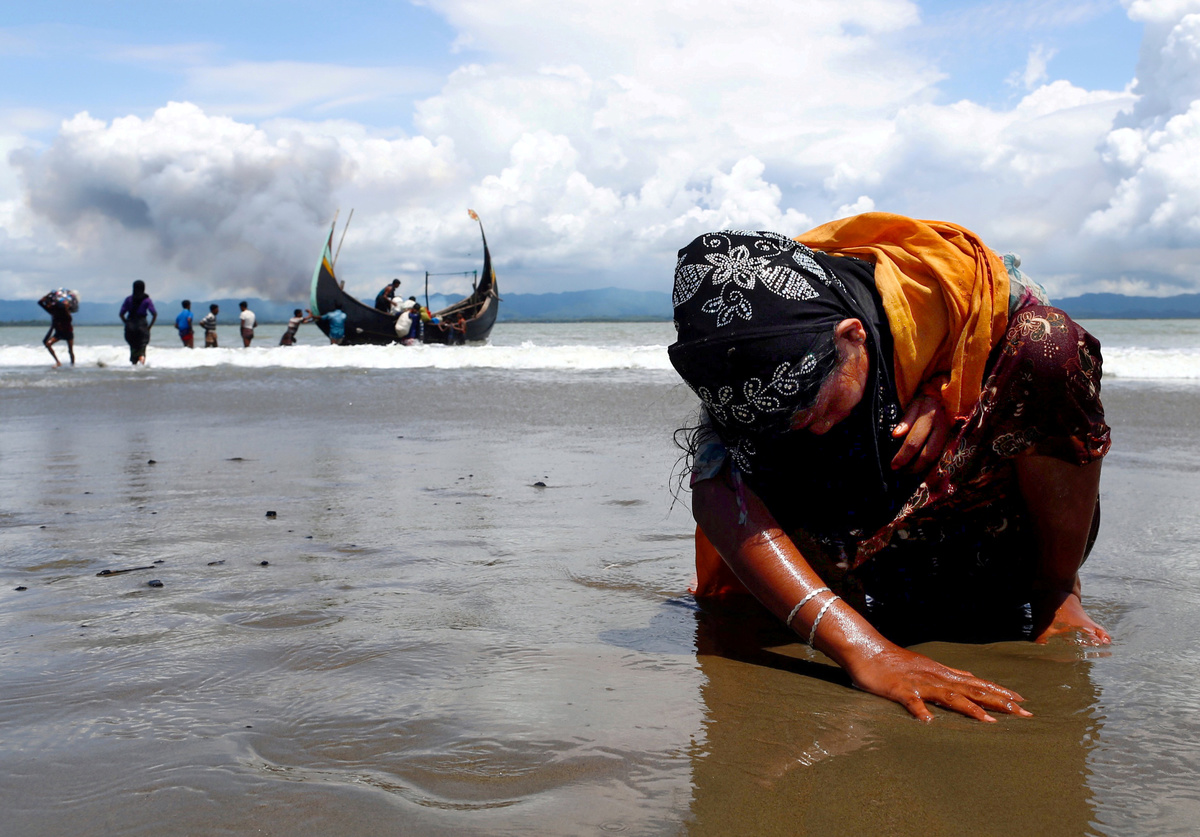
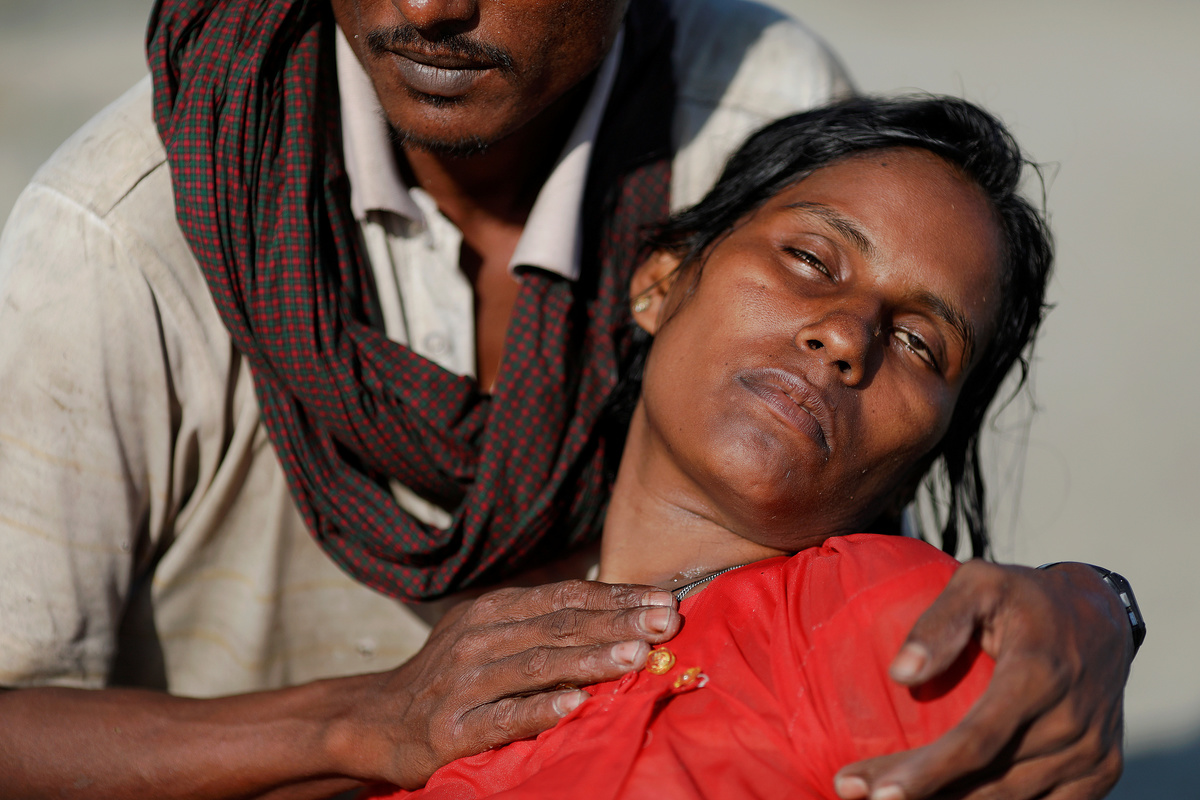
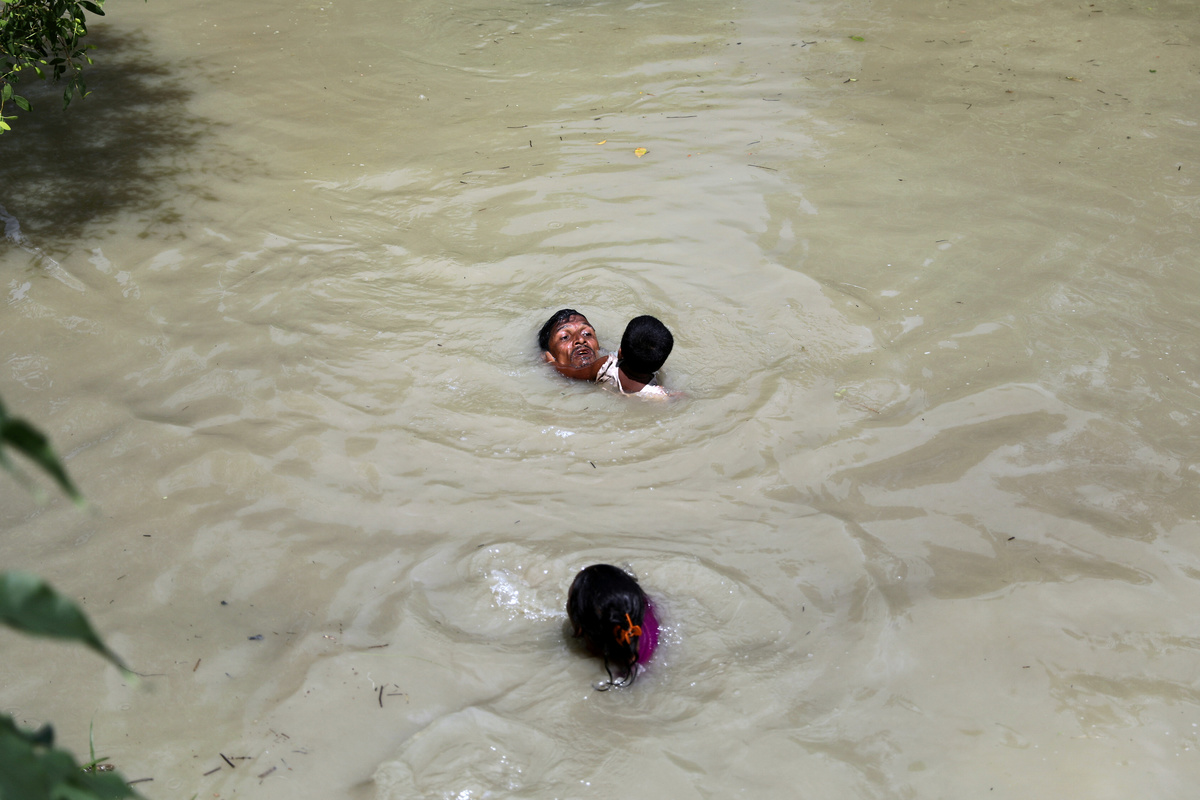
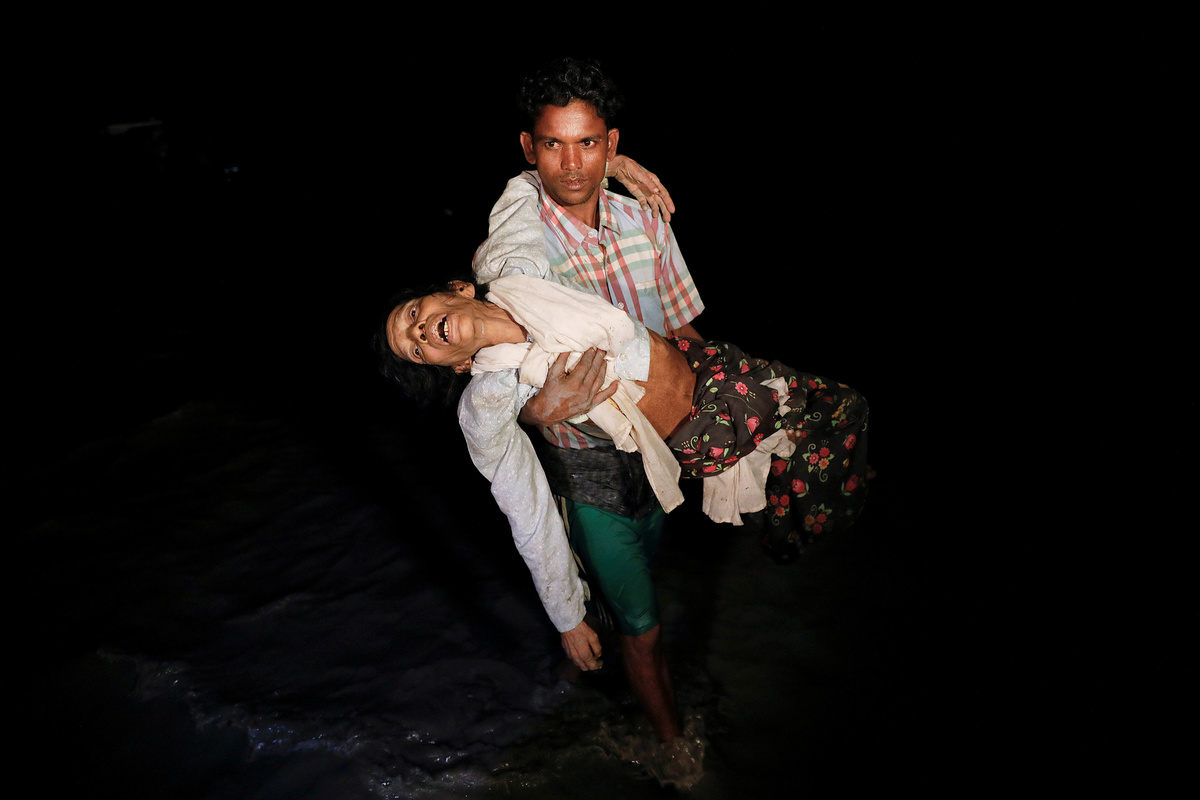
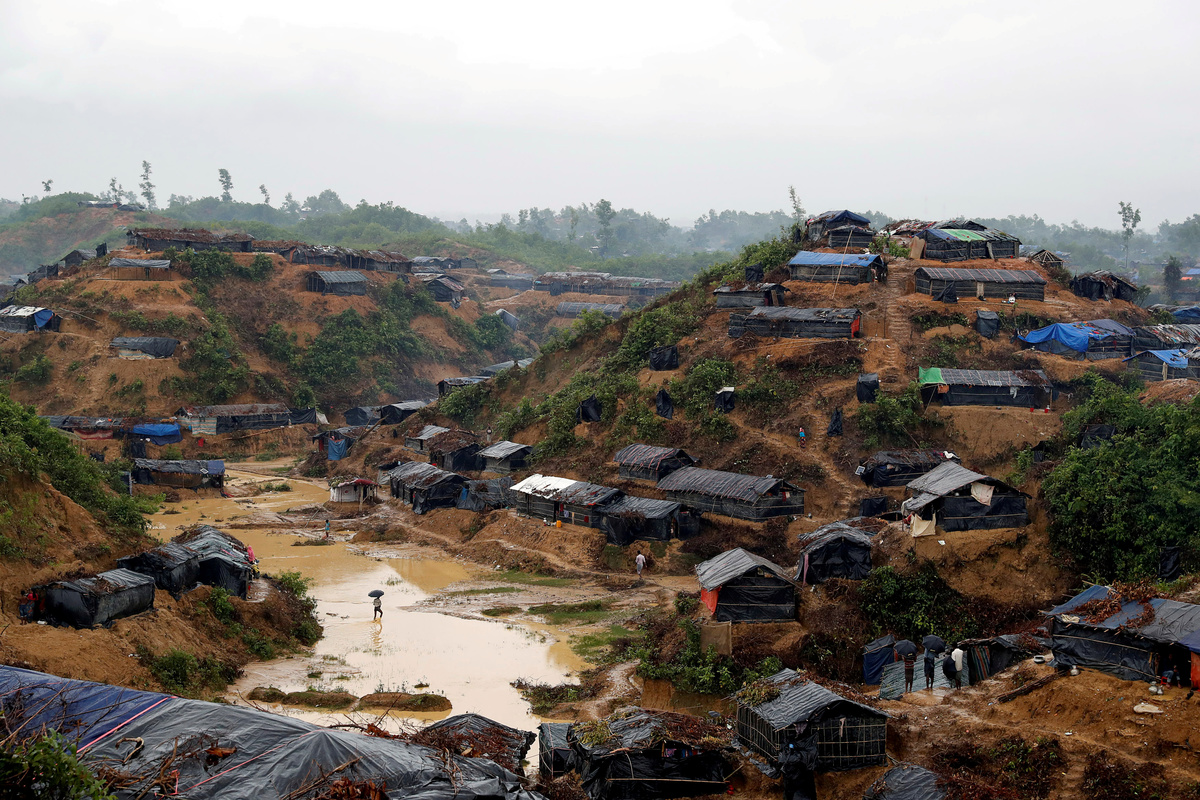
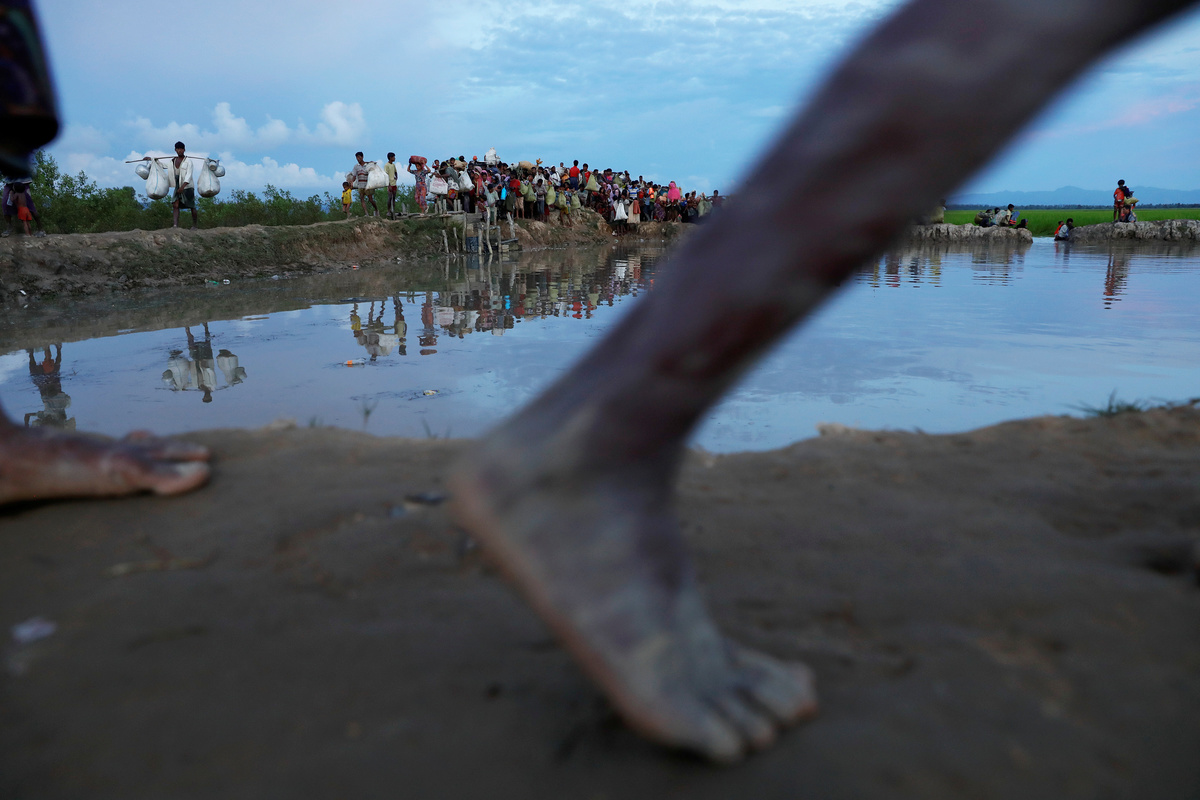
Rohingya refugees collapse from exhaustion after they arrive by a small wooden boat from Myanmar to the shore of Shah Porir Dwip, in Teknaf, near Cox's Bazar in Bangladesh, October 1, 2017. Reuters photographer Damir Sagolj: "Unlike those who were crossing the Naf River under the cover of the darkness, this group of Rohingya refugees were landing at the beach of Shah Porir Dwip in the broad daylight. They were totally exhausted - I could only imagine what these people had been through before the rickety vessel brought them to Bangladesh. After landing, many just collapse. But not much later, as if awoken by survival instinct, they got back on their feet, collected children and the few possessions they brought with them, and continued by foot towards the refugee camps, a safe haven for those fleeing danger in Myanmar." REUTERS/Damir SagoljAn exhausted Rohingya refugee woman touches the shore after crossing the Bangladesh-Myanmar border by boat through the Bay of Bengal, in Shah Porir Dwip, Bangladesh September 11, 2017. Reuters photographer Danish Siddiqui: "It was a clear morning and I could see the several clouds of smoke in the background on the Myanmar side. After a few hours waiting on the beach the fishing boats started arriving with Rohingyas. This image was taken just after a family member of the Rohingya woman carried her from the boat. The exhausted Rohingya woman sat on the beach and put her hand to feel the shore after the long and dangerous journey from Myanmar." REUTERS/Danish SiddiquiArif Ullah, who said his village was burnt down and relatives killed by Myanmar soldiers, comforts his wife Shakira who collapsed from exhaustion as Rohingya refugees arrive by a wooden boat from Myanmar to the shore of Shah Porir Dwip, in Teknaf, near Cox's Bazar in Bangladesh, October 1, 2017. Reuters photographer Damir Sagolj: "That morning, a group of Rohingya refugees crossed the Bay of Bengal on a rickety, wooden boat, for landings at Shah Porir Dwip, a village at the mouth of the Naf River. Most of the refugees, exhausted from the trip, collapsed after finally reaching the shores of Bangladesh. Shakira, unable to stand on her own, rested in her husband's arms for some 10-15 minutes before getting up and continuing on foot towards a relief centre nearby." REUTERS/Damir SagoljRohingya refugees carry their child as they swim to cross the Myanmar-Bangladesh border in Palang Khali, Bangladesh, October 9, 2017. Reuters photographer Mohammad Ponir Hossain: "That morning I heard that a couple of thousand people were waiting at no-man's land and many Rohingyas were still crossing the border near Anjuman Para, Cox's Bazar. Myself and another Reuters photographer Jorge Silva set off around 11 a.m. There are several paths so we decided to take different routes to try to ensure that at least one of us would get there. There were a few boats available at the location but members of the Bangladesh border guards didn't allow them to use them. The refugees had to swim with their children to make their way to Bangladesh." REUTERS/Mohammad Ponir HossainNobi Hossain wades through the water carrying his elderly relative Sona Banu as hundreds of Rohingya refugees arrive under the cover of darkness by wooden boats from Myanmar to the shore of Shah Porir Dwip, in Teknaf, near Cox's Bazar in Bangladesh, September 27, 2017. Reuters photographer Damir Sagolj: "Dangerously overloaded boats come from the other side of Naf River under the cover of darkness, to avoid coast guards. Everything happens very quickly and in almost total silence - the refugees first help their sick, elderly and children to get off the boats, then everyone wades through the water towards the beach. This man was carrying his relative - an elderly, exhausted woman. After reaching the beach, she was given some help and the family continued towards the relief centre in a local Islamic school in Shah Porir Dwip." REUTERS/Damir SagoljA Rohingya refugee camp in Cox's Bazar, Bangladesh, September 19, 2017. Reuters photographer Cathal McNaughton: "It was important to show the scale of the situation. To show the terrain, the earth where the Rohingya had to live. I waited for the element that would bring all this image together. The person in the bottom left of the frame holds the umbrella in the monsoon rains in an attempt to bring some respite from their situation." REUTERS/Cathal McNaughtonAerial view of a burned Rohingya village near Maungdaw, north of Rakhine State, Myanmar, September 27, 2017. REUTERS/Soe Zeya TunRohingya refugees who fled from Myanmar make their way through the rice field after crossing the border in Palang Khali, Bangladesh October 9, 2017. Reuters photographer Damir Sagolj: "We were covering a tragic accident in which a boat carrying Rohingya refugees capsized and many, mostly children, died when we got a tip from colleagues that two hours drive to the north, thousands of refugees stranded on the border were finally crossing into Bangladesh. I rushed in that direction and made it just before the darkness to witness unreal scenes. Many thousands of people, carrying the sick and injured, the elderly and children, and their few possessions were slowly making their way through the mud and rice fields to the relative safety of Bangladesh. I thought I had witnessed enough tragedy that day for a lifetime, and yet it was just another day in a never-ending story for the Rohingya people fleeing Myanmar." REUTERS/Damir Sagolj
Sign up to read this article
Read news from 100’s of titles, curated specifically for you.