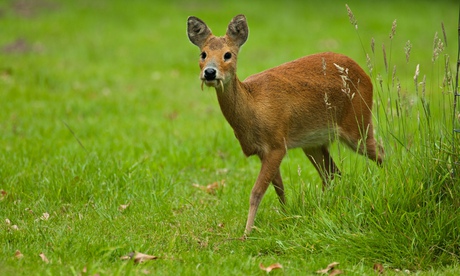
I inched forward and was suddenly eyeball to eyeball with what is surely one of the sweetest faces in all British nature. A Chinese water deer has dark liquid eyes emphasised by a ring of pale around each socket. Even its shortsightedness adds a layer of endearment.
When quiet and unaware of human presence the beast has a rather comedic, bustling manner. Once it is alarmed, the round teddybear’s ears bat back and forth like radar disks, while a wet button nose jabs skywards as it samples the alien presence its vision cannot quite resolve.
When a deep draught of danger finally hits the brain, the creature turns and loops away, thrusting a big bottom up and down in undulating flight. If really spooked at close quarters the deer assumes an enormous head-down drive in its forward run.
When caught full-face at leisure, however, a male Chinese water deer also has a little of the demonic image that environmentalists frequently project on to non-native species. Curving down from his upper jaw are two fangs that bury their sharp tips in pale fur at his throat side. The Dracula of deers he may look, but I was intrigued to hear how, according to one Norfolk estate manager, the species was having no detectable detrimental impact on the farm or the native flora and fauna.
Unlike other deer (or rabbits and hares), this species doesn’t take bark off trees or nibble saplings, nor eat arable crops. In fact of all alien species, the Chinese water deer may have more moral claim to protection in this country than any other.
In China it’s now thought to number as few as 10,000 because of habitat loss and persecution (the semi-digested milk in the fawn’s stomach has an assumed medicinal value).
This shrinkage in the home contingent means that our population assumes an ever-increasing importance in the survival of the species. Contrary to its fortunes in Asia, the deer here has gone from 600 in 1994 and 1,500 in 2004. My sense is that, over the decade, the trend has strongly continued, especially in the Norfolk Broads.