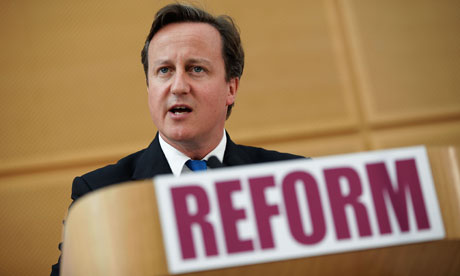
As David Cameron unveiled his plans for public services in England with the open public services white paper yesterday, I couldn't help but wonder if we are in the middle of a perfect storm. The NHS needs to save £20bn; local authority spending on older people is continuing to fall and meanwhile our society is ageing with more than 10 million people in the UK aged 65+. More people than ever need help and support, and deciding how best to provide it against the backdrop of cuts and political maneuvering is a huge challenge.
Over the last few weeks it has felt like we're seeing the effects of this storm: the end of care home operator Southern Cross and the huge uncertainty that creates; the poor standards of care revealed in the Care Quality Commission (CQC) reports into older people's experiences in hospital; the Equality and Human Rights Commission inquiry into home care of older people; and the ruling in the Elaine McDonald case. Not enough money; not enough services; not enough respect. So what can we do?
The government is advocating "more freedom" and "more choice" for service users, and providers have a crucial role in demonstrating what constitutes good quality services and value for money. If more choice is going to become the norm then we will need to make sure that older people know what services are available. This is why information and advice, often provided by the voluntary sector, is so important. In ensuring that people know their entitlements and are informed about the range of services and support on offer, we can help older people and their families and carers to make informed choices when they need support.
Decent services make a huge difference to older people's quality of life which is why it is vital that they have this awareness. Day-to-day, services can help to alleviate loneliness, get people get back on their feet after a crisis and make sure people have enough money to live on. These are not nice "add-on" services: they are essential and can often be transformational. I see their impact on older people's lives every day at Age UK, from handyperson services to befriending and benefits advice. There are a whole range of services that can improve quality of life and delay or even prevent the need for more intensive support later on. These types of services must continue and must grow – if they do not then we risk older people's quality of life deteriorating. There is a wealth of good practice to draw from, some of which is demonstrated in our Prevention in Practice publication.
One of the debates about preventive services has always been whether and how they can be made accountable, showing how they save money, and how these savings can be realised. This is an important question right now, when resources are tight and pressure to implement effective change is at its height. However, it should not obscure the fact that the services are valued by older people and are worthwhile in their own right and not just in relation to the money they save.
If we're looking at accountability and savings as Cameron asks us to, let's take falls as an example. They are the main cause of disability and death from injury in people aged 75+ in the UK. The estimated falls cost to NHS and social care is £6m per day, or £2.3bn a year for hip fractures alone.
Services and interventions can substantially reduce the risk of falling and there's a wealth of good practice about ways to develop and deliver these services . The challenge is twofold. Firstly, how to achieve greater coverage of falls prevention services, which all require good partnership working, and secondly how to realise the savings in a way that releases actual investment for falls services. If we are successful in meeting this challenge, and I believe we can be, then the benefits to older people and to hard pressed-commissioners and providers are considerable.
Sustaining and developing preventative services has to be one of the ways we deal with the challenges we face. I offer two other thoughts about how we can sustain ourselves in difficult times.
First, we need to remember that older people are often the solution rather than a problem which needs to be dealt with. Take the recent CQC reports into hospital care. It found that a large number of hospitals which were spot-checked were non-compliant or identified as in need of improvement. I'm sure I'm not the only person who felt despair at reading this. Less reported was the central role that older people played in identifying these issues through the Experts by Experience service, where older people with experience of care are playing a central role in talking with patients and staff and observing the care provided. What needs to happen next is older people having a role in helping to put the problems right which will all help to bring about the change that Cameron's white paper hopes to realise.
Second, at a time when there is, quite rightly, criticism of the health and care that older people are able to get, we mustn't lose sight of the good care that is provided. We must celebrate those care workers, volunteers, support staff, advisers and others who each and every day make a positive difference to people's lives. This is not the time to lose our ambition about what we can achieve in providing services for later life. It is the time to be courageous about tackling the huge problems we face, celebrate what we do well, and remain tireless in our efforts to provide the best possible services.
We can weather the storm.
Helena Herklots is the services director of Age UK
Age UK is holding its first conference dedicated to promoting excellence in older people's services on 13 July in London. Services for Later Life 2011 will see professionals from across the public, private and voluntary sectors come together with older service users to share expertise, ideas and innovation in developing and providing services for older people. For more information click here
This content is brought to you by Guardian Professional. To join the voluntary sector network, click here