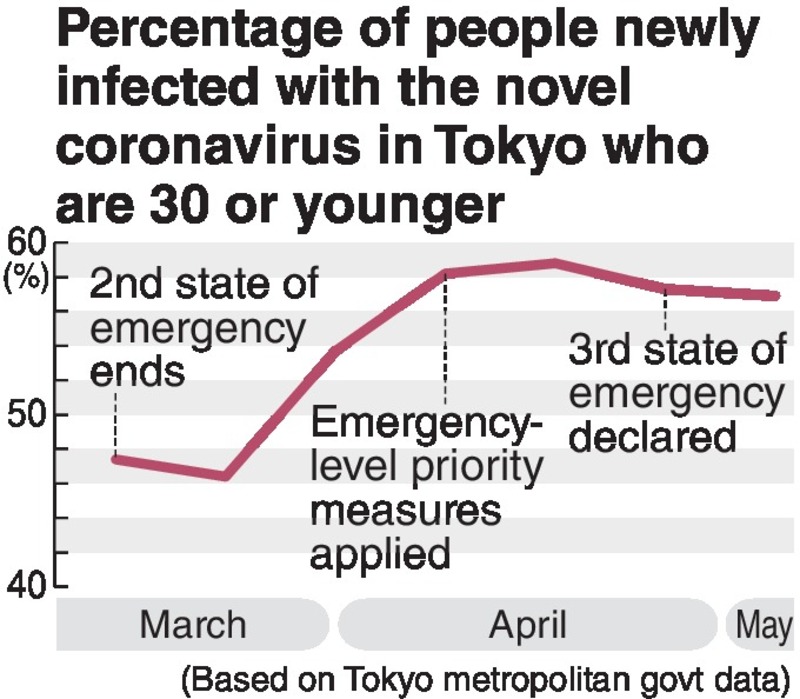
The proportion of young people infected with the novel coronavirus has been on the rise in the Tokyo metropolitan area and the spread of infectious variants is thought to be the cause.
In Tokyo, people in their 30s or younger accounted for less than 50% of new infections from late January to March this year, but the percentage exceeded 50% in April, rising to 59% from April 13-19, and has remained high in May.
Of the 969 new infections confirmed in Tokyo on Wednesday, people in their 30s or younger accounted for 568, nearly 60%.
"Infections [among the younger generation] are increasing as they are relatively more active," Tokyo Gov. Yuriko Koike said.
Infectious disease specialist Prof. Hiroyuki Kunishima of St. Marianna University said the average age of critically ill patients at St. Marianna University Hospital decreased after the outbreak of COVID-19 variants from April to May.
"Even the younger generation may become seriously ill," Kunishima said. "I'm urging the public to meet fewer people, stay alert even when outside and not to take off their masks when talking to others."
-- Experts call for restraint
There has been more movement of people between Tokyo and other prefectures during the current state of emergency than during the past two emergencies, prompting experts to call for people to refrain from traveling.
According to Yomiuri Shimbun analisis of NTT Docomo Inc. data that estimates the population in a given area based on mobile phone locations, the number of people traveling in and out of Tokyo from the nation's other 46 prefectures at around 3 p.m. on weekdays had decreased by 44% during the first state of emergency from April to May 2020 compared to a pre-pandemic period in January last year, but has decreased by only 23% during the current emergency.
As for the flow of people coming in and out of Tokyo during the Golden Week holidays in May, the average tally on May 1-5 this year was 1.8 times higher than that of May 2-6 last year.
"The lifting of the first state of emergency in May [last year] was possible because many people refrained from going out. But this time, there has been an increase in the flow of people, including those crossing prefectural borders," said public health expert Prof. Koji Wada of the International University of Health and Welfare. "We must refrain from nonurgent and nonessential travel between prefectures."
Read more from The Japan News at https://japannews.yomiuri.co.jp/