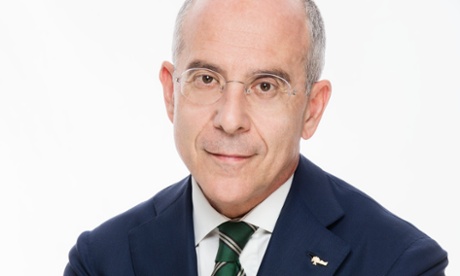
Enel, based in Rome, is the largest power company in Europe by customers, with operations in more than 30 countries across four continents. Mr Starace was previously chief executive of Enel’s subsidiary Enel Green Power, which focuses on renewable energy in 15 countries across Europe, the Americas and Africa.
Do you feel renewables are a natural solution to helping people access energy in developing countries?
There are parts of the world where the growth of renewables is not due to
environmental consciousness, or regulatory pressure, but simply because it’s the best option.
Firstly, this is because there’s often an abundance of wind or sun or water, and the space to develop the plants, but secondly, it’s often down to time. Typically a government will say it needs more power because the country’s population is
multiplying, and its economy is growing, but what can be done quickly?
Renewables can start generating power in a very short time compared to other sources – the cycle is less than a year for solar, two years for wind, yet more than three years for a coal-fired plant, and anything from five to ten years for nuclear.
Are there any particular countries that spring to mind?
In South Africa, coal had been the baseline for energy supplies but the country’s energy needs sky-rocketed when the economy and the population started to grow and coal-powered plants just couldn’t keep up with demand. So they launched an ambitious renewables programme which has been a huge success, with the cost of energy dropping dramatically. We’re now working in the country, as well as in Egypt, Morocco, Kenya and Namibia, on some major wind and solar projects.
We are also operating in Brazil, which is a big hydro country, with the Amazon supplying a lot of its energy. But what if you have three dry years in a row? That means trouble as far as energy supply is concerned, so we’re working with the government on some huge wind and solar programmes to fill the gap. Again, it comes down to using a good mix of resources.
Do you think we’re seeing a similar enthusiasm for renewables in industrialised countries?
Yes, certainly. Take the US: it’s replacing 300,000 megawatts of coal plant with
gas-fired and renewables. China is addressing many of its issues too, and Europe’s 2030 emissions targets are very ambitious. Renewables are being used to shift away from more polluting energy resources, and improve the stability and sustainability of energy costs.
What have been the most significant changes you’ve seen in the way energy is generated?
The evolution of energy generation is basically like a cake with layers. I’ve seen big stages of development for nuclear in the 1970s, then a big push for gas in the 1980s, and now renewables have become more prevalent. They sit one on top of the other and we need to accept that we need this mix of sources in order to provide a supply of accessible, affordable and sustainable energy.
“Sustainability is part of Enel’s culture” – what does this mean in practice?
It means talking to local communities and involving them in our work. Just because a company has a permit from a government to start building and developing infrastructure, doesn’t automatically mean everyone is in favour.
We believe that communities must be part of what we are doing and not just
passively receive some form of compensation, as often happened in the past.
You need to show local communities some shared benefits and develop a common focus on what you’re trying to accomplish; just listening to people and what they have to say can be really important in helping you to sustain good relationships.
Also, there are more than a billion people without power in the world. If you find a cheap, robust contraption that brings energy to people in remote areas with little buying power and education that might change your business model at home. So, yes, we are doing this because we want to bring this [technology] to everyone but also because, if it is sustainable in these conditions, it is even more sustainable in [the rest of] our world – which we think is barely sustainable.
The company recently signed up to the EU’s Startup Enterprise Partnership which supports innovation. How important are new ideas to the energy industry?
There isn’t a great track record of innovation in utilities and that needs to change. We need to work with people from outside the industry – both the bright minds and the venture capitalists – and help them understand what we really need.
For wind the key areas are around sensors and electronics that can help existing machines to perform better, while with PV (photo-voltaic), its developments are around the materials that are used. The other huge issue is finding new ways to store the energy we create.
Staying with innovation, you’re heavily involved with ‘smart grids’ – what do they involve?
Smart grids are about digitising the electricity network, adding meters and ‘brains’ which give you more control to make sure the right amount of power goes in the right direction at the right time. This opens up possibilities to do things more efficiently and cheaply, while using largely the same infrastructure we already have.
Italy is fully digitised and we’re about halfway through introducing a system in Spain. Parts of the US, China and northern Europe now have smart grids too, and I’m confident Latin America will be next.
Digitising the network goes hand-in-hand with renewable energy. As renewables hit 30-40% of the energy mix and because, invariably, renewable energy plants are smaller, the importance of how a variety of loads are distributed across the grid, becomes more important. If the grid is not self-adjusting to these variations, then you hit a limit, but if it’s digitised that limit is automatically removed and renewables can penetrate a lot deeper.
What renewable technology do you see as the next big thing?
The wind turbines today are so much better than the wind turbines we had five years ago. In this technology we will have, not a quantum leap, just a steady improvement that will go on for at least 20 years.
In PV, we will see jumps like in television screens – where we had the cathode system, then plasma, then LCD and so on. I think in the next three years, maybe, we will see another technology improving drastically on the existing one.
If we look at marine technologies [taking energy from the oceans] coming up in the next five to ten years, there are some good ones at work in the labs today. Improvements there will finally produce some commercial success. So if you asked me what is the real new thing, maybe it’s marine technology.
Apart from smart grids and renewables, what are the other things Enel is doing to help decarbonise economic growth?
There is a third leg, which is pushing energy consumption to electricity in areas where today it is not that present. I’m talking, for example, about transportation. Diffusion of electric cars can bring a big benefit to reducing CO2 emissions of industrialised countries.
For us, an electric vehicle is a battery on wheels. How much do you drive a car in your life? A fraction of each year: most of the time your car is sitting there. If a car is plugged into my smart grid and I pay you to use your battery when you are not using it then, for us, this [storing energy in cars to meet demand elsewhere in the grid] is an interesting business idea. There are a lot of things around electric vehicles that have nothing to do with the vehicle itself: if you look at it, 7,000 hours a year it’s a battery and 1,000 hours it’s a car.
You’ll be at the Paris climate change summit later in the year – what’s your big hope for the discussions?
I think Paris will be more of a success than people think because, as far as the
industry is concerned, all we want from the summit is direction.
The main thing for me is to avoid the exhaustion of having to draft an agreement that everyone likes. Instead, we should focus on the fact that we no do not deny any more that there is climate change produced by mankind, and that this can be fixed if we all reduce CO2 emissions.
You were recently asked to join the board of the United Nations Global Compact [which encourages businesses worldwide to adopt sustainable, socially responsible policies] how did that come about?
As a company we’ve been involved with the UN for some time, particularly through our Enabling Electricity programme, which is part of their Sustainable Energy for All initiative – and I am a member of the SE4ALL advisory board. This is helping to fight energy poverty by providing isolated communities and disadvantaged people with sustainable access to electricity.
For instance, in Chile at the Ollague Project, we’ve developed an off-grid hybrid plant combining PV and a mini-wind turbine generator, coupled with an energy storage system, while at Curibamba in Peru, we’re helping to bring electricity to a remote community by building a hydropower plant.
You also met with Kumi Naidoo, executive director of Greenpeace, earlier this year – what sparked that meeting?
We had drafted a new strategy which set out how we intended to grow in terms of distribution and digital grids, as well as our plans to develop smaller plants, with no more exposure to gas, oil and coal. When Greenpeace saw this, they approached us and said: “You’re kind of strange in the industry and it looks like your agenda is similar to the model we would like to see all energy companies adopt.”
We met and found out that we have a lot in common around energy production and the direction the industry should take. Greenpeace is a very intelligent organisation and understands that these changes won’t happen overnight – you can’t shut down the plants that keep the lights on just because they are coal-based – but the important things is that coal is seen as a fuel from the past, and something which we are phasing out.
They also share our idea that communities should be part of the choices and not just passive. We are going to have more talks and a relationship with Greenpeace and
I think establish a roadmap to measure the progress we are making on the [sustainability] agenda.
So how does this link with the Access to Energy campaign you’re running with the Guardian?
Quite often we find that people are really surprised when they hear a utility company speaking about sustainability. But I think it’s time to put an end to the idea that we are just about coal and pollution.
We need to educate people that the industry is changing and the more we talk about it, then the more other energy companies will find out that this is the right way to go and that whole sustainable way of thinking will gain momentum.
How do you think development professionals working in the field in developing countries should perceive Enel?
They should look at energy companies as enablers because energy provides
people with the strength to do things that you wouldn’t otherwise do. We provide
opportunities and give people the chance to start a business, open a new restaurant, have an education, or simply travel from A to B. Even where economies are starting to grow, people need support to do more things, and that’s what we do.
About Francesco Starace
Francesco Starace has been group chief executive of Enel since May 2014. Between 2008 and 2014, he was chief executive of Enel Green Power, the group’s renewable power generation subsidiary and a leading player in the global renewables industry.
In May this year he was appointed to the board of directors of the United Nations Global Compact [which encourages businesses worldwide to adopt sustainable, socially responsible policies]. Since June 2014, he has also been a member of the advisory board of the UN’s Sustainable Energy for All initiative.
After a degree in nuclear engineering at Milan Polytechnic, Mr Starace’s career began in construction management of power generation plants. He has worked for General Electric Group, ABB Group and at Alstom Power Corporation, where he was head of worldwide gas turbines sales.
He joined Enel in 2000, and has held several executive positions including head of business power (from July 2002 to October 2005) and managing director of the market division (from November 2005 to September 2008). In November 2010, he led the Initial Public Offering (IPO) of Enel Green Power, floating it on the Milan and Madrid stock exchanges with a market capitalisation of €8 bn. He has lived and worked in countries including the United States, Saudi Arabia, Egypt and Bulgaria.
He is married with two sons, is a keen cyclist and supporter of AS Roma football club, and is passionate about poetry.
Content on this page is paid for and produced to a brief agreed with Enel, sponsor of the energy access hub at the Guardian Global Development Professionals Network.