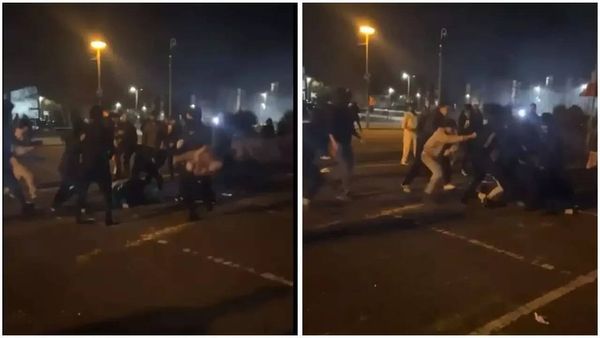
A month on, Adam Romain is still clearly deeply traumatised by the outburst of violence that took place on the doorstep of his Swansea home.
Rioters set fire to cars outside his terrace house, and when he attempted to stop them, hurled bricks through his windows. Delivery driver Romain turned on a head-cam and captured the screams of his partner and children as glass smashed and the flames danced outside. He dialled 999 and told the operator: “They’ve targeted my house. They are throwing bricks at my house. I have two children inside, please come.”
A quietly spoken, thoughtful man, Romain, 34, has spent hours mulling the causes of the Mayhill riot, in which scores of people took to the streets, pushed a car down the dizzyingly steep Waun-Wen Road and attacked police vans after a vigil for a local teenager turned sour.
He has come to believe the riot was part of a bigger social problem. “I think the feeling has grown that you can get away with a lot and nobody will do anything about it, a sense of lawlessness,” he said. “A lot of people seem to think they don’t have much to lose. The lockdowns may have something to do with it. People are feeling pent-up, frustrated.”
Romain has moved his family away. “I can’t imagine sitting in the front room not knowing when the next brick is going to come through the window.”

The riot has not been the only outbreak of violence and antisocial behaviour in the area in recent months. On Bonfire Night, the derelict Boys’ Club just across from Romain’s house was set on fire. There was a previous incident in which a car was rolled down Waun-Wen Road, and residents frequently have to dodge out of the way of motorbikes hurtling along pavements. In the early spring there were brawls involving gangs of young people a mile or so down the hill on the waterfront in Swansea.
There have been other incidents across south Wales. Armed officers were on the streets of Pontypool following reports of teenagers carrying weapons, while hundreds defied social distancing rules to party in front of the Welsh parliament building in Cardiff.
Martin Innes, the director of the Crime and Security Research Institute at Cardiff University, believes pressure that has built up during lockdowns, combined with social problems exacerbated by the Covid crisis, is leading to explosions of violence.
“It is a worrying situation,” he said. “Forces are coming together. Compliance with lockdown was pretty good. The problem is when you take the handbrake off. There is a sense among some young people that they have been abandoned and the future is hopeless.” He does not believe it is a situation unique to Swansea or south Wales but one that could hit anywhere in the UK. “We may have a long, difficult summer coming up.”
There are obvious signs of what is being done in the aftermath of the Swansea riot. Blocks of concrete have been positioned towards the top of Waun-Wen Road to stop cars being rolled down. “It feels a bit like the Berlin Wall,” said retired toy factory worker Pamela Yates, who lives on the road. “But if it keeps us safe, fair enough.”
Mayhill and neighbouring Townhill – referred to locally as “the Hill” – have a rollercoaster history. They were created a century ago as a “garden city estate” built to get people out of the city slums. Many houses have wonderful views over Swansea Bay and towards the Gower peninsula or the Brecon Beacons.
In the 1990s, however, it was a car crime hotspot with dozens of chases between joyriders and police taking place in a single night. The area was used as a location for the 1997 film Twin Town starring Rhys Ifans, which tells the story of a pair of joyriding brothers.
Things improved, thanks largely to the success of projects such as the Phoenix Centre, which was opened in March 2001 by the then prime minister, Tony Blair, and backed by funding from the EU. Twenty years on, it continues to run a successful nursery, library, sports facilities and job clubs.
Mike Durke, a former chief executive officer of the trust that operates the Phoenix, said the approach was to listen to what people said they wanted. “We wanted to be led by local people who had been pushed to the margins. It worked better than anyone could have felt possible, because we treated people with dignity.”
But the area remains one of the most deprived in Wales. In Mayhill, 14% of people have never worked or are long-term unemployed, against 5% for Swansea as a whole, according to the council’s ward profile (pdf). The proportion of single parent households is at 25%. Crime has increased this year, with offences for the January to March quarter the highest for three years.
Leanne Dower, the manager of the Phoenix, said her reaction to the riot was: “Wow, where did that come from?” Dower grew up in the area and remembers the time when the area was known as the “Hill of Despair”. “It is really not like that now,” she said.
She is proud of the reaction of people following the disturbance. Other residents helped the victims clean up and children from a nearby school, Ysgol Gymraeg y Cwm, wrote letters to those affected expressing their sorrow. “This behaviour should not be tolerated,” wrote one, “the violence was mad.”
Swansea council has promised to work with residents to make the place better. Joint deputy leader and Townhill councillor David Hopkins said: “Those who took part in the disorder are a minority and their disgusting behaviour was unacceptable. We’re working with partners including the Welsh government and the police to understand how the incident happened, what can be done to further support families and to ensure this doesn’t happen again.”
Swansea as a whole is on the up. A new city-centre arena is nearing completion; there is a Marco Pierre White restaurant on the SA1 waterfront; poetry lovers flock to the Dylan Thomas Centre.
“All that doesn’t do us much good,” said Jon (not his real name), a Hill resident who was present on the night of the riot, though only as an onlooker. “There’s a bit of an us and them kind of vibe – loads to do down there but fuck all up here. We’re the forgotten ones.”
There did seem precious little for youngsters to do this week. The youth centre at the community hall was closed and nobody was playing football or basketball on the Phoenix pitches. The doors of the boxing club were shut.

Tony Roper, 75, who was born and bred on the Hill and is a former chair of a group that acted as a link between the police and community, said it was very different when he was young. “There was something on every night for the young people, from sports to basket-weaving. That’s all gone.”
He suggested a reason for the riot may be that people have simply got used to images of people protesting or fighting the police. “They see people standing up to authority and think they can do it too.”
Julie James, the Labour Welsh parliament member for Swansea West, said it seemed clear that the violence escalated after images of its beginnings were shared on social media, and said a review would look at whether it should have been anticipated or spotted sooner and stopped. She also raised concerns that the area is going to miss out on funding in this post-Brexit world. “There’s no doubt the loss of EU funding will hit the area,” she said.
The Welsh government launched a fierce attack this week on the UK government’s replacement for EU funds, the shared prosperity fund (UKSPF). It pointed out that the pilot for the UKSPF, the community renewal fund, is worth £220m across the UK in this financial year.
Welsh ministers argued that if the UK had remained in the EU, Wales would have had new EU structural funding worth at least £375m each year for seven years from January 2021 – on top of funding from the current EU programmes. James said: “This is a serious cut in the amount of money Wales should get.”

The UK government’s Ministry of Housing, Communities and Local Government disputes the Welsh administration’s claims as “misleading and based on highly speculative figures, arguing: “Our UKSPF will invest in people, communities and local business to level up and create opportunity in places most in need and for people who face labour-market barriers.”
James also believes lockdown may have played a part. “Lockdown has been more frustrating to young people, and the poorer you are the harder it is to sustain yourself in lockdown – you have less access to IT and outside space.”
Another person still trying to understand the Mayhill riot is Jonathan Russ, the father of Ethan Powell for whom the vigil was held after his sudden death at the age of 19. “It left us angry and embarrassed that his name was even connected to what went on. He was such a lovely boy,” Russ said.