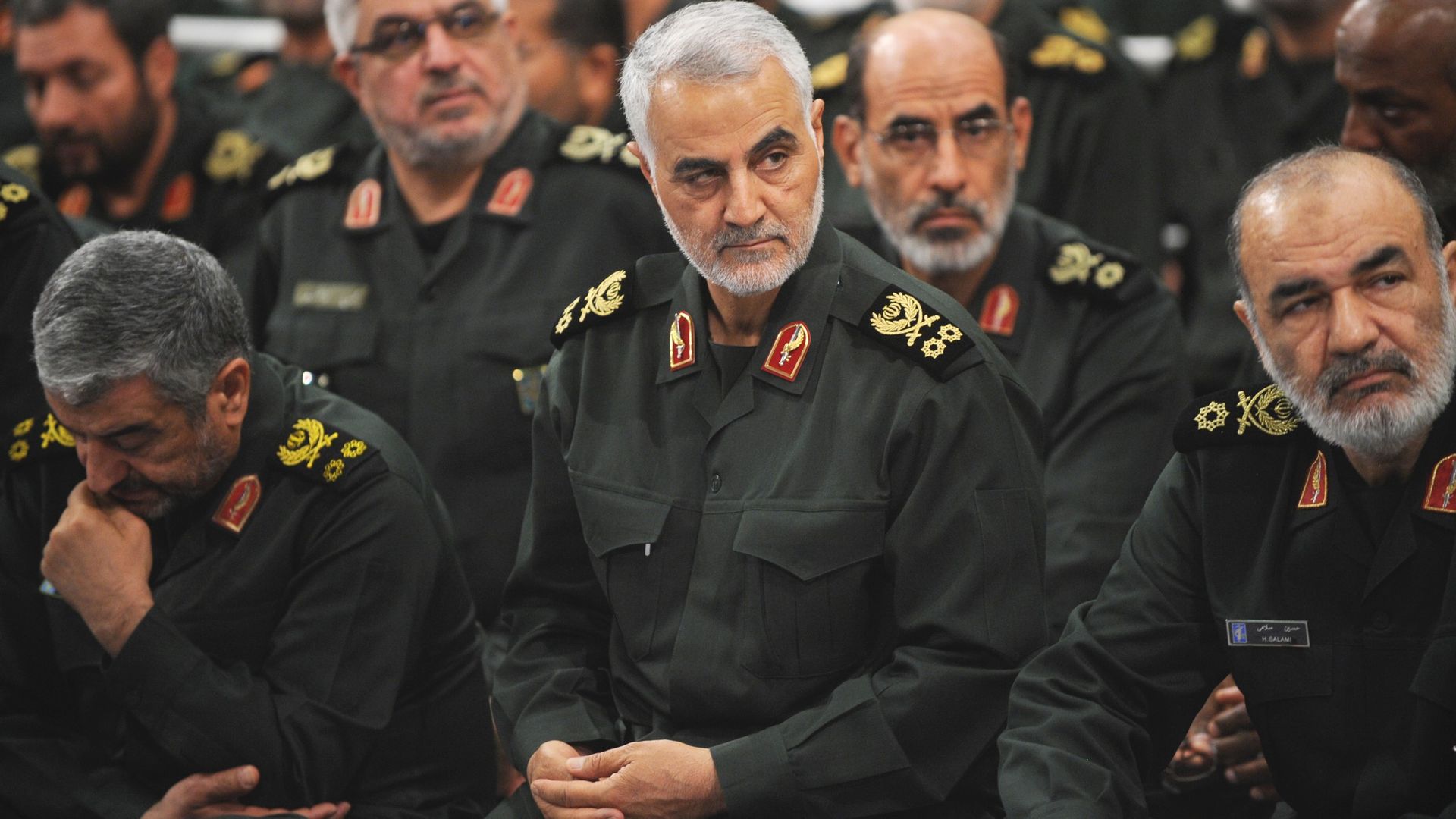
One of the Iranian regime's most powerful figures has been killed in a U.S. airstrike near Baghdad's international airport, the Pentagon has confirmed.
Why it matters: Qasem Soleimani, the leader of the elite Quds force of the Islamic Revolutionary Guard Corps (IRGC), was as revered by Iran's proxies and supporters across the region as he was reviled by Iran's foes, who considered him the mastermind of state-sponsored terrorism.
The big picture: Soleimani was often referred to as Iran's second most powerful person, behind Ayatollah Ali Khamenei. Tehran can be expected to respond forcefully to his assassination, and the already tense U.S.-Iran standoff will instantly become far more dangerous — including for U.S. forces in the region.
What they're saying:
Behnam Ben Taleblu of the Foundation for the Defense of Democracies tells Axios this is "one of the most significant security events in modern Middle Eastern history."
- "While Soleimani has institutionalized at least some of his war-fighting aptitudes within the [IRGC], what isn’t institutionalized is his name-brand and charisma," he adds.
Mahdi al-Muhandis, founder of the Iran-backed Iraqi militia Kataib Hezbollah, was also reported dead. Kataib Hezbollah responded to deadly airstrikes by the U.S. on Sunday with two days of violent protests outside the U.S. embassy in Baghdad.
- Defense Secretary Mark Esper said Thursday that there were indications that Iran or its proxies may be planning additional attacks, and that the U.S. was prepared to take preemptive action.
- “The game has changed,” he said. “And we’re prepared to do what is necessary to defend our personnel and our interests and our partners in the region.”
President Trump threatened to retaliate after the chaotic scenes at the embassy, but has also said he doesn’t want war.
- He previously cancelled airstrikes on Iran at the last minute after the downing of a U.S. drone in June, concerned by the prospect of escalation. There are few steps that could have guaranteed swifter retaliation than the assassination of Soleimani.
Oil prices were up roughly 3% within hours of the attack.
- Jason Bordoff, head of a Columbia University energy think tank, predicted via Twitter that Iran's response "certainly may include escalating attacks on energy infrastructure."
- He said the major September aerial strikes against Saudi Arabia's oil infrastructure, which the U.S. blamed on Iran, were "just the beginning."
Flashback: The U.S. designated the IRGC as a terrorist group last April, and Secretary of State Mike Pompeo said at the time that Soleimani would be treated by the U.S. as a terrorist leader — on par with then-ISIS leader Abu Bakr al-Baghdadi.
Go deeper: A 2013 profile of Soleimani from the New Yorker's Dexter Filkins.