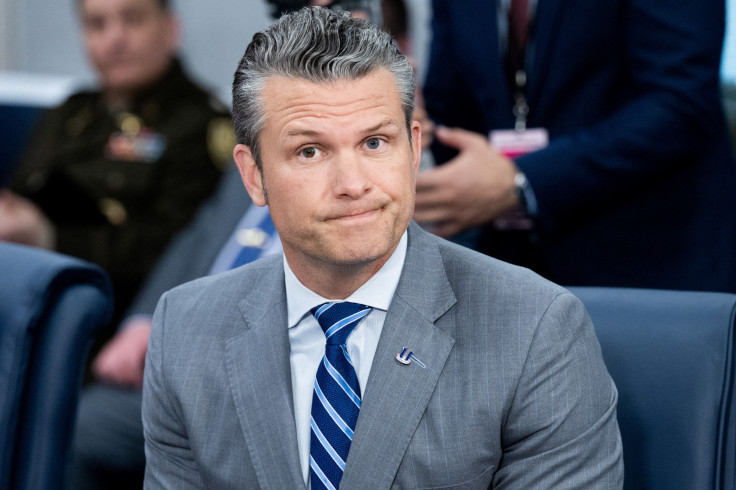
A Pentagon briefing on U.S. operations in the Strait of Hormuz took an unexpected turn Tuesday when Defense Secretary Pete Hegseth was asked about reports that Iran could deploy "kamikaze dolphins" to attack U.S. ships, prompting a denial that briefly shifted the tone of an otherwise high-stakes update on the conflict.
"I can't confirm or deny whether we have kamikaze dolphins, but I can confirm they don't," Hegseth said, responding to a question tied to recent media reports. Standing alongside him, Joint Chiefs of Staff Chair Gen. Dan Caine said he had not heard of the claim, adding jokingly, "You mean like sharks with laser beams?"
The question followed a report from The Wall Street Journal last week which claimed that Iranian officials had discussed the possible use of unconventional weapons to counter the U.S. naval blockade, including dolphins trained to carry mines toward enemy vessels.The report referenced earlier accounts that Iran had acquired military-trained dolphins decades ago, raising speculation that such programs could be revived under mounting pressure.
The Pentagon dismissed reports of “kamikaze dolphins” in the Strait of Hormuz, with Gen. Dan Caine joking, “Like sharks with laser beams.” Defense Secretary Pete Hegseth added he could not confirm such claims, but said he "can't confirm or deny whether we have kamikaze dolphins"… pic.twitter.com/kDcIxdNEVM
— CBS News (@CBSNews) May 5, 2026
The exchange stood in contrast to the broader message of the briefing, which focused on escalating tensions in the strategic waterway. Hegseth reiterated that the U.S. mission, dubbed "Project Freedom," is intended to restore commercial shipping through the strait, a corridor that previously handled roughly one-fifth of global oil flows.
"To be clear, this operation is separate and distinct from Operation Epic Fury," Hegseth said, describing the escort mission as "defensive in nature" and "temporary in duration." He added that U.S. forces would avoid entering Iranian airspace or territorial waters and emphasized that Washington was "not looking for a fight," as The Independent points out.
At the same time, the defense secretary maintained that the U.S. blockade of Iranian ports "remains in full effect," underscoring the dual-track approach of reopening maritime traffic while continuing economic pressure on Tehran. Analysts have described the blockade as significantly limiting Iran's ability to export oil, forcing tankers to turn back and restricting alternative trade routes.
The briefing also highlighted ongoing instability despite a declared ceasefire. Caine said Iran had fired on commercial vessels nine times and attacked U.S. forces more than 10 times since the truce was announced, though he noted these incidents remained below the threshold for renewed large-scale combat.
Hegseth said U.S. forces had struck six Iranian vessels and confirmed that some commercial ships had begun transiting the strait under U.S. protection. "They said they controlled the Strait, they do not," he said, as TIME reports.


© 2025 Latin Times. All rights reserved. Do not reproduce without permission.