PHILADELPHIA _ The lights cut out suddenly in the bare-bones storefront in northeast Philadelphia that houses Hillary Clinton's presidential campaign office.
But it was prime calling time, so volunteers who spend hours each night contacting voters worked by the light of their cellphones, pleading for support in the dark.
The power failure last week, which affected several buildings, forced campaign officials to move their celebratory launch of Pennsylvania Latinos for Hillary into a used furniture store across the street.
Then, once there, community leaders who were expected to take part in a pep rally instead took turns excoriating a senior Clinton campaign official for what they saw as a lackluster commitment to the area. In tones of dread, they demanded more ads, more mailers, more of anything that could help them help defeat Donald Trump.
In Philadelphia, the Democratic political pulse is thrumming with both resolute optimism and panicky fear.
After more than 20 years as reliably blue in presidential contests, Pennsylvania by dint of other states' moves is suddenly the Clinton linchpin, the place that could deny Donald Trump the presidency.
That puts heavily populated Philadelphia in the hot seat, perhaps the most important target for Clinton in what ranks now as her most important state.
Little more than five weeks from Election Day, the battle is on.
Ads for and against the candidates beam from televisions and blare from radios at all hours. Groups funded by activists as diverse as the conservative Koch brothers and liberal Tom Steyer are dialing phones and knocking on doors by the hundreds of thousands.
Barely a week has gone by without a visit from the candidates or, in Clinton's case, her high-powered bank of surrogates. Clinton will be back in the Philadelphia area Tuesday; her running mate, Tim Kaine, hits town one day later.
Here, a simple trip to a Philadelphia hair salon means running into actress Alfre Woodard, who on Friday implored a dozen or so women backed up against the styling sinks to rally their families and friends in support of Clinton.
"If you guys in Philadelphia turn up and turn out in record numbers, that will keep Pennsylvania blue," Woodard said after delivering impassioned praise of the Democratic nominee. "And if Pennsylvania goes blue, then you will determine the fate of this country. That's the power you have in your hands right now."
That might sound exaggerated. It's not.
In the past two elections, the Democratic linchpin has been Ohio, a state currently in Trump's control.
Even if he wins Ohio, however, Trump likely cannot win the presidency without a victory in neighboring Pennsylvania as well. And while Ohio is not a must-win for Clinton, it's hard to concoct a path to the White House for her without Pennsylvania.
The state hasn't sided with a Republican since 1988, but Trump has made inroads this year, as elsewhere, by appealing to blue-collar voters on economic and cultural grounds. So Democrats are under more pressure than they have been in years to maximize turnout in southeastern Pennsylvania and in the city of Philadelphia, where huge margins for President Obama and other Democrats served to offset losses elsewhere in the state.
In the 2012 race, Obama racked up a margin of almost half a million votes in Philadelphia. That _ and less substantial victories in a few surrounding counties and in Pittsburgh _ accounted for his eventual statewide margin of more than 300,000 over Republican nominee Mitt Romney.
Public polls taken before last week's debate showed Clinton's once-firm lead here collapsing. She is presumed to have made back some ground because of her successful debate performance _ as she did in other battleground states _ but no new polls have been published to clarify her standing.
In Philadelphia, a Clinton victory centers on two things: generating enthusiasm among the voters who powered Obama's two victories here, especially the African Americans who make up more than half the city's vote, as well as among young voters. And persuading voters here to take Trump seriously as an opponent.
High-ranking surrogates and celebrities have pressed those points in recent visits.
"Remember, it is not about voting for the perfect candidate. There is no such person," first lady Michelle Obama told LaSalle University students on Wednesday. "In this election, it is about making a choice between two very different candidates with very different visions for our nation. ... It is not enough to get angry and just speak out about the need for change; we all must take action to elect folks who will stand with us to make that change."
The candidates have adopted different approaches in Pennsylvania. Clinton and her fellow Democrats have more than 50 offices in the state, more than half a dozen in Philadelphia alone. Her campaign is organized to the precinct, neighborhood and street levels.
According to campaign officials, Clinton volunteers since Aug. 1 have made 2.5 million phone calls and spent 87,675 hours contacting voters and registering non-voters.
Trump's campaign has belatedly tried to build a state organization; during a rally in south-central Pennsylvania on Saturday night he said his supporters had knocked on 100,000 doors. But the overall premise seems to be that his voters, encouraged by his big rallies, will need little outward encouragement to cast their ballots.
Democrats instead fear the power of Americans for Prosperity, the effort funded by the Koch brothers and other conservative donors. That group is not even targeting the presidential race _ working instead to re-elect Republican U.S. Sen. Pat Toomey _ but some Democrats believe it could expand the ranks of Trump voters. The group has focused on 660,000 voters who it believes are inclined to vote against Democratic Senate candidate Katie McGinty, a Clinton ally.
AFP has made 1.2 million phone calls and knocked on 92,000 doors since June, said Beth Anne Mumford, AFP's state director.
"We are there to talk about the Senate race and that's where we keep our conversations to," she said. "Obviously it's an election season and there are other personalities involved."
Countering her group is For Pennsylvania's Future, a joint effort by wealthy activist Steyer and four labor organizations.
Spokesman Dave Scholnick said the group has knocked on 376,000 doors, focusing on African American, Latino and younger voters likely to side with Clinton and McGinty. The target by election day: more than 1.4 million voters.
"The name of the game is mobilization," he said.
A more immediate demand for Clinton is registering voters. Clinton forces have spanned across the state to try to register Pennsylvanians ahead of the Oct. 11 registration deadline. After that, the campaign will turn to pushing voters to the polls on Nov. 8, a more meaningful day than in most states because there is no early voting.
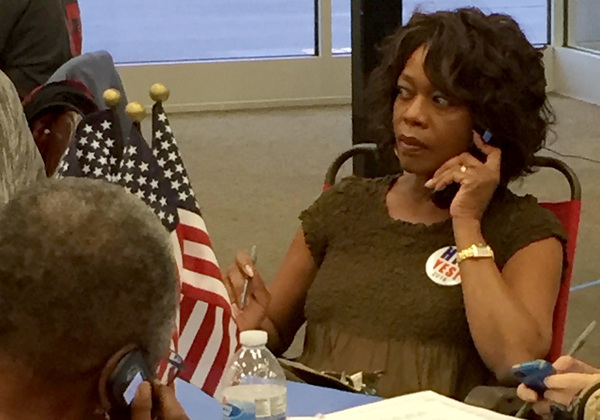
Monica Huff is one of scores of Clinton volunteers in Philadelphia. Each day, fresh from her full-time job working with special needs children, she puts in several hours at the northeast Philadelphia office calling would-be voters. The 44-year-old Democrat also shows up on weekends.
"This is a battleground," Huff said the other night, sitting in darkness during the power failure. "I truly believe that Hillary will come out on top."
Confident about Philadelphia's turnout _ but only "hesitantly optimistic" about the nation overall _ was volunteer Joshua DeMilta, decked out in the gear of his alma mater, the University of Southern California.
"You have a lot of people who feel like they don't have a voice anymore," DeMilta said. "It's going to come down to voter turnout. That's what's motivating me. Pennsylvania can still go either way."
Across the street at the Pennsylvania Latinos for Hillary gathering, community leaders were a lot less optimistic, at least publicly.
Some of that may be timing; the officials wanted campaign goodies at a time when the Clinton operation was focused more on the last surge of voter registration than in lawn signs that do little to influence elections.
But they also spoke to the multitude of fears among Democrats about a race that, for now at least, is tighter than most had expected.
"For the Obama campaign in 2008 I saw excitement," said David Rodriguez, the chair of the state Democratic Party's Latino caucus. "In this campaign, I'm going to be honest, I do not see the excitement."
But that is only half of the dilemma for Clinton, caught between some voters who are not excited about her candidacy and others who refuse to take Trump seriously.
"Some people say, 'Don't worry about it, David, Hillary is going to win,'" he said. "We can't be overconfident."