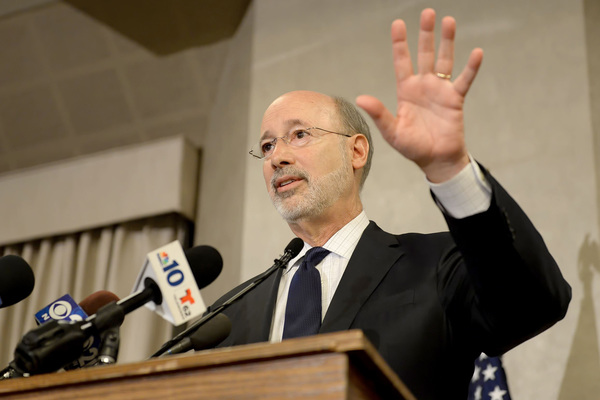
HARRISBURG, Pa. _ Calling the opioid overdose epidemic "a public health crisis, the likes of which we have not before seen," Gov. Tom Wolf spoke Wednesday to a packed House chamber in a rare joint session of the state's General Assembly as he launched his bid to have passed and to sign, by year's end, around a half dozen measures aimed at curbing addiction.
"Families have identified loved ones. People have buried their childhood friends," Wolf said, citing a fatal overdose tally of nearly 3,500 last year. "It's a crisis that has been building for years, right here in Pennsylvania and again, all across the country."
He called it "an invisible problem" with concrete ramifications. "People with substance use disorders and their families fear the stigma of addiction, which keeps them isolated and unwilling to ask for help. The consequences therefore fall to law enforcement, jails and prisons, and understaffed treatment centers."
He urged lawmakers not to limit their expectations despite the waning of the legislative session, noting that numerous measures have passed one chamber or the other.
"We are going to take a stand against the vicious disease of opioid addiction," he said.
The governor said he wants to limit _ with some exceptions _ prescriptions of opioids to one week's worth of pills for minors and patients seen in the emergency room.
"We've all have heard too many stories _ too many horror stories _ about high school athletes whose futures are robbed by addiction that begins with prescription painkillers," he said. "Of course, those suffering from crippling pain need relief, and we must be careful to protect the ability of sufferers of long-term pain or victims of trauma to receive appropriate medication."
Wolf would also like to compel doctors to check the new patient drug history database every time they prescribe a controlled substance.
"Our current law is not strong enough," he said. "It only requires doctors to check the system the first time they prescribe to a patient, or if they believe a patient is suffering from the disease of addiction."
A bill would prohibit medical providers from prescribing more than a seven-day supply of any opioid to a minor, with a few exceptions. The bill, by Republican state Sen. Gene Yaw, would require that if more than a week's worth of opioids was needed, the prescriber would first assess whether the young person had a mental health or substance abuse disorder, and discuss the risks with a parent or guardian. Prescribers who flaunted the rules would face discipline against their licenses.
The Pennsylvania Medical Society, which represents doctors, has helped to write prescribing guidelines, but has generally opposed legislation setting prescribing rules.
Wolf also wants to require that insurers cover abuse-resistant formulations of painkillers, mandate opioid education in schools, and create of a system under which a patient can formally declare that they don't want to be prescribed opioids.
He would like medical schools, as a condition of receiving state funding, to teach good painkiller prescribing practices. He wants to require that prescribers take refresher courses in the pros and cons of opioids every two years.
"The opioid epidemic did not start overnight and we will not fix it overnight, or even in this session," he said. "But by acting on these bills _ and by putting other ideas on the table _ we can continue to stem the tide of opioid abuse in Pennsylvania. We can make progress for the families we have met _ the parents who have cried on our shoulders."
He said the crisis "calls on us to cast aside partisanship once again. It calls on us to reject cynicism once again. It calls on us to take action once again. ... Let's get this done."
Earlier Wednesday, the House Children and Youth Committee heard experts from around the state describe the effects of the opioid epidemic on families.
Kim Rogers, administrator of Washington County Children and Youth Services, related a 911 call placed by two children, ages 5 and 6, reporting a parent's overdose.
"Our young children are the ones calling 911, and it's really difficult to understand what they're saying, because they are crying and screaming while they watch their parent die," said Rogers.
She said that referrals to her agency driven by parental substance abuse doubled from 2014 to 2015, and continue to rise. Some opioid-addicted parents nod off in meetings with caseworkers, pass out in cars with their children in the back seats or keep virtually no food in the home, she said.
Statewide, more than half of the cases in which children are placed outside their birth families stem from parental substance abuse, said Cathy Utz, deputy secretary for the Office of Children Youth and Families of the Department of Human Services.
Is there much Harrisburg can do?
"We really do need a collaborative approach," said Cathleen Palm, founder of the Center for Children's Justice, based in Bernville, Berks County.
Data released Tuesday showed that the incidence of newborns with neonatal abstinence syndrome _ opioid dependence driven by exposure in the womb _ has increased nearly tenfold in 15 years.
Last year, 2,691 newborns in the state had substance-related conditions, of which 82 percent had neonatal abstinence syndrome.
"So these poor (newborns) are going to be incredibly expensive for us to care for, and it's a completely preventable problem," said Dr. David B. Nash, dean of the Jefferson College of Population Health, at Thomas Jefferson University in Philadelphia. "There's no telling today what the downstream implications and the social costs are."
A Pittsburgh Post-Gazette investigation published in May showed that the state lagged behind many of its neighbors in efforts to monitor patient drug histories, teach doctors the dangers of opioids, promulgate guidelines for the use of painkillers and discipline physicians who prescribed them wantonly. The investigation found that over five years, 608 doctors were disciplined for narcotics prescribing practices in the states that include most of Appalachia _ but just 53 of those were in Pennsylvania.
"State officials also need the tools to identify inappropriate prescribing and dispensing practices among health care providers to better crack down on abuse," Wolf said Wednesday.
Meanwhile, opioid prescribing in Pennsylvania trended only slightly downward, while cheap heroin and fentanyl drove fatal overdoses skyward. In 2010, 1,916 residents of the state died from overdoses, and since then that grim has risen relentlessly to 3,383 last year.
Wider distribution of the medicine naloxone, encouraged by Wolf's administration, has resulted in 1,502 "saves" in potentially fatal overdoses since November 2014.
Over the summer, the Board of Medicine approved opioid prescribing guidelines for several medical specialties. The state became the 49th in the nation to operate a prescription drug monitoring program, through which doctors must check a patient's medication history before adding a new controlled substance. The budget includes $20 million in new funding for treatment, including 45 Centers of Excellence meant to treat 10,000 people annually.