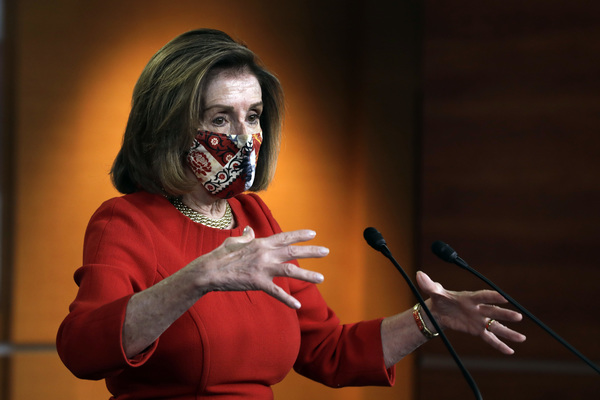
WASHINGTON — House Speaker Nancy Pelosi said there's momentum building toward a compromise fiscal stimulus plan, though Republicans complained about the scale of aid to states included in the bipartisan proposal that's become the best chance yet for a deal.
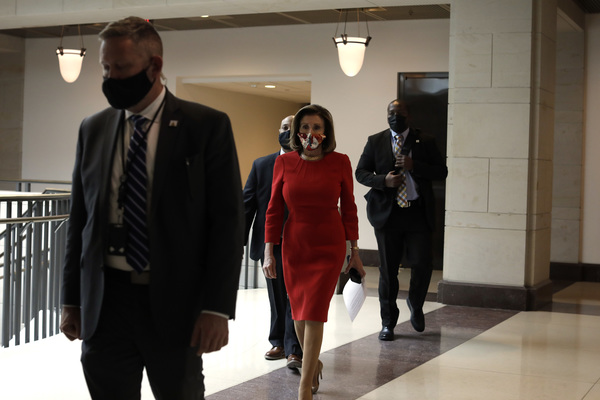
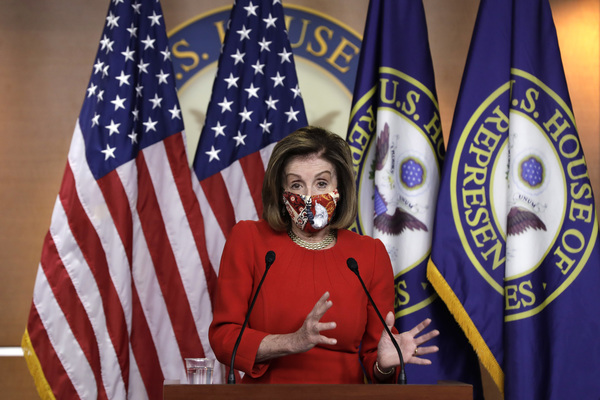
"There is momentum with the action" by a group of Republican and Democratic lawmakers on a $908 billion package, Pelosi said at a press conference Friday in Washington. She said she and Senate Majority Leader Mitch McConnell have discussed attaching the relief measures to an omnibus spending bill that the parties are working on separately to keep the government funded beyond Dec. 11 into 2021.
While Democrats wanted a much bigger effort, the fact that President-elect Joe Biden — who aims to seek additional economic-rescue measures — will be taking over soon, and the imminence of coronavirus vaccines, have amounted to a "game changer," Pelosi said.
An agreement is still pending, however, with White House economic adviser Larry Kudlow saying "I can't say one way or the other what the outcome's going to be." He also indicated that the $160 billion proposed for state and local aid in the bipartisan package could be a problem for the GOP, which has decried a bailout for poorly run Democratic-led states.
"Sen. McConnell has indicated that he's not happy with that part of the bipartisan group" plan, Kudlow said on Bloomberg TV.
As support was building for the proposal, so were complaints.
Vermont Sen. Bernie Sanders, who has a fervent following among progressive Democrats, said he'd vote against the bipartisan effort "unless it's significantly improved."
He cited a provision to suspend coronavirus liability lawsuits and the lack of direct payments to individuals.
New York Rep. Alexandria Ocasio-Cortez also said that the legislation should include such payments, though she told NBC News that she'd support the framework from the bipartisan group. She said she was willing to work with Republicans like Missouri Senator Josh Hawley, who supports such aid, to get it passed. Hawley replied affirmatively on Twitter.
Biden also backs including individual payments, though he said that whatever package passes before the end of the year would be "just a start" and more would be needed in January.
"I think it would be better if they had the $1,200, and I understand that may be still in play," he said at a news conference Friday.
Some Republicans were wary of including state aid, which many in the GOP oppose. Sen. Chuck Grassley said Thursday that, "If the figure's over 150, I won't like it," referring to the billions of dollars for state and local help.
Still, Grassley was one of a number of GOP members expressing openness to the bipartisan plan, which has four Republican co-sponsors in the Senate. That could put pressure on McConnell, who this week has separately pushed his much smaller scale proposal — along the lines of a previous bill that was roughly $500 billion — and touted that it has the backing of President Donald Trump.
Kentucky Rep. John Yarmuth, a Democrat from McConnell's home state who knows him well, predicted the Senate leader would swing round. "He will budge because his members will make him," he said.
Another key element is the coronavirus liability protection for businesses that McConnell and other Republicans have demanded but that Democrats have characterized as a poison pill.
House Majority Leader Steny Hoyer said Friday that "if it's a moratorium on filing suits, we can look at that. Obviously we don't want to change the rules of the game in terms of how people are compensated for wrongdoing of others."
Hoyer also said that $908 billion is the "lowest we should go to" on stimulus. "If $908 billion over four months is what we agree on then we ought to pass it," he said on MSNBC.
Democratic lawmakers cited Friday's weaker-than-expected November jobs report as a fresh call to action on a relief bill. The 245,000 rise in payrolls was less than almost all forecasts in Bloomberg's survey. It was also the smallest increase since the job market started recovering in May.
"This jobs report is blaring warning that a double-dip recession is looming and must be a wakeup call for anyone who is standing in the way of true bipartisan emergency relief," Senate Democratic leader Chuck Schumer said in a statement.
Republican Tom Cole, a House member from Oklahoma, agreed on the implications of the release: "I think today's jobs numbers really help" the relief effort. "We may disagree about the specifics but there is no doubt the economy needs help."
The omnibus spending package to fund the federal government past Dec. 11 has run into its own challenges, with Senate Republican and House Democratic lawmakers and staff hashing out details behind a $1.4 trillion bill. Meantime, sponsors of the stimulus plan are working on turning their outline into legislative language.
Monday is the goal for that language, said Rep. Tom Reed, a Republican who co-chairs the Problem Solvers group of GOP and Democratic House members that first tried a bipartisan proposal before the election.
"Everyone is at the table now," Reed said Friday, saying that the drafting involves the core bipartisan group but also congressional leadership and the White House.
An agreement to attach COVID-19 relief to the omnibus could "accelerate the discussion" on the bigger funding bill, Pelosi said.
"That is the vehicle leaving the station," Pelosi said, as Congress winds down its legislative work before the year-end holidays.