
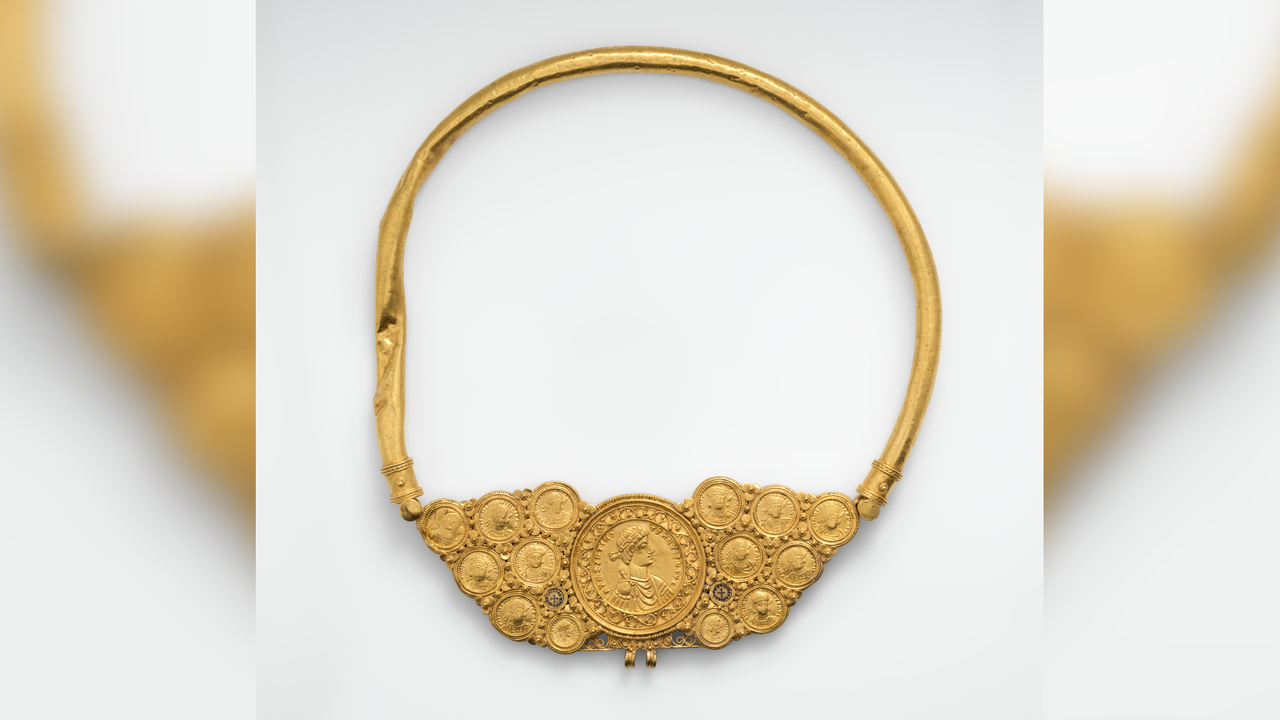
Name: Pectoral with coins
What it is: A necklace made from gold coins
Where it is from: Egypt via Constantinople (modern-day Istanbul)
When it was made: Between 539 and 550
In the early centuries of the Byzantine Empire, it was fashionable to make necklaces, bracelets, belts and rings out of gold coins to showcase one's wealth, power and association with the emperor. This pectoral, or neck ring, which was found in Egypt but was likely made in Constantinople, is "one of the most intricate pieces of gold jewelry to survive from the mid-sixth century," according to Stephanie Caruso, an assistant curator at the Art Institute of Chicago.
The gold pectoral is in the collection of the Metropolitan Museum of Art in New York City. A total of 14 gold coins and two gold discs have been set into a gold, lattice-like framework and attached to a bent gold tube to create the piece of jewelry. The pectoral weighs three-quarters of a pound (about 340 grams) and measures roughly 9.5 inches (24 centimeters) in diameter. Originally, a medallion, which is now in the collection of the Smithsonian National Museum of Asian Art, was attached to the bottom.
On each side of the large central disc are seven gold coins called "solidi" and one gold "tremissis," which was worth one-third of a solidus. These pure-gold coins were introduced in the waning days of the Roman Empire, and they were struck in a mint in Constantinople. Each solidus — from which we get the French "sou" and the Italian "soldi" — was made of 0.16 ounces (4.45 grams) of gold, which is equivalent to roughly $580 today.
Byzantine citizens who could afford to lose a solidus might turn one into a pendant with a simple loop attachment or a hole poked through it. But many coins were inset into much more complicated settings, which allowed the wearer to visually represent their connection to the emperor and to protect themselves from misfortune, as historical records suggest that coins were often used as talismans.
All of the gold coins in The Met's pectoral are relatively rare, Caruso wrote; bronze and silver coins were more common in everyday transactions. All were struck between the fourth and sixth centuries, which means someone used a collection of coins spanning more than 200 years to create the pectoral. The large, gold disc in the middle is not an official coin, but it was created to look like one, complete with an emperor figure and a fake inscription. On the back of the disc is a personification of a city, perhaps Constantinople, along with a Christian cross.
The dangling medallion part of the pectoral that's now in the Smithsonian included an official commemorative coin issued by Theodosius I, the last emperor of the Roman Empire before it split into Eastern and Western sections.
"The inclusion of an officially struck medallion attachment on The Met's pectoral suggests that this pectoral belonged to not just a wealthy individual but to someone with imperial ties," Caruso wrote. Byzantine iconography suggests that pectorals were worn by military men, so this jewelry may have belonged to a socially connected individual, such as the emperor's bodyguard.
The main point of this elaborate gold necklace, according to Caruso, was "asserting the wearer's elite status and direct connection to the imperial court while simultaneously protecting against misfortune."
For more stunning archaeological discoveries, check out our Astonishing Artifacts archives.