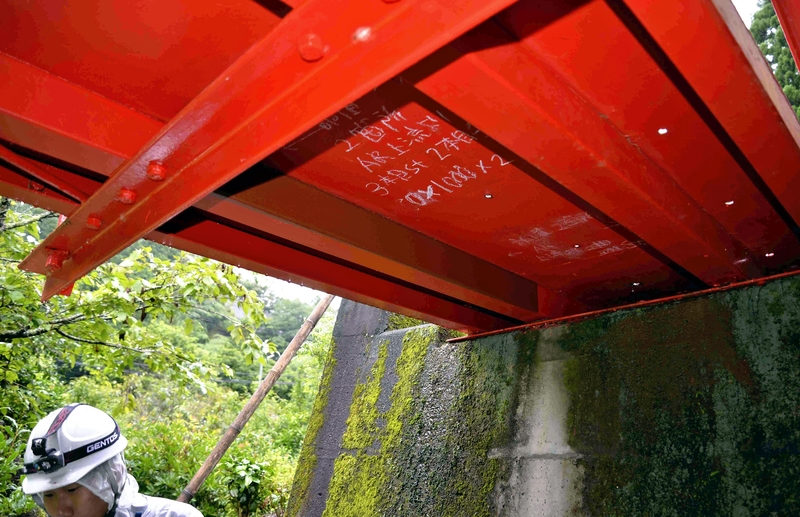
Paint containing toxic polychlorinated biphenyls (PCBs; see below) has been detected in at least 334 of the 719 large outdoor structures such as bridges examined across the nation, according to figures compiled by the Environment Ministry. However, checks on about 7,800 more structures have yet to be completed, so the number of PCB-tainted structures is certain to increase. The findings have shone a spotlight on the slow pace of checking these structures and disposing of paint containing PCBs.
This is the first time a nationwide survey has been conducted to examine PCBs in what are considered to be important infrastructure.
According to the ministry, production of PCB-containing paint started in 1966, but its use was prohibited in 1974. To gauge the extent of the remaining PCBs, the ministry had asked local governments and companies to report the numbers and other details of large structures such as bridges and water-control gates that had been painted from 1966 to 1974, and whether PCBs had been detected from the paint.
As a result, the ministry discovered PCBs could exist in the paint of as many as 8,510 structures.
The local governments and companies completed checks on 719 of the structures by the end of March 2019. Of them, a high concentration of PCBs -- over 5 grams per kilogram of paint -- was detected at 49 bridges. A low concentration, considered to be 5 grams or less per kilogram, was found at a further 285 structures, including bridges, oil tanks and water-control gates. PCB was detected at 46% of the examined structures.
PCB-containing paint used on outdoor structures could peel off as the structures age under years of exposure to the elements. The volatilization of PCBs could disperse them into the atmosphere.
Several experts have pointed out that structures where PCBs have been detected need to have their paint scraped off and repainted, but workers involved in this process face health risks. However, there have been no reports of residents living near the structures suffering any harm to their health.
The Stockholm Convention on Persistent Organic Pollutants that came into force in 2004 decided that the use of PCBs would be eliminated by 2025. Japan has established domestic legislation that required waste containing high concentrations of PCBs to be disposed of by the end of March 2023, and to complete the disposal of waste with low PCB concentrations by March 2027, such as by incineration in specialized facilities.
Despite this, little progress has been made in disposing of PCB-containing paint used on large structures. The structures mentioned in replies to the ministry's survey account for only 8% of such structures in Japan. This is partly because of the high costs and considerable time required for local governments and companies to examine the structures.
Alarmed by the approaching deadline for disposing of PCB-tainted waste, the government last month amended the law to change the boundary between high and low concentrations from 5 grams per kilogram to 100 grams per kilogram. This 20-fold expansion in the scope of what is considered low concentration is aimed at pushing back the deadline by which most PCB-containing paint must be disposed of to March 2027. Even so, it remains unclear whether disposal of all PCB waste can be completed during this period.
--Polychlorinated biphenyls (PCBs)
Man-made, oily chemical substances that have been widely used as insulating oil in indoor transformers and other equipment, and were mixed into paint to prevent corrosion of outdoor structures. Following the 1968 Kanemi oil poisoning incident in Kyushu, in which at least 14,000 people suffered skin diseases and other health problems after consuming rice bran oil that had been contaminated with a PCB, the government in 1974 legally banned, in principle, the production or further use of PCBs. However, products and structures containing PCBs from before then still remain in many places. PCBs accumulate easily in the bodies of living things and are said to be highly toxic.
Read more from The Japan News at https://japannews.yomiuri.co.jp/