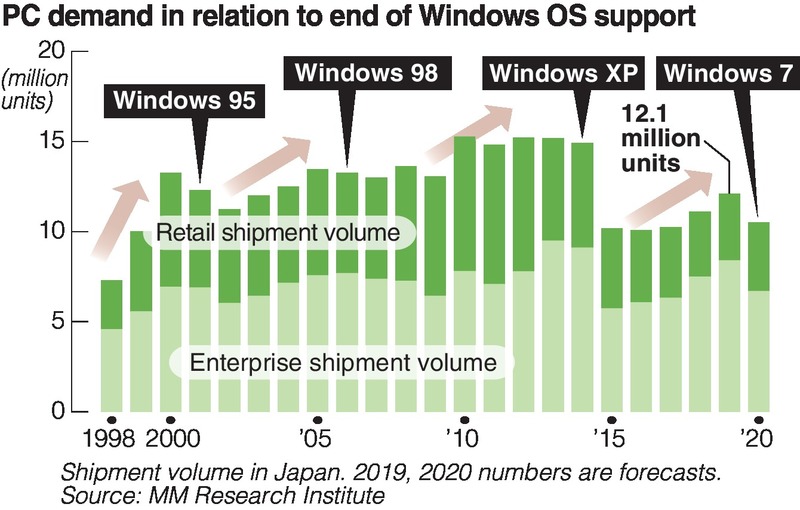
Sales of personal computers to corporate customers have been brisk in the PC market ahead of Microsoft Corp.'s planned end of support for the Windows 7 operating system in January 2020.
Companies wary of information security risks are replacing their PCs, while efforts to reform work styles have also contributed to the surge.
However, the central processing units (CPUs) at the heart of PCs are in short supply worldwide, leading to such situations as PC shortages and price hikes.
A Tokyo-based PC retailer had to inform a customer recently that a large delivery volume of a certain computer model by the end of the 2018 fiscal year would be difficult. The company said that there has been an increasing number of cases in which it has not been able to meet orders from companies and schools.
According to the business research firm MM Research Institute, Ltd., the total shipment volume of PCs in Japan in 2019 will rise 9 percent from the previous year to 12.1 million units, which would make it the third consecutive yearly increase.
Shipments to corporate customers are predicted to show a double-digit rise of 12 percent from the previous year to 8.4 million units.
Due to the spread of so-called work style reforms, the ways people work are changing, with more people, for instance, working from home. This has lead to an increase in sales of notebook PCs, which are lighter and easier to carry around.
Meanwhile, a supply shortage of CPUs made by Intel Corp. has surfaced amid the spike in demand. Intel's chips are in about 90 percent of PCs worldwide.
Since last summer, major PC manufacturers have faced supply shortages of some of their processors.
Dell Inc. of the United States said that its deliveries have been delayed by up to about two weeks.
Demand for PCs among corporate customers typically rises when support for an operating system ends, however, "demand this time was much higher than expected," an Intel executive said.
Last year, Intel announced a capital investment increase of 1 billion dollar (about 110 billion yen) and other measures to enhance its CPU production capacity. "By the end of 2019, the shortage will be resolved," said Kunimasa Suzuki, president of the Japanese unit of Intel.
But the supply shortage will likely continue for the time being, impacting PC prices.
According to business research firm BCN Inc., the average price of notebook PCs for general consumers in February was 105,000 yen -- about 10,000 yen higher than in February last year.
In contrast, the market size for consumer PCs in Japan in 2019 numbered about 3.7 million units -- less than half that of the peak in 2011 -- as the use of smartphones and tablet computers has become more widespread.
If prices of consumer PCs continue to rise, sluggish sales may further worsen.
Masaki Nakamura, operating officer and research division chief of MM Research Institute, said, "If demand rises due to last-minute purchases ahead of the consumption tax rate hike in October, it is possible that the supply shortage and price hikes will become more serious."
Read more from The Japan News at https://japannews.yomiuri.co.jp/