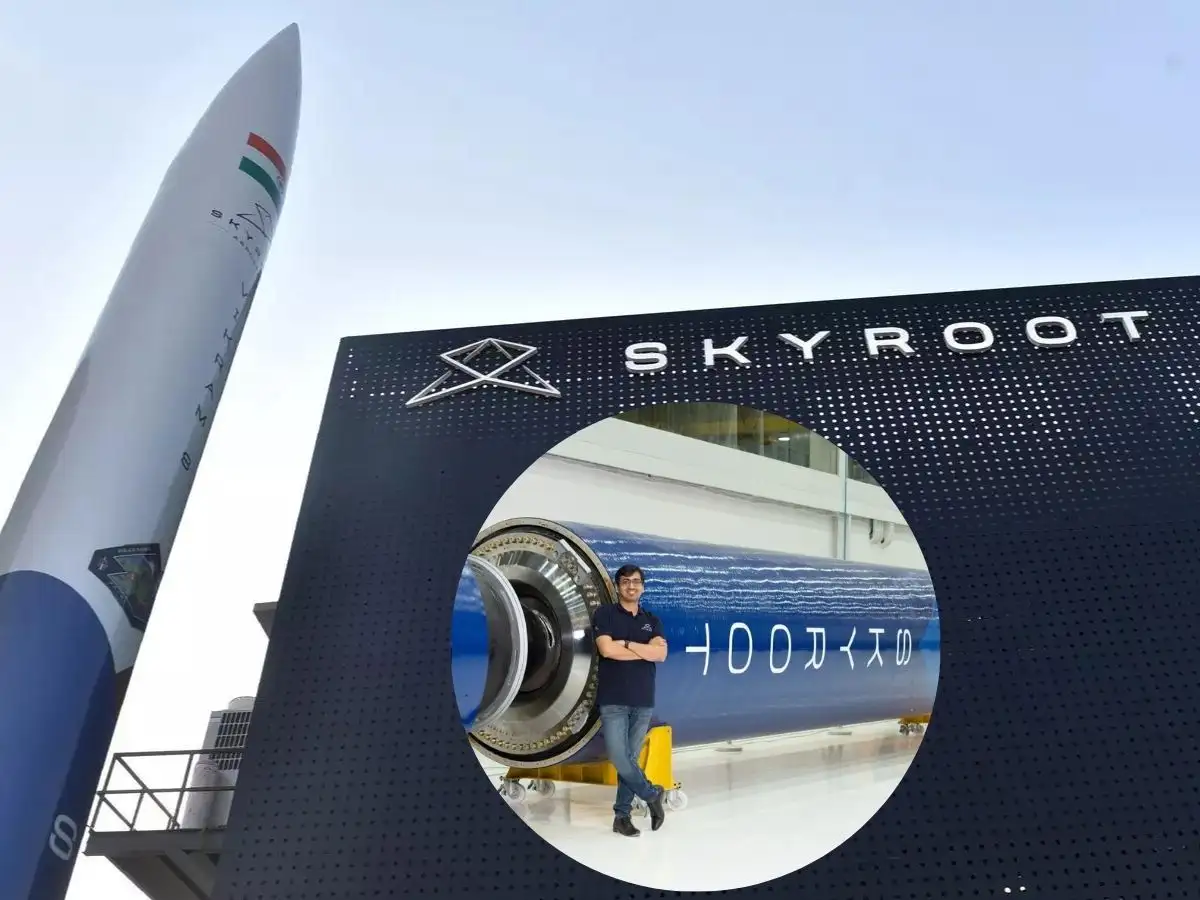
Skyroot Aerospace successfully launched Vikram-1, India's first privately built orbital rocket, on Saturday from ISRO's Satish Dhawan Space Centre in Sriharikota. The rocket successfully carried technology demonstration payloads from Indian and foreign customers into low earth orbit, along with a handwritten postcard from Prime Minister Narendra Modi that reads "Vande Mataram," postcards from scientists, engineers, and astronauts, and a micro-art payload. The Hyderabad-based company has named the launch "Mission Aagaman." Behind the rocket is Pawan Kumar Chandana, a former ISRO scientist who once struggled so badly at maths that he barely scraped a passing score in school.
Also Read: Skyroot Vikram-1 launch time: When will India's first private orbital rocket lift off?
That contrast is the whole story. A boy who feared numbers grew up to build the machine that does the most complicated maths in the country, orbital mechanics. Chandana's Skyroot is now attempting what only a handful of private companies worldwide, like Elon Musk's SpaceX and Rocket Lab, have managed: sending a self-built rocket into orbit.
Pawan Kumar Chandana, Skyroot CEO
Chandana was born in 1991 in Hyderabad, Telangana. That makes him one of the youngest founders in the world to lead a company attempting an orbital rocket launch.
Pawan Kumar Chandana Education: School was not kind to Chandana. He once scored just 51 marks in mathematics, the subject that would go on to define his entire career. His father refused to write him off and enrolled him in coaching classes for the IIT entrance exam. Somewhere in that grind, the fear of numbers turned into a fascination with them. Chandana cleared the exam on his first attempt and joined IIT Kharagpur in 2007, where he completed a dual BTech-MTech degree in Mechanical Engineering. While his classmates lined up for high-paying corporate jobs abroad, his mind stayed fixed on rockets.
Pawan Kumar Chandana Net Worth
Chandana has never publicly disclosed his personal net worth, and no verified figure exists for it. What is known is the value of the company he built: Skyroot Aerospace was valued at around $1.1 billion after raising $60 million in May 2026, in a round co-led by Sherpalo Ventures, the firm of Ram Shriram, Google's first outside investor, and Singapore's GIC. As Skyroot's co-founder, Chandana's wealth is tied closely to that valuation, even without an official personal number attached to his name.
From ISRO Scientist To Startup Founder
In 2012, Chandana joined ISRO straight out of college. The salary was modest, but he loved the work enough to imagine spending his entire career there. Over nearly six years at the Vikram Sarabhai Space Centre in Thiruvananthapuram, he worked on the GSLV Mk-III, India's heaviest launch vehicle, the S-200 solid booster for GSLV Mk-II, and later became deputy project manager for the Small Satellite Launch Vehicle. An internal innovation award followed in 2016. But an idea kept nagging at him, building a private space company in India, at a time when the law did not even allow it.
A Cold Message On LinkedIn
Chandana quit ISRO in 2018, walking away from a stable government job with no business background and no investor contacts. He cold-messaged Mukesh Bansal, founder of Myntra, CureFit, and NuRX, on LinkedIn. Bansal, a fellow IIT Kharagpur graduate, took a chance and invested $1.5 million. Then the pandemic hit, freezing further funding just as Chandana needed it most.
Also Read: Skyroot's Vikram-1 launch today: All you should know about India's first private orbital rocket
The founders of renewable energy company Greenko stepped in to keep the dream alive. In June 2018, Chandana and fellow ISRO engineer Naga Bharath Daka co-founded Skyroot Aerospace in Hyderabad. Two years later, in July 2020, the company built and tested the Raman-1, becoming the first private Indian firm to test a rocket engine, named after Nobel laureate C.V. Raman.
Skyroot's Rise, One Milestone At A Time
When India opened its space sector to private players in 2021, Skyroot was first in line, signing an MoU with ISRO and raising $51 million, India's largest deep-tech funding round at the time. On November 18, 2022, the company launched Vikram-S, India's first privately built suborbital rocket, which reached an altitude of 90 kilometres as part of "Mission Prarambh." Modi later inaugurated Skyroot's new manufacturing facility, by which point the company had grown to nearly 1,000 employees and built the country's largest private rocket-making unit.
Skyroot's Mission Aagaman
Skyroot's Vikram-1 is a four-stage rocket. "The four-stage rocket is set to launch from ISRO's Satish Dhawan Space Centre at Sriharikota," the company said. Tucked among its technical payloads are small, symbolic ones too, postcards from a Prime Minister, scientists, and astronauts, plus a piece of micro-art. It turns a highly technical mission into something more personal.
Skyroot's Vikran-1 Launch
With Vikram-1 reaching orbit successfully, Skyroot has joined an exclusive list of private companies capable of regular orbital launches, currently led by SpaceX in the United States and Rocket Lab in New Zealand. For a man who once failed to clear half marks in a maths exam, it would be a fairly large correction.