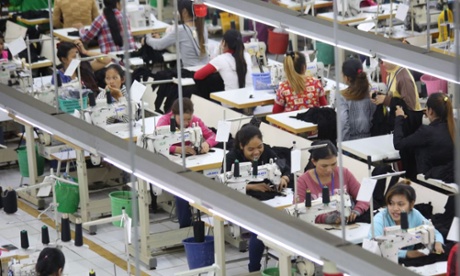
Every garment worker has the right to earn enough money to support their family and cover their living costs. Yet in some production countries, progress on fair pay has been slow, with many workers living in poverty, often suffering from poor health and malnutrition.
Widespread protests saw the minimum monthly wage for garment workers in Bangladesh rise 77% to $68 in 2013 and the Cambodian government has just agreed to a 28% rise to $128 per month. Despite this, more work is needed to close the gap between actual and fair living wages. And with fashion brands and retailers under pressure like never before to act on pay and labour conditions, a realistic pathway to change is vital.
So what does H&M define as a fair living wage and how is it setting out to make this a reality?
“Workers sit at the heart of our living wage strategy,” explains Maritha Lorentzon, H&M’s social sustainability co-ordinator. “People know what they need, so we must direct our efforts towards reaching a fair living wage as defined by workers, in addition to staying apprised of industry benchmarking.
“We wanted to make a public commitment that solidifies our position and explains how we’ll work more stringently with stakeholders to create lasting, systemic change,” continues Lorentzon. “Taking a holistic approach is integral to achieving the scale and momentum we need to make progress on this complex issue. Everyone must be engaged to make fair living wages a reality.”
Launched in 2013, the “H&M Roadmap to a fair living wage” highlights the company’s plans to collaborate with garment workers, factory owners and governments, as well as enhancing its purchasing policy. Building on H&M’s existing supplier projects, the roadmap sets clear expectations and could prove an inspiration to the wider textile industry. In particular, its top suppliers, who make 60% of its products, will be required to pay their 850,000 workers a fair living wage by 2018.
This begins with implementing the Fair Wage Method, a 12-point approach to achieving a living wage in garment factories, in three “role model” factories - one in Cambodia and two in Bangladesh. H&M will help factory owners go beyond respecting minimum wages and correctly compensating for overtime to take into account a worker’s skill level. In 2015, the company will extend this support to 70 factories in Cambodia, Bangladesh and China.
For its part, H&M will improve its purchasing practices to enable suppliers to pay workers a fair wage. Its buyers will seek information on labour costs when negotiating orders and enhance their forecasting to reduce peaks in production. Pay will also be high on the agenda of ongoing “social dialogues” with suppliers. By 2018, H&M wants all its suppliers to be able to show that democratically elected workers committees are genuinely representing workers’ interests.
“We’re increasingly surveying workers’ perceptions of living wages and how this compares with their actual earnings, and encouraging open debate on what incentives and bonuses should look like,” says Lorentzon. “Developing a fairer, transparent pay structure and involving workers in wage discussions will promote more efficient working and open the door for discussions on other important topics, like labour conditions.”
Education is one of the fundamental ways in which H&M plans to empower garment workers in its supply chain. Through a new Centre of Excellence, a joint initiative with the International Labour Organisation (ILO) and the Swedish International Development Cooperation Agency (SIDA), workers in Bangladesh will – for the first time – be able to gain a certification that proves their level of experience.
H&M will support the Centre of Excellence with both funding and knowledge gained through its former Bangladesh Training School, and aims to train 5,000 students by 2016. It will also help suppliers to take ownership of their own training schemes at a factory level.
“In Bangladesh, a skilled worker joining another factory may be asked to start again at the lowest pay grade,” explains Lorentzon. “Equally, achieving a pay rise is tough without evidence of a higher skill level. We hope that this will catalyse a wider movement to help workers obtain the wages they deserve through objective, nationally recognised certifications, supported by governments.”
Further, policymakers have a central role to play in influencing the wider system to ensure that all workers – not just those in H&M’s supplier factories – are paid fairly, according to Lorentzon.
“Governments have the power to create the legal framework through which wage discussions can take place,” she says. “Our roadmap shows our support and commitment to remain in production countries while clarifying our intention to encourage policymakers to identify a fair living wage level, establish legal minimums and review wages annually.”
Increasingly, H&M sees collaboration with competitors as a vital way forward, and is already working with 14 brands on an “enabling principles” project to develop a dialogue on fair living wages. Through this and other formal collaborations like the Fair Wage Network, the company will bring its ideas, experience and best practice to the table.
“We can’t do this alone,” concludes Lorentzon. “Brand collaboration is all important and we hope to inspire other companies so that we can make real, industry-wide progress on this issue – together.”
Katharine Earley is a sustainability copywriter and journalist interested in social impact, supply chain and the circular economy.
Content on this page is paid for and produced to a brief agreed with
H&M, sponsor of the sustainable fashion hub.
More from the H&M partner zone:



.png?w=600)