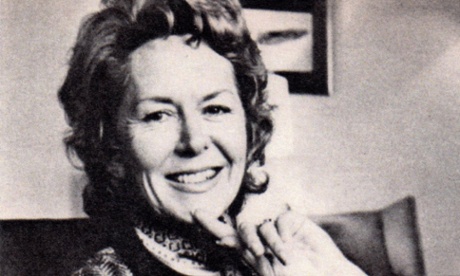
Pauline Neville, who has died aged 91, was one of those novelists who inspired something close to adoration in her regular readers but who never won a big award. She was greatly admired, too, by fellow writers, who recognised her seriousness of purpose and her honesty. Nothing in her work was ever there for cheap effect.
Neville grew up in the lowlands of Scotland between the two world wars, and retraced these years in her first and best-known work, In My Father’s House (1969). It tells of the relationship of a clergyman to his parish, of children growing up in rural surroundings, and of the binding influence of the family dog. Its follow-up, Peggy (1999), which was shortlisted for the JR Ackerley prize, explored the author’s personal connections with Northern Ireland, where she often spent family holidays, through an account of two cousins spending time there against the ever-present background of political restlessness.
Elements of memoir are strong in all Neville’s books, though she tended to camouflage them in fiction. Voyage of a Life (1971), The Cousins (1973), Blackwater (1974), and her last novel, Double Vision (2002), all drew on aspects of her personal life and reflected something of the travel lust that was apparent in her middle years. Voyage of a Life and Double Vision are about sea journeys, the first to Africa and the second to Crete, where its heroine tries to make contact with ancient Minoan culture.
Once she had established herself as an author, Neville devoted much of her time from the 1970s onwards to becoming an active supporter of English PEN, a writers’ association that campaigns to defend authors whose freedom of expression is at risk. Encouraged by Ronald Harwood and Antonia Fraser, both presidents of English PEN, she joined the Writers in Prison Committee and at once set about creating a scheme for getting books to incarcerated authors. It was not always successful, but Neville never accepted defeat and as a result the morale of countless prisoners – including Václav Havel, Jack Mapanje and Ken Saro-Wiwa – was raised by the occasional receipt of books that she had organised for them. She also arranged for many prisoners to receive Christmas cards.
Born in Crossmichael, Kirkcudbrightshire, Neville was a daughter of the manse. Her father, James Fisher, was a Church of Scotland minister, an intellectual who encouraged his daughter to read, and her mother, Marjory (nee Pawling), a capable overseer of the family home, also instilled in her a love of books, for she was a descendant of the founders of Mudie’s Lending Library, Victorian pioneers of the public borrowing of reading matter.
Pauline was sent away to school, first to St Trinnean’s in Edinburgh (which gave its name to Ronald Searle’s St Trinian’s school cartoons) and later to Queen Anne’s in Caversham, Berkshire. She became an ambulance driver, a model (she was a strikingly handsome woman) and an art student. Having married a soldier, Michael Forrester, in 1947, she was with him on his postings to Washington and the hotspots of the day, Cyprus and Kenya. After their divorce she married Richard Neville, an adviser in the City, in 1960. Her main creative outlet up to that point had been painting, usually of landscapes, but by the late 1960s she had turned to writing, encouraged by Christopher Sinclair-Stevenson of the publishers Hamish Hamilton, who brought out her first book, In My Father’s House.
Neville continued to be active in English PEN until well into her 80s, reporting on conferences and advising on policy. In 1995 she was part of a small mission to Ghana, establishing links with writers and amazing everyone with her delight in dancing to the local highlife music.
Richard died in 1980. She is survived by two sons, Simon and Nick, from her first marriage.
• Pauline Margaret Clara Neville, author, born 23 April 1924; died 3 October 2015