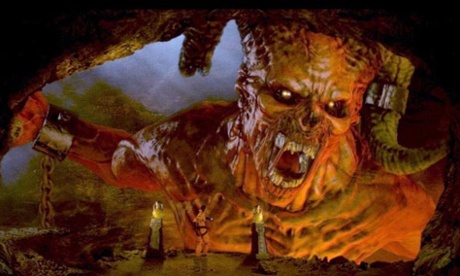
What is it about being underground that frightens us so much? A fear of confinement or something more deeply rooted? Nearly all ancient cultures, and certainly the world’s major religions, have told us that hell is, literally, beneath our feet, a place where souls will be tortured and tormented for all eternity by Satan and his demonic minions. A large part of my new book, Killing Sound, is spent underground (the London Underground, to be precise) and was inspired by a quote I read about it from 1860: ‘The forthcoming end of the world would be hastened by the construction of underground railways burrowing into infernal regions and thereby disturbing the devil’.
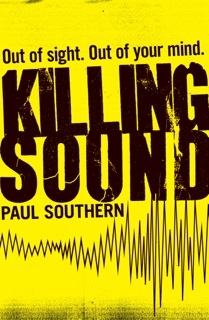
Trudging down the dark, disused Tube lines with just a halo of torchlight to guide me, and with temperatures and winds falling and rising inexplicably around me, it was easy to imagine this. There is something hellish about the place. And, whether or not you believe the devil still rides the Underground, the writer was correct in at least one respect: something does get disturbed down there – your imagination, the source of all our fears. You see, something was lurking in that vault of blackness. Any second, I expected hands (or, worse, tentacles) from some imaginable horror to come snaking out and grab me…
So here we have it, then: a top ten list of Underground Menaces (some a little scarier than others, but all takes on the same dread theme).
1. Satan.
Surely the greatest of all underground menaces, the ultimate bad guy, and star of many a Hollywood film. He comes in various guises – a pillar of fire, a cherub with wings, a horned demon, and even human form – but always exhibits the same disregard for others. He rails a lot against God and is very jealous of men. His finest literary moment is probably Milton’s Paradise Lost (a very long poem which children don’t read unless they’re forced to – try Phillip Pullman’s His Dark Materials trilogy instead), but his most popular could be South Park’s excellently subversive Damien episode, where he squares off with Jesus in a boxing match. Definitely a menace to be avoided.
2. The ‘moon plant’ in John Christopher’s The Lotus Caves
Marty and Steve live on the surface of the moon in a protected environment called the Bubble. One day, they find the journal of one of the original settlers, which mentions a curious flower growing on the surface. As boys do, they steal a lunar vehicle and attempt to find it, crashing through the surface of the moon in the process. Here, they find the original settler living in caves with a large, sentient plant. It has a soporific effect on them all (much as the Lotus plants do in Homer’s The Odyssey). The chief threat of the plant comes from this inertia, which is a prescient thought considering how drugs and the internet have sedated (young) people now (and stopped them figuratively crashing through the surface of moons and exploring the outside world). Christopher’s novel is a beguiling, psychedelic sci-fi that touches upon the nature of freedom and responsibility.
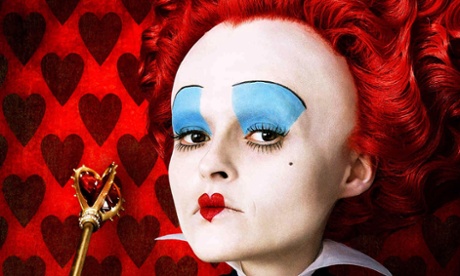
3. The Queen of Hearts in Lewis Carroll’s Alice in Wonderland
Aggressive women who habitually yell at you are not just a feature of our homes and town centres. They can be found at the bottom of rabbit holes, too. Lewis Carroll’s Queen of Hearts cuts a truly menacing and despotic figure. Carroll himself described her as ‘a blind and aimless Fury’, and even amidst the surreal nonsense that goes on in Wonderland, there is something dangerous about that. Anyone who crosses her is likely to be met with an ‘Off with his/her head!’ Like all good children’s books, Alice in Wonderland’s surrealism masks a genuinely frightening and savage reality.
4. The Morlocks in H.G. Wells’s The Time Machine
The Time Machine is one of the most influential sci-fi books ever written. It’s also home to one of its scariest underground villains. The Morlocks are ape-like troglodytes who terrorise the passive Eloi on the surface of the Earth. We find out they are the descendants of human beings who’d been driven underground to work for the Eloi, in a division of labour Marx couldn’t have foreseen. Now, they have the upper hand. When the Time Traveller’s Time Machine goes missing, he is forced to descend into the underworld to get his machine back. Rather him than me.
5. The prehistoric creatures of Jules Verne’s Journey to the Centre of the Earth
There are no actual dinosaurs in Verne’s book, as palaeontology hadn’t yet caught on, but it was hugely influential on dinosaur books to follow, notably Sir Arthur Conan Doyle’s The Lost World. Axel and his uncle, Professor Otto Lidenbrock, come across a group of fearful marine monsters, ‘more hideous in the reality than in [a] dream’, a herd of mastodons, giant insects and mighty birds after discovering a passageway into the centre of the earth. They escape from them spectacularly though a blowhole in the side of a volcano.
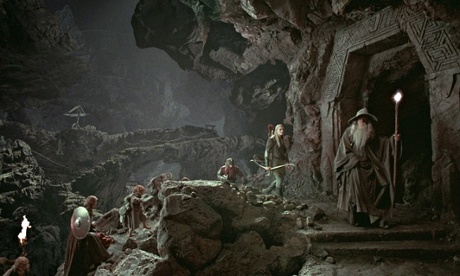
6. The Balrog in The Fellowship of the Ring by J. R. R. Tolkien
This fire demon of the ancient world has driven the dwarves from Moria and now threatens the fellowship. Tolkien rightly doesn’t spend a lot of time describing it, but rather lets our imagination, and the reactions of the characters to it, do the work. Peter Jackson recreates this brilliantly in the film, when we are given an aerial shot of hundreds of orcs scaling a cavernous underground hall to get out of its way. The balrog’s confrontation with Gandalf at the bridge of Khazad-Dum is one of the highlight reels of The Lord of the Rings. As a child, the ‘drums in the deep’ line filled me with every kind of primordial fear. It still does.
7. The Minotaur in the labyrinth
One of the best loved Greek myths, the story of Theseus’s duel with the Minotaur has everything going for it: a dread half-man, half-bull (born of Minos’s wife and a white bull – you can only imagine); a labyrinthine maze; a handsome hero; and a beautiful girl who gives him a sword and a ball of thread so he can fight it and find his way out. After all the fighting, you’d think Theseus and Ariadne would have sailed off into the sunset but Homer suggests she was already married (it happened then, too). As underground menaces go, this rates very highly, particularly if you were one of the fourteen Athenian youths sent down the labyrinth as sacrifices.
8. The ‘children of Paul’ in John Blackburn’s Children of the Night
I read Blackburn’s book when I was about ten. A series of unexplained deaths in the English village of Dunstonholme has the villagers literally looking beneath their feet for answers. Although ancient evils are always being awoken, Blackburn gives this one a really convincing feel with secret cults, Satanism and local legends. When children with lethal, telepathic powers start to creep out of the ground, the whole village looks doomed. Shades of John Wyndham’s The Midwich Cuckoos but great fun.
9. The ‘swine-things’ in William Hope Hodgson’s The House on the Borderland
Hodgson was a remarkably imaginative writer. He threw in science fiction, the occult and horror and trod the twilit realm between reality and fantasy. The House on the Borderland is a work of sustained brilliance. Humanoid, pig-like creatures living in a huge chasm under the Recluse’s house, emerge from out of a pit at the side of it. Their attack on the property had me reaching for my rifle. I would have filled the pit in with tons of cement immediately afterwards but the Recluse decides to investigate (albeit with his dog Pepper) to see where the creatures are coming from. Needless to say, there is worse down there. Terrifying.
10. Stephen King’s It.
Stephen King is one of only two novelists to have made me cry, and not because of the book length (It comes in at a whopping 1138 pages), but his often overlooked depiction of childhood, its traumas and travails and loss of innocence. Indeed, despite his ‘king of horror’ status, King excels at bildungsroman. It’s horror is made more chilling by the fact that so many of the victims are children. Pennywise the clown (really a monstrous entity) lurks in sewers beneath the town of Derry (Maine) and from there lures them to their doom. When Georgie Denbrough sees his paper boat go down a storm drain, you know something bad is going to happen. What eventually does affects the whole town and haunts a group of six misfit children (the ‘Losers Club’) into adulthood. Sewers are custom built for horror – they’re dank and dark and dangerous - and King furnishes his with one of the most memorable and frightening underground menaces. Pennywise’s ‘We all float down here’ has become part of horror movie folklore.