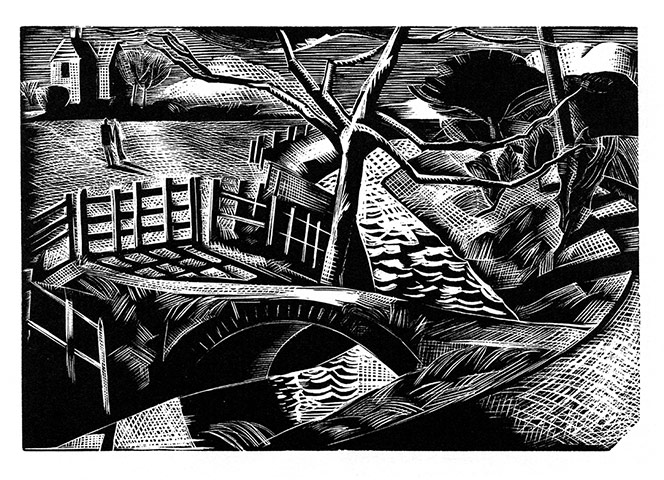
In the 1920s and 30s Paul Nash captured an age-old idea of England steeped in mystery and magic, in the forward-thinking language of modern art. His paintings of rural Britain’s standing stones, lonely copses and grassed-over forts are full of eerie surrealist expanses, jarring juxtapositions and semi-abstract forms. Clare Neilson’s collection of his work – including illustrated books, wood engravings, photos and letters – provides an engaging insight into his evolving passions. Neilson became friends with Nash when he lived in Rye; his Tyger Tyger uses a photo of a ruin in the forest and bears the words “collage for Clare”.
Pallant House Gallery, to 30 Jun
RC Photograph: PR
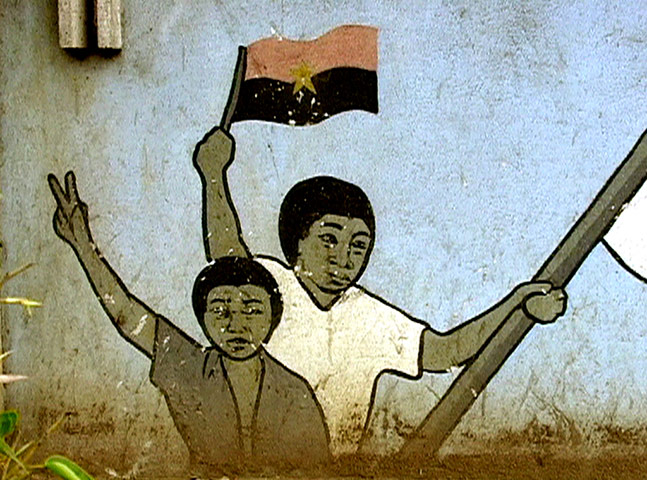
Subtitled What Do You Do With Your Revolution Once You’ve Got It, this exhibition tackles the problems of post-revolutionary politics worldwide. Most of the work takes an oblique angle, this after all being art rather than political documentary. Eoghan McTigue’s photographic installation Empty Sign might initially appear to use images of the Paris Commune flag, but it turns out to be a far less politically obvious picture of the noticeboard from Queen’s University Belfast after being cleared of any notices, politically inflammatory or not, by the artist. Sarah Pierce goes further by piling up the empty paint tins and shredded packaging left over after the work of the other artists was installed.
Cornerhouse, to 18 Aug
RC Photograph: PR
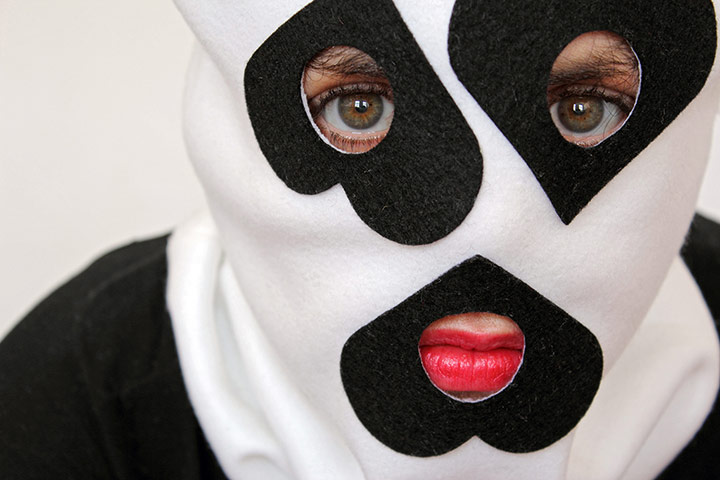
EC Davies presents her documentation of the lives of rather eccentric characters, all of whom turn out to be herself dolled up in shape-shifting disguises. Her protagonists hoard objects of sentimental value: one samples voice recordings from films, another amasses fortune cookies. The dress sense tends towards art-college chic: intimidating balaclavas worn with fancy dresses. Pretend museum displays, photographs, videos, animations, and the sort of sad sewn objects you find in charity shops all convey a futile loneliness. Or could it be a playful metaphor for the solitary make-believe that is the common artist’s lot?
Vane, Sat 13 Apr to 18 May
RC Photograph: PR
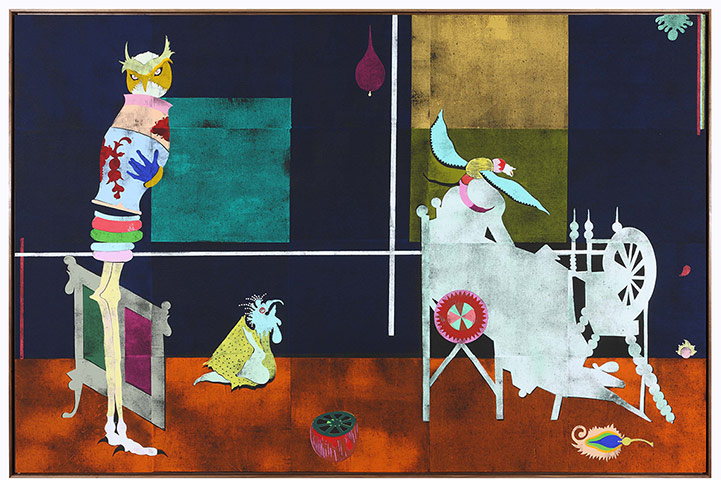
Transylvanian twins Gert & Uwe Tobias’s art is full of bugs and beasties, grinning carnival masks and bulging eyes that nod to their homeland’s folklore, Hieronymus Bosch and old horror movies. While as creepy and comic as a turn by Bela Lugosi, it’s masterfully constructed and utterly seductive. Working across woodblock prints, painted etchings, ceramics, collage and “typewriter drawings”, the brothers fuse their spooky material with abstract imagery harking back to modernist painters such as Malevich, Miró or Mondrian, plus a graphic elegance that recalls communist poster design. They create a private world of shared references that’s all their own.
Whitechapel Gallery, E1, Tue 16 Apr to 14 Jun
SS Photograph: PR

Hugo Canoilas freely plunders techniques and styles in installations that might encompass both figurative and abstract paintings, video monitors, cryptic performances, sound loops and – in one recent case – an 18th-century carved wooden boat on loan from the São Paulo City Museum. The overall effect, like so much Portuguese art, is mixed-media poetry; a collective set-up of fragmented images that viewers are seduced into making some kind of sense of according to their own personal inclinations.
Workplace Gallery, to 4 May
RC Photograph: PR
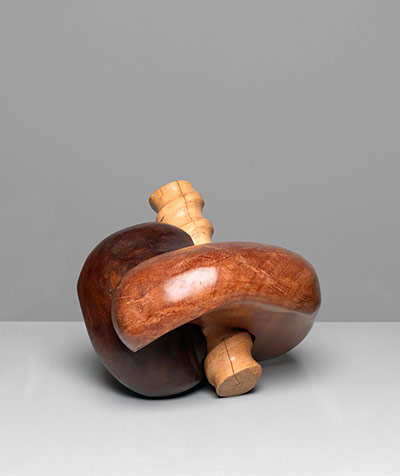
There’s a fascinating fusion of forms and influences in the art of Beirut-based trailblazer Choucair. Stone and wood hewn into curvy interlocking shapes slot together to make slender blocks or tottering towers, and a sense of order and freeform organic energy pervades her paintings too, from chunky nudes to pure abstraction. Now aged 97, Choucair’s vision is steeped in her local urban landscape and the European modernism she discovered studying in 1940s Paris. Le Corbusier’s modular units and her friend and tutor Ferdinand Léger’s machine-age brand of cubism made their mark on her imagination, alongside the crisp geometries of the Dar al Sayad office block back home.
Tate Modern, SE1, Wed 17 Apr to 20 Oct
SS Photograph: PR
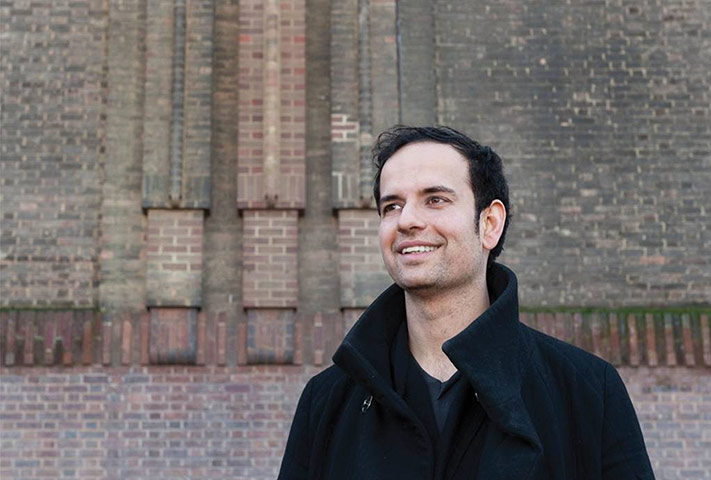
Following his massively popular These Associations in Tate Modern’s Turbine Hall last year, Tino Sehgal brings his touring piece This Situation to the IMMA’s temporary space at the National Concert Hall, Earlsfort Terrace. Trained in both the complexities of political economics and the spatial intricacies of dance design, Sehgal appears to have an extraordinary knack for staging situations that break down public inhibitions and catalyse moments of mutually shared intrigue. Here, a group of six specially selected “interpreters” will continuously engage visitors in meticulously choreographed yet open-ended discussions about art, culture and the meaning of life in general. Refusing to record the event, Sehgal preserves its transitory magic.
Irish Museum Of Modern Art, National Concert Hall, to 19 May
RC Photograph: PR
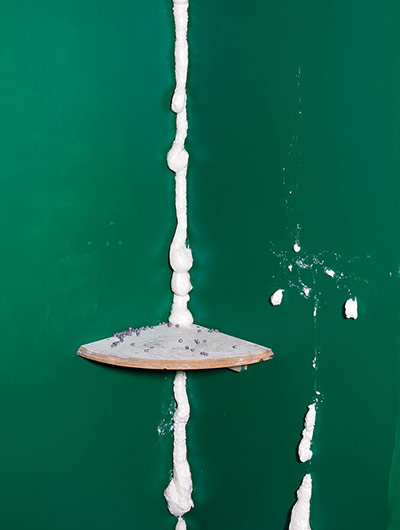
Anne Hardy’s photos capture windowless spaces with stories to tell, such as underground cells, control rooms, bunkers and basement clubs. They look festive and messy, like the aftermath of some monumental knees-up; the last party, perhaps, at the end of the world. It’s all a fiction: these are not rooms at all but sets meticulously created in Hardy’s studio with street finds, DIY and charity shop bric-a-brac. Here this includes a strip-lit wall, coated in brown paper and apparently decorated with mobiles made from old bottles and balloons. But are those targets and bullet holes? Not party decor then, but a secret shooting range. Meanwhile, in the gallery upstairs, for the first time Hardy has created an installation giving us the chance to experience her sinister habitats up close.
Maureen Paley, E2, to 26 May
SS Photograph: PR