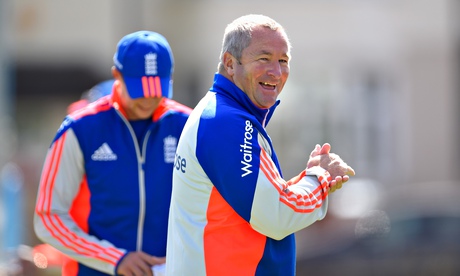
During the handshakes that followed England’s thrilling but ultimately failed run chase at The Oval on Friday night, Paul Farbrace, their interim head coach whose detractors are yet to be identified, and New Zealand’s Brendon McCullum, the much-praised evangelist of aggressive cricket, shared a word.
“It’s going to be a great series,” the tourists’ captain told his rival, after New Zealand held their nerve for a 13-run rain-affected win that means the two teams go into Sunday’s third one-day international in Southampton all square. “I hope so,” replied Farbrace, who said he was as proud of his side’s attempted pursuit of 399 as he was their record‑breaking 408 for nine at Edgbaston on Tuesday.
“We’re not getting too deep with our thinking and planning, we’re just talking about playing with great intent in everything we do,” Farbrace said after the defeat. “So far, it has been exciting. The first game, everyone got carried away but we didn’t. And still the mood is quite upbeat now because we feel we’re making progress.”
The bowlers could be forgiven for wanting a calmer third instalment on the south coast, with 1,369 runs having been scored in two matches with New Zealand’s left-arm seamer Trent Boult being the sole propeller of white leather to go at less than six runs an over. The likelihood is that with both sets of batsman seemingly hard-wired to attack from the outset we will witness another high-scoring encounter.
It was on this ground two years ago that, until Friday night’s 398 for five, England suffered their costliest innings in the field on home soil, with Martin Guptill’s unbeaten 189 propelling the tourists to 359 for three and, ultimately, an 86-run victory. Any scarring from that day should be minimal however, with Eoin Morgan, Joe Root and Jos Buttler the sole survivors from that shellacking.
England, unchanged for the first two games of this series, lost two players to injury on Saturday: Chris Jordan (side strain) and Liam Plunkett (thigh strain). It means the team management should turn to the Northamptonshire all-rounder David Willey, fresh from scoring 60 from 27 balls and taking two wickets in the NatWest T20 Blast win over Derbyshire on Thursday night, and Mark Wood, sufficiently rested following back-to-back Test matches. Somerset’s 21-year-old seamer Craig Overton was called up on Saturday to provide a reserve option, while a replacement for Plunkett will be named on Sunday.
Jordan may welcome the break after his nine overs went for three runs shy of a century – even if his removal of Grant Elliott lbw, using the lesser-spotted delivery known as the yorker, was arguably the smartest piece of bowling on the night at the Oval.
With possible showers forecast, the match officials may yet again be reaching for the Duckworth-Lewis charts that played such a prominent role on Friday and led Morgan calling for the equations to be looked into in light of the fielding restrictions that now means sides regularly post stratospheric totals.
Morgan’s grumble will fall on deaf ears, however, with such a revision having already taken place. The official title of the number-crunching system is now Duckworth-Lewis-Stern following the input of the Australian academic Steve Stern, who helped modify the mathematics before the World Cup to factor in the modern trend of free-scoring one-day sides.
What cost England – and meant 54 runs required from 37 deliveries became 34 from 13 after a 45-minute rain delay – was that they were slow in bowling their overs and were seven down when the heavens opened. Getting a move on in the field and protecting one’s wicket remain essential virtues in this sport.
There was no such annoyance from Farbrace, who continues to view the game, come rain or shine, through the most positive of prisms. “I don’t think we’ll worry too much about that,” he said. “When you lose wickets, you know Duckworth-Lewis goes against you. Our sole focus is what we can do and what we can achieve. The exciting thing was how well we played and kept going at such a decent pace.”
The former Sri Lanka coach, who will drop down to the role of assistant when Trevor Bayliss arrives in 10 days’ time, is similarly upbeat about the efforts of his bowlers and is not among the growing number who believes permitting four fielders outside the circle – a rule that will come under review by the International Cricket Council later this year – has created too great an imbalance between bat and ball.
“The skilful bowlers are still taking wickets. Boult is very skilful and has bowled brilliantly in both games,” he said. “The batsmen have taken the game on and it’s up to the bowlers to try to match it skill for skill. When Twenty20 started, batters dominated. But then bowlers learned to bowl wide yorkers, slower balls, from back of the hand.
“Every aspect of the game is getting more skilful as people are seeing what they are capable of achieving. I think the bowlers will catch up and it will be up to the batters to take it on again.”
England (probable) A Hales, J Roy, J Root, E Morgan (capt), B Stokes, J Buttler (wkt), S Billings, D Willey, A Rashid, M Wood, S Finn
New Zealand (probable) M Guptill, B McCullum (capt), K Williamson, R Taylor, G Elliott, M Santner, L Ronchi (wkt), N McCullum, T Southee, M McClenaghan, T Boult
Umpires B Oxenford (Aus) and T Robinson (Eng)
Third umpire S Davis (Aus)