Most of us have been there: that seemingly innocent meeting, which is specifically, yet cunningly designed to allow two people, who have never met before to get to know one another on the off chance that they just might subsequently enjoy a long and fruitful relationship together. All too often the matchmaker’s best intentions end in disaster. But not always.
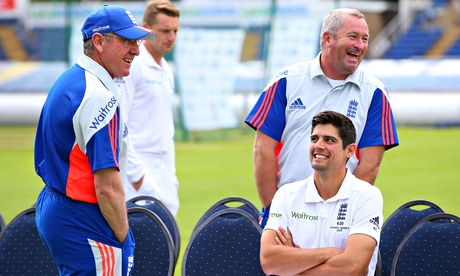
Paul Farbrace, England’s assistant coach, briefly found himself in this role while on a recent working holiday on the continent. “I thought I would have to be a bit of a matchmaker in Spain, said Farbrace at an event for Ashes sponsors Hardys of the time when Alastair Cook and Trevor Bayliss began to swap notes. “But actually they are such easy-going blokes that it was never going to be a difficult job. They genuinely do get on very well because they’re such down-to-earth people.” Currently it does not seem like a fleeting holiday romance. Back in this country it’s still going swimmingly.
English cricket has been this way before – without the obvious use of a matchmaker. In 1999 Nasser Hussain and Duncan Fletcher would have struggled to recognise one another in the street. Yet they were thrown together as captain and coach at the end of a calamitous summer and the relationship worked from the start. It seems that Cook and Bayliss are also getting along fine (though a 169-run victory over Australia probably works even better than a shared bottle of the finest champagne when breaking the ice).
Farbrace, still in the Cilla Black role, offers further confirmation: “Cookie and Trev actually complement one another nicely. Trev is positive in everything he does even if he doesn’t necessarily appear that way. He’s someone who wants the game to move forward at pace – and I think he’ll give Cookie a decent nudge along the way. The two of them have started really well together, right from Spain. There was obviously some hesitancy going there. What Trevor did really well was that he fitted into what we’d been doing as opposed to everyone else having to try to fit into him. He isn’t that sort of bloke. He’ll do his work quietly and pick people off one at a time.”
At first glance and from the glowing references that everyone delivers about Bayliss, he is “the anti-coach coach”. This must be one reason why even Shane Warne rates him so highly.
Cricket teams run best when the captain is obviously in charge with the coach helping, prodding and picking up the pieces wherever necessary. That was how Fletcher worked; it was also the pattern when Andy Flower began with Andrew Strauss. The coach’s input might be all-encompassing yet it often remained clandestine.
Farbrace, who was qualified for the matchmaker’s role because he knows Bayliss so well from his time as his assistant with Sri Lanka, explains how Strauss, England’s new cricket director, was adamant the captain should impose himself at the start of the summer. “In the New Zealand series Straussy was very keen that none of the support staff should try to be the head coach. It was Cooky to run the show and he did that really well. He [Cook] said he wanted us to stop talking about scrapping and fighting and take that as a given. It was now time to show our skills, for the players to express themselves and enjoy playing for England, to play with a bit of freedom.”
Captains often say stuff like that. It’s quite rare for it to actually come to pass out on the field, which was the case in Cardiff. There a few cagey onlookers were saying of Cook’s side in their second innings: “OK, a bit of freedom is fine but not total abandon, please.”
Farbrace confirms that Bayliss wants his teams “to fight fire with fire” despite the Australian’s impenetrable, almost passive demeanour. “His calmness is his biggest thing”, says Farbrace. “In the winter after a tight match for the Sydney Sixers I saw Brad Haddin the next day and said to him: ‘Trev was looking really excited yesterday in the dugout – he actually pushed his glasses up his nose at one point.’”
So it may not be an overtly passionate affair between Bayliss and Cook and the rest of the England players, but the relationship seems to be working rather well so far. If Farbrace really was a matchmaker he can puff his chest out with pride. But he denies much input to the Bayliss acquisition: “I’d love to take all the credit, but I can’t really. Apart from putting them in touch right at the start of the process I had no involvement whatsoever.”
At the moment Bayliss may be the only Australian in this country purring about how the series is going. His opposite number, Darren Lehmann, has some decisions to ponder, principally whether to stick with Shane Watson at six or to replace him with Mitchell Marsh. Lehmann can also do blunt common sense: “We are not going to panic. Our lead-in was perfect for that Cardiff pitch – with the West Indies slow and then two tour games on slow pitches – so I can’t complain about that. The simple fact is they outplayed us and we didn’t play as we can.”