Of all the different ways in which the centenary of the start of the first world war was commemorated this year, none struck a chord with the public quite so powerfully as the tide of scarlet poppies spilling into the moat of the Tower of London. The installation, Blood Swept Lands and Seas of Red, drew crowds of 4 to 5 million, with people standing six deep around the tower’s moat to catch a glimpse of the display in its final weeks.
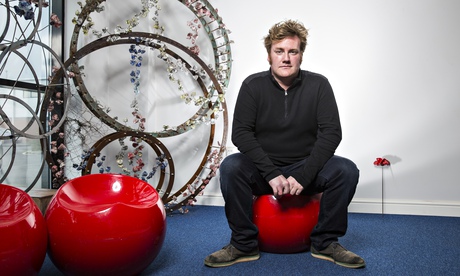
I meet Paul Cummins, the poppies’ designer and creator, at his studio on a trading estate in Derby in late November. A former architect, his only previous major ceramic project was the English Flower Garden series he made for the Cultural Olympiad in 2012, in which models of non-indigenous flowers of Britain represented the diversity of the country today. Symbolism is clearly very important to the artist: “Everything I do is based around flowers,” he tells me, “and I won’t do something unless there is meaning behind it.”
The idea of the poppies came to him in his local library a few years ago when he found the line “Blood Swept Lands and Seas of Red” in a will written by an unknown Derbyshire soldier in Flanders, 1914. He knew instantly “it could be translated into something. I contacted the War Graves Committee to see how many people had died at the front, and it came to 888,246. I wanted to visualise that number in a way that meant more to people. I then had to find a space big enough, so I rang the Tower of London and explained exactly what I wanted to do. It took them two or three weeks to come back to me and say yes, but it all kicked off from there.”
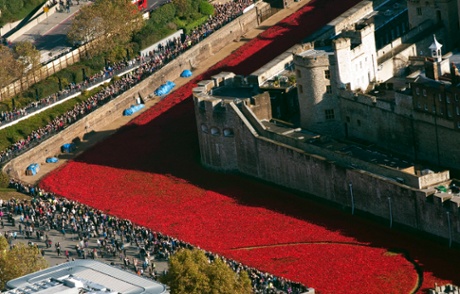
A key goal of the project was to raise money for six military charities by selling the poppies, and by late October, all of them had been bought at £25 each, raising £10m. “I was surprised by how much the public took it to heart,” Cummins says. “But people could relate to it because it’s such a simple idea. I don’t believe art should be pretentious, it should be accessible to everybody so they can relate to it in their own way,” he adds, in a nod to the critics who thought the installation too simplistic.
What about those who felt it had undercurrents of nationalism? “The figure [888,246] represents not just British people [who died] but the whole old Empire: Rhodesia, India, Australia, Canada…”. He pulls out his phone and shows me a photo of a world map covered in red dots – this time, signifying where all the volunteers who planted and dismantled the poppies travelled from (countries as disparate as Brazil, Iceland, Japan and Russia are marked).
“The thing that made it for me was the volunteers and their stories, actually. The people I spoke to were either current or former members of the forces, or remember people who were in the forces, or had grandfathers who were in the first world war. A lot of them were quite emotional about what the installation meant to them.”
After the first poppy was planted on 17 July, the installation continued to take shape until Armistice Day, when the last one was put in place. Fifteen hours later the display started being dismantled, and although there was significant demand to keep the poppies displayed, Cummins is adamant it had to end then: “Over time, people would either get bored of it, or it would turn into a tourist attraction… But it was there to represent the people who died, and because of what each poppy signifies, I won’t make any more.”
It took 300 people just over a year to make all the poppies using as little machinery as possible. “It was the electric machinery that took my hand,” Cummins says, referring to the accident he had in April. “I was rolling clay, my top got caught and my hand went in – one of the guards wasn’t on so my fingers were flattened, like in Who Framed Roger Rabbit?.” The middle finger from his right hand had to be amputated – which, as an artist, must have been devastating. “I’m not sure what I felt about it at the time – I didn’t actually feel any pain because it crushed all the nerves in my fingers. I’m still making things, I just can’t throw a wheel yet until my ring finger’s been fixed.” (Later, he shows me the type of machine that did it with a chuckle, as if pointing out a mischievous child.)
Coming next for Cummins are projects in the UK and Europe (he is tight-lipped about the details), working on his PhD at the University of Derby, and, if rumours are to be believed, an OBE: “Touch wood – we’ll see what happens,” he says. He seems somehow detached from the whole year, as if not quite believing it all happened to him. “To see an idea from three years ago come to fruition, and to see what everybody feels about it…” he pauses. “It hasn’t sunk in yet, to be honest, and it probably won’t for a long time.”