I have a fascination with the human voice which borders on obsession. It has driven my work as a composer, musician and teacher, and it has driven my personal life – all my girlfriends were singers, as was my wife, dearest Maria Huesca. I’ve written 16 operas, all exploring different aspects of voice, music and language. Often writing my own words, language has often been crucial to my storytelling. So I have written about ancient Mexico in Náhuatl (in La Malinche), with the original words of real Japanese concubines during the 11th-century Heian period (in The Pillow Song), and with Homer’s classical Greek in his story of the Sirens (in The Sirens and the Sea), as well as with several modern languages. Interestingly, audiences always seemed to understand the story and the characters, whatever language was sung.
So, in El Gallo, an opera for six actors and two string quartets from 2009, I gave up on language altogether and composed invented sounds; not a single recognisable word is sung or spoken by any of the actor-singers for 90 minutes. It has been performed well over 100 times since, and across three continents and won several awards, so I guess it is well enough understood. Language – or an absence of it – does not necessarily present a barrier to understanding in opera. Opera is, for me, about capturing and being involved in emotion.
This year I have returned to writing words, and in English. But not for the human voice. I’ve got two small works that are being performed at this weekend’s Tête à Tête opera festival in London. I call them operas, because that is how I think of them. (And, after all, they are being performed at an opera festival!) They seem to represent different aspects of what opera might be – not without language – but without a voice.
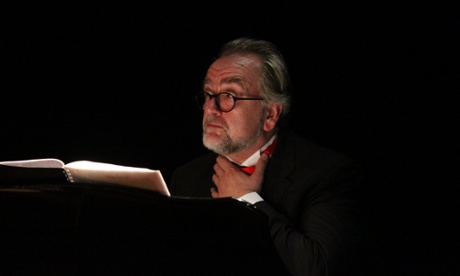
My Voice and Me is a biographical sketch of Oliver Curry, an English tenor who lost his voice rehearsing I Pagliacci in Naples a few decades ago. So traumatic was his experience there that he completely lost the ability to speak, and became permanently unable to make any sound at all. He tells his story today with the aid of a synthetic voice (which sounds strangely familiar) while simultaneously playing the piano. But there is one positive in that ill-fated Naples trip – he met his future wife, the soprano Maria Bovino, who makes an unexpected guest appearance towards the end of the work. Oliver’s story is perhaps a little sad, and it is touching how he has taught his speaking machine to cough nervously, checking his voice is there, just as he himself did when he was a professional tenor. But his story has the true flavour of Neapolitan opera, against which romantic backdrop his voice sounds mechanical and, arguably, unemotional. It is like many synthetic voices, such as that annoying voice that always apologises for late trains on the railways, which actually sounds as if it doesn’t care. But underpin this voice with the romantic, aching echoes and gestures of I Pagliacci, albeit on the piano, and suddenly he sounds sincere and you want to listen.
A uniquely emotional talking head is the star of the second work, Of Zoe and the Woman I Sing, which explores the relationship between an artist and his muse. An artist turns his argumentative muse into an avatar, the better to control her, or so he thinks. The avatar – modelled on the actress Zoë Lister, who is also on stage – speaks with a unique synthetic voice called Xpressive Talk that’s been developed by Toshiba Research Europe. The synthetic voice – which has been created using Zoë’s voice – has been designed to emulate any human emotion. So in the case of the avatar (that we’ve called Zoe, without the dots), I wrote the words “she” speaks and then chose the specific emotions with which she delivers each of “her” lines.
Our human voice is our identity; it efficiently defines us emotionally, intellectually and perhaps physically. As Steven Connor put it, “my voice is, literally, my way of taking leave of my senses”, and Zoë and I might have felt that once or twice as we have tried to rehearse these last weeks around our unbending avatar. But the whole process of working with speaking machines and avatars on stage alongside (not instead of) actors has been enormous fun. Although neither Oliver’s voice nor Zoë’s avatar sing in these works, their performance is extraordinarily musical, and dramatic. Friends who see our rehearsals also, thankfully, laugh a lot. After all, the emotion of humour is, for anyone on stage, the most challenging one to perform!
One last thought about Zoe, the avatar. She has confided to me that she is lonely, rather stuck in her box on stage and off. So I have started discussions with Toshiba about finding a friend for her, perhaps a male friend. (Confidentially, real Zoë actually got married a couple of weeks ago, and I suspect avatar Zoe might be feeling a little ... envious?) When the festival returns next year we might be able to stage a passionate love song, for two avatars. I just hope we can get their chemistry right.
- The Artist, His Muse, The Singer and Her Lover: a comedy double bill is part of the Tête à Tête opera festival at Kings Place, London on 8 and 9 August.