Creative ideas do not necessarily have to spring from the vision of a single person; many innovative solutions emerge as a result of collaborative effort. Not every company can have an Elon Musk but companies can certainly create an innovative culture that can foster its own army of innovative soldiers.

What organisations need to provide to employees are spaces, opportunities and different kinds of communication channels to encourage people to share their ideas; it can start with something as simple as a white board.
“Although innovative leaps do sometimes come directly from the CEO, this is less common than business profiles and biographies make it seem,” Micah Solomon, a US-based author and customer service consultant, wrote in Forbes magazine last April.
“More commonly, successful leaders drive innovation via their people: by inspiring and sustaining their employees in ways that promote this essential discipline.”
Anna Simpson, director of Flux Compass, a Hong Kong-based consulting company specialising in sustainability and innovation, supports the argument that without an innovative culture, ideas will not flourish.
“A culture is a sum of our collective behaviour,” she told Asia Focus at an event arranged by Innov8rs, a global community for corporate innovators, in Bangkok last month. “If we have a culture that limits the ways in which we speak and meet and share, then the ideas won’t be able to flow in an organisation.”
Ms Simpson likens ideas to butterflies that “grow” when people share them. One of the most crucial aspects when it comes to how ideas are being shared is diversity. “The more diverse perspectives we have, the more ideas will be circulated,” she said.
It is also important, in her view, to create “structured spaces” to share ideas and dedicate time for those ideas to grow in a culture that is built on trust and openness.
“Think of it as children playing in a playground where they are free to fall over and they are free to laugh when something goes wrong. You need this casual approach to ideas so that they are not inhibited.”
Being open and diverse while providing time and space for people to share and nurture ideas is important, but organisations also must be aware of unique cultural factors, says William Malek, leader of the Innovation Centre Delivery Team at Southeast Asia Centre (SEAC), an executive development education provider based in Bangkok.
The process of innovation, as it exists in Silicon Valley, can be a “complete failure” in another context, especially in a culture that is very different from that of the San Francisco Bay area, he said.
Mr Malek bases his observations on experience as a former programme director at Stanford University, where he worked with Hasso Plattner Institute of Design.
A natural part of the creative process, he says, is to be able to disagree, which tends to create friction. In a creative environment, that “friction” is used to create a third idea that two conflicting parties might not have been able to work out by themselves. This scenario, however, might not happen in the Southeast Asian setting.
In Thai culture, Mr Malek maintains, the notion of kreng jai (being considerate) usually overrides the desire to express conflicting ideas.
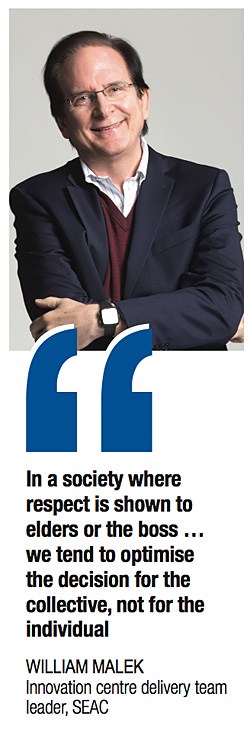
“In a society where respect is shown to elders or the boss … the bias is that we tend to optimise the decision for the collective, not for the individual,” said Mr Malek. “And this is where you get a really clear contrast, where Silicon Valley is not about optimising the decision for the collective at all. It is about the individual.”
The strength of the collective and adherence to certain social norms means that Thai employees are discouraged from challenging their superiors even if they strongly disagree, Mr Malek says. He also notes the “dramatic difference” when the boss is not in the room, as employees will tend to talk more about the collective’s problems.
“It is almost the reverse of the US, where the employees are there to get things done for the employer but but they can talk to each other about it openly,” he said. “Over here, it is about the employees working for the boss while all of what the boss is supposed to do is to make the decisions for the collective and the team trusts that. They do not want to violate the social contract within the collective and lose face or get embarrassed.”
Apart from reluctance to express disagreement, uneasiness with experimentation and failure is highly prevalent in Southeast Asia. No one can get something right the first time, and even if you are lucky enough to do so, you still require more time and research to prove that the result is repeatable.
The problem is that people who try and fail in Southeast Asia are often seen as failures who let the collective down, said Mr Malek. He cites academic research showing that Asian people in general tend to avoid high uncertainty because they do not want to put the collective at risk.
In environments where there is a heavy focus on experimentation, he says, the assumption has to be reframed “so that it is not about losing face, it is not about losing social capital when you fail” he says.
“It should be, ‘Oh, your product didn’t work? Well, what did you learn?’ How fast can you get it set up again for the next experiment? That way, you can constantly, incrementally work your way forward.”
Ms Simpson similarly observed fear of expressing disagreement with a group in Singapore, where she came up with a novel way of disassociating the speaker from the issue being discussed.
“We used a mask so that they can adopt a different persona. That idea came from David Bowie who found it much easier to perform on stage as Ziggy Stardust rather than himself,” she said.
She agrees with Mr Malek that there is a clash between the individualism and collectivism in Southeast Asia, but she also believes that too much individualism could lead to unhealthy competition to put forward ideas. What companies need, she believes, is a combination of collectivism with openness to differences.
Ms Simpson recommends basic ground rules for behaviour such as listening when somebody else is speaking, making sure that different voices are heard in different communication styles. For example, not everyone is comfortable about speaking up in a meeting, so surveys or a wall for people to anonymously write down opinions can go long way to promote innovative culture.
“People often say they are open and they want people to speak up but they do not put the structure in place,” she says. “In a meeting, one person talks and the others are meant to listen. Unless you really change that meeting structure, you are not going to have everyone opening up.” being compelled to innovate to stay relevant. The financial sector in particular is going through a very challenging time, according to Orapong Thien-Ngern, a co-president of Siam Commercial Bank.
Google’s launch of lending in India, JD Central’s decision to introduce its own wallet, Line’s plan to open an online bank next year and Grab’s plan to offer lending directly to taxi drivers are among the examples within his industry.
“These are just some examples of what happened in the last few months that showed the potentials to totally disrupt the banking industry,” he wrote in response to questions from Asia Focus.
SCB has won three innovation awards, including the Innovators Award 2018 from Global Finance magazine last year.
Mr Orapong believes more financial platforms will be introduced by large companies, while startups will also facilitate transactions between consumers, merchants and banks. This means that banks will become “less relevant” to people’s lives and platform providers will profit at their expense.

“If banks do not transform, we will be competing on providing the lowest cost of funds and offering the right to provide financial services to platform providers. This new form of ‘partnership’ will be detrimental to the banks,” he said.
That is why innovation is no longer an “ad hoc” response to an immediate challenge, but a never-ending process that requires a “holistic” approach and “willingness to challenge and transform the existing business at speed”, he said
SCB began its journey by identifying four pillars to enable its transformation strategy: customer centricity, innovation, speed and risk culture. It believes that if it is successful at shaping employees’ mindsets and behaviour in line with these four attributes, the organisation will make the changes it needs to make.
Mr Orapong said employees need to understand and internalise the fundamental fact that disruption is coming rapidly, and the world of digital is “the world where the winner takes all”.
“We need to recognise that if we are not yet the winner, then there must be plenty of room for improvement,” he said. “We need to continuously challenge what we do and ask whether it will enable us to be the winner. If the answer is no, why are we doing it?”
Thinking beyond current businesses and challenging themselves to define new business models is also more useful than just copying the obvious ones from competitors, he added. Meanwhile, taking “prudent risk” is important in the search for solutions in order to achieve good returns on investment.
“We must adopt the growth mindset to welcome challenges and have courage and perseverance to pursue our vision,” he said. “Failures are unavoidable in a fast-moving environment. However, it will not be wasteful if we all learn from the failures.”
CUSTOMER FOCUS
Another important element in creating an innovative culture within an organisation is to ensure that employees truly and thoroughly understand the pain points of their customers, according to Yuttana Jiamtragan, vice-president of corporate administration at SCG, Thailand’s largest industrial group.
“This is not easy because people in each country are different according to their social and cultural context,” he wrote in response to questions from Asia Focus. “Even people that are living in the same country may also be different.”
SCG won five awards at the Thailand Corporate Excellence Awards 2018 organised by the Thailand Management Association, including the Innovation Excellence Award.
Industrial groups that operate internationally, such as SCG, are facing many challenges, ranging from trade tensions to new technology that is displacing the products they current make. Mr Yuttana says SCG has responded with a four-pillar strategy to help employees change their mindset while encouraging an innovative culture at the same time.
The first priority is to provide employees with tools and spaces to help them identify customers’ real needs and pain points. The second is to promote education on how to create innovative ideas and products. Third is to instill attitudes and a culture that allow employees to focus on finding solutions for customers. Finally, it needs to support the deployment of innovative products and services to better serve clients.
“The way to create an innovative culture within an organisation is for it to be done gradually,” said Mr Yuttana. “It also requires the fulfillment of employees’ needs such as creating an open environment for employees to share their ideas, allowing them to do challenging work with an effective performance evaluation process, while providing suitable compensation in return.”
To change employees’ mindset, the company has changed to a project-based management strategy, where small teams bring together people from different fields to work on small projects with a relatively short life span.
After these small teams have worked together for a while, they evaluate their progress by asking themselves if the solutions they are developing will truly answer the customers’ needs. Then they can gradually build on their successes and learn from mistakes.
These small teams are also provided with technology to help them innovate, and their work is assessed to ensure it will be beneficial to customers through effective implementation. This requires separate tools and solutions for the management of innovations that have just been created and for innovations that have proven to be working successfully, Mr Yuttana added.