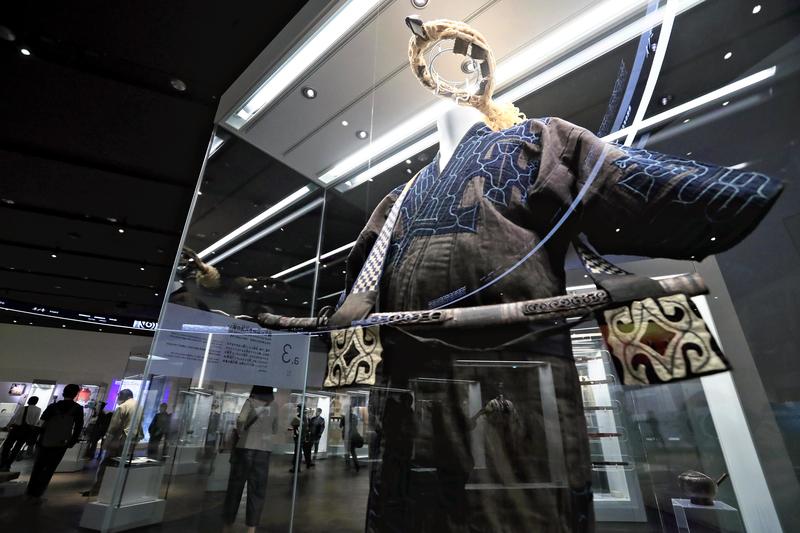
Upopoy, the National Ainu Museum and Park that opened in July in Shiraoi, Hokkaido, has become the center of resurrection of the culture of the Ainu, the indigenous people of northern Japan. Its central facility, the National Ainu Museum, tells of both the history and present of the Ainu people through traditional crafts and other source material.
Shiro Sasaki, 62, the musem's inaugural director, has recently spoken to Yomiuri Shimbun Staff Writer Masafumi Taga about the museum's policies for the future.
The following are excerpts from the interview.
We collected a vast amount of Ainu artifacts while making preparations for the museum's opening. Among the items of particular importance is a set of manuscripts once in the possession of linguist Mashiho Chiri (1909-61), an Ainu himself, which includes records of a meeting between the representatives of the Ainu Association of Hokkaido and a senior member of the General Headquarters in occupied Japan following World War II.
To understand history from an Ainu perspective, the exhibits are divided by time periods, such as the age of archaeological remains, the age of historical documentation and the age when the accounts and memories were recorded by the Ainu themselves. We are also introducing details of little known historical events, such as the fact that the Ainu fought with the Mongolians in Karafuto, an island north of Hokkaido, around the same time the Mongolians invaded Japan during the Kamakura period (1192-1333).
The spiritual world of the Ainu is quite distinct. The concept of "kamuy" may appear similar to kami, the Japanese word for god, but it is completely different in some aspects. Anything in the natural world -- animals, plants and even weather -- can become kamuy. On the other hand, even though animals such as bears and foxes are kamuy, deer and salmon are understood to be blessings from the kamuy to the Ainu. On the (Eurasian) continent, people drew figurative pictures, such as dragons and snakes, using curved lines, whereas the Ainu only drew abstract patterns. They stitched patterns on cotton clothes that came from the Honshu island, which is another manifestation of their own aesthetic.
The unique Ainu culture, influenced by both Japan and the continent, has been in danger of being wiped out because of a Japanese government integration policy since the Meiji era (1868-1912). The lives of the Ainu were particularly affected by the prohibitions of salmon fishing and their traditional hunting method using poisoned arrows. Furthermore, Japan's development policy and Russia's border demarcation repeatedly forced the Ainu to move from one place to another. Many of the Ainu settlements that remain today were established during the Meiji era or later.
Introducing the history of the Ainu's ordeals is an important mission of the museum, but I'd also like visitors to learn about the Ainu of today, too. It seems that people still believe that the Ainu people make a living by hunting in the mountains. I'd like to introduce various lifestyles of the Ainu people, such as those who are working as chefs, actors and so on, to eliminate this incorrect assumption.
The indigenous people of Ainu have made contributions to the enrichment of Japanese culture. Our museum's staff includes non-Japanese researchers from China, South Korea, Britain, Spain and other countries. I would like to add their perspectives to our exhibitions and make this museum a platform for ethnic harmony in the truest sense.
Read more from The Japan News at https://japannews.yomiuri.co.jp/