The recent news that the four Japan Railway companies are to stop serving food and drink on trains, including Shinkansen services, in March has met with regret from some customers.
The decision, which will be implemented at the same time as a schedule change, was based on the fact that an increasing number of people are opting to purchase food and drink before boarding. However, some other train companies are plowing extra efforts into onboard food services.
Since East Japan Railway Co. (JR East) announced the end or reduction of onboard food services on the Tohoku, Hokkaido and Joetsu Shinkansen lines on Feb. 18, quite a few have expressed regret on the internet that Shinkansen-exclusive ice cream cups will no longer be available. Nagoya-based manufacturer Sujahta Meiraku started selling the specialty on the Tokaido Shinkansen around 1991 before rolling it out nationwide.
The ice cream is served so hard that it is almost impossible to scoop out with a spoon, a characteristic that gained public attention and helped popularize it. Customers were quick to let JR East know that they will miss the product.
JR East will stop selling food on Shinkansen services and some limited express trains on March 15, in tandem with the schedule change, which comes into effect on March 16.
Hokkaido Railway Co. (JR Hokkaido), Kyushu Railway Co. (JR Kyushu) and Shikoku Railway Co. (JR Shikoku) will also implement the change by that date, except on some tourist trains.
The major factor behind the decision is the growth of ekinaka commercial areas in train stations. At Tokyo Station, the Gransta shopping complex opened inside the ticket gates in 2007. The number of stores is currently 92, almost double that when it opened. Combined with other adjacent ekinaka facilities near the gates, total sales in the last fiscal year amounted to about 30 billion yen (271 million dollar), triple the amount 10 years ago.
Meanwhile, last fiscal year's onboard sales on JR East's Shinkansen and limited express trains were less than half their peak in fiscal 1999. JR Hokkaido's food sales in fiscal 2013 were less than half of their 800 million yen peak, and those of JR Kyushu decreased by about 30 percent over the five years from 2012.
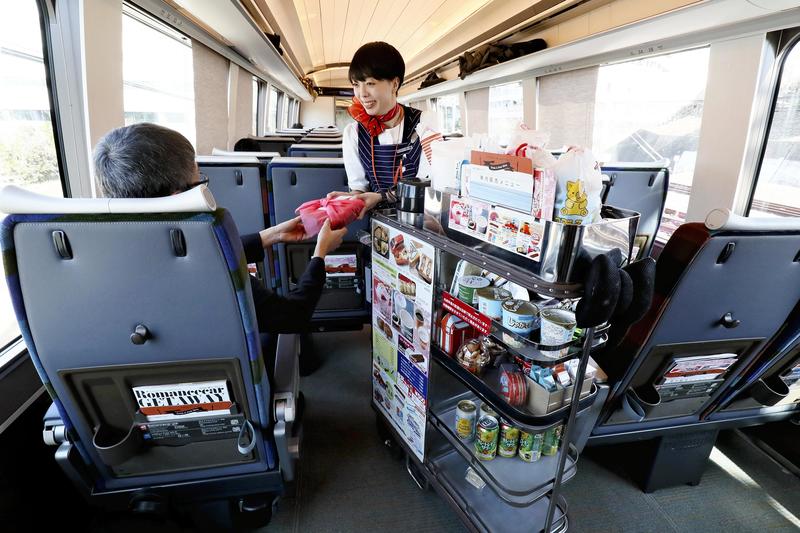
Against the trend, some railroad companies are trying to make a key selling point of onboard sales.
Fuji Kyuko Co. in Yamanashi Prefecture is aiming its catering at the foreign tourist market. On limited express trains running between Otsuki and Kawaguchiko stations, 90 percent of about 80 kinds of foods and miscellaneous goods sold onboard are the company's own. Some products feature Mt. Fuji motifs to appeal to travelers from overseas.
Many items, such as craft beer made by a local sake brewery, are sold only on trains. A Fuji Kyuko spokesperson said, "We're focusing on making onboard shopping a reason to ride our trains."
On Odakyu Electric Railway Co.'s limited express Romancecar, which runs between Shinjuku and Hakone, bento lunch boxes in the shape of its latest vehicle are popular among families and foreigners. Odakyu began serving drinks in 1949, soon after the end of the war. Many elderly people who ride the train cherish memories of those days, and the company wants to stay true to its traditions.
In some cases, salespeople are assigned to additional duties. JR-Central Passengers Co., a subsidiary of Central Japan Railway Co. (JR Tokai), which handles food and drink sales on the Tokaido Shinkansen, has about 760 sales staff. Moreover, the number of newly recruited graduates has increased by 50 percent in the past five years.
Although the Tokaido Shinkansen route is a cash cow, used by about 470,000 people a day, high demand for onboard sales is not the only reason for the increase. In March last year, JR Tokai reduced the number of conductors on Tokaido Shinkansen trains from three to two. Since then, salespeople's scope of work has expanded to include safety, evacuation guidance and emergency first aid.
Read more from The Japan News at https://japannews.yomiuri.co.jp/