Of course the BBC has political bias built in. Just read the rival manifestos, listen to the attendant chatter, and see how much less threatening a Labour government must seem along Langham Place: warm tributes to the “enrichment of cultural life”, easier licence-fee rises, more jobs saved, business as usual. And of course most of the press has similar temptations to weigh (resisted far less stoutly than in Broadcasting House). Think tycoons in mansions, non-dom proprietors, handy peerages et al. Not to mention Ed Miliband defining political courage as telling Rupert where to get off. But now add an old patch of scorched earth to that equation.
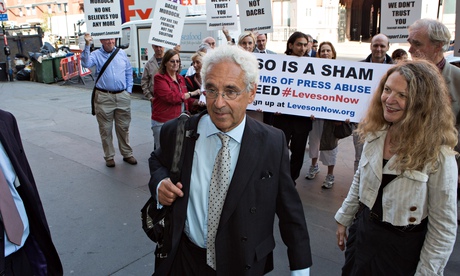
Yes, it’s Leveson time again, and here comes the Labour manifesto: “We remain strongly committed to the implementation of the recommendations of the Leveson inquiry… We made a promise to the victims of the phone-hacking scandal. We stand by that promise and will keep it.”
And maybe a Lib-Lab pact looks even more menacing to old Fleet Street. “If, in the judgment of the Press Recognition Panel, after 12 months of operation, there is significant non-cooperation by newspaper publishers, then – as Leveson himself concluded – parliament will need to act, drawing on a range of options including the legislative steps necessary to ensure that independent self-regulation is delivered,” according to the Lib Dems.
“Need to act” is Leveson code for installing Ofcom as back-up regulator and assessor of performance, a suggestion from Sir Brian that got howled down first time around in parliament and replaced by royal charter status as a supposed way of keeping politicians, and the statutory regulators appointed by politicians, out of the act.
But students of Intractable Studies may note that the recognition panel established to assess the worth of a self-regulator applying for sanctification under the charter – and appointed in turn by an appointments committee of great and good public servants – has had nothing substantive to do from day one. It’s a show with no road to run on while Sir Alan Moses’s Independent Press Standards Organisation toils away hearing the cases and making the judgments of actual self-regulation.
So there’s a basic question that neither Labour nor the Lib Dems can deal with. No signed-up Ipso member endorses the royal charter version, and no non-Ipso member – the Guardian or the Independent, with the FT on a distant digital sideline – loves it either. The outgoing editor of the Guardian called it a “medieval pantomime horse” and wants no part of it (especially because politicians aren’t quite as irrelevant to possible Snowdenesque scenarios as politicians themselves profess). Indeed, a united newspaper and magazine front behind Ipso, keeping any government at arm’s length, isn’t by any means improbable, especially as Sir Alan grinds out greater powers for his fledgeling organisation.
All of which means that the Labour and Lib Dem pledges seem out of time going on slightly potty (especially because they sit amid a Liberal Democrat array of media reforms which aims to depoliticise the leadership of Ofcom while plonking the Ofcom we have centre stage on newspaper regulation). Confused? You have every excuse. And every reason, too, for wondering why manifesto writers penning pledges wouldn’t be wiser to keep their ink dry. The plain fact is that Ipso will prove a decent, active and feisty champion of press standards, or fail, in some future public debacle, to measure up.
If there’s another debacle on a phone-hacking scale then the regulators, lawyers, politicians and media academics will come swarming over the drawbridge. But if, as now, cases arise and are dealt with reasonably, then the prospect of more debates, more threats, more votes and more disparaging world comment on British “freedoms” is a depressing waste of words and time.
■ Suppose, while we settle down for yet another discussion of media plurality in election Britain, that Rupert Murdoch owned the biggest search engine in the land (and the world). That every time you placed an ad, Rupert had his finger in the pie. That “Foxicle”, or whatever cuddly named he called it, could condemn those outlets who used other search engines to relative obscurity, bury the work of news providers that didn’t fit, and control the whole edifice of commerce and information (while proclaiming high-minded neutrality). Foxicle, for the purpose of this discussion, would have 89% of the UK market.
Stand by for blasting? Naturally. Yet because it’s Google in the firing line, pursued last week by the European commission, there isn’t much of a bang. Election manifestos may twitch over Mr Murdoch’s actual 34%, but the hidden power of search doesn’t rate a mention – another sad reflection of Britain’s political horizons. Plurality is a practical joke in cyberspace, but our masters only use very old gag books.