Naivasha is a lake town of key water resource interest in the Rift Valley region of Kenya, and the entire country at large. Competition for water use is stiff, usually between pastoralist Maasai with their livestock, small holding farmers in the Aberdare Highlands who use water from the rivers that flow into Lake Naivasha, large-scale horticulture and floriculture farmers around the lake, hotels, industries and urban and peri-urban consumers.
It's the flower farms around Lake Naivasha that have fuelled the region's economic growth over recent years, and their dependence on water risks business taking the lion's share of available water resources, at the sake of the poor communities who have arrived to find work here.
Ironically, abstraction for water supplies by the local water utility (Naivawass) is drilled wells and not directly from the lake, due to high costs of pumping and treating the lake water. This limits availability of drinking water, which is further compounded by the presence of high levels of fluoride in both surface and underground water, and leads to skeletal deformations over time. This stressful situation, created by competing demand and lack of sources with quality water for drinking, takes its heaviest toll on the poor urban and peri-urban dwellers in the municipality.
The majority of the poor living in Naivasha have no access to municipal water supply and sewerage services. To make it worse, they are nearly voiceless when it comes to matters of resource allocation for developing social services. This, over the years, has led to proliferation of informal water businesses that rely on borehole sources drilled by private owners. Borehole owners sell water from point sources to donkey vendors who in turn cart and re-sell to consumers at exorbitant prices, exacerbating poverty amongst the lowly paid migrant farm workers.
In 2007, Water and Sanitation for the Urban Poor (WSUP) began to implement a project to help the near 100,000 poor peri-urban dwellers in Naivasha to access portable, affordable, accessible and reliable drinking water. The approach works in partnership with formal service providers and businesses to put transparent structures in place that continue long after the project ends. The project has institutionalised the consumer voice and enabled informal private water businesses to meet required regulatory standards without forcing them out of the market.
Combined with a series of other interventions (social, environment, hygiene and sanitation improvements), the primary element of the project has been to convert private borehole water supply businesses to serve a wider community through formal on-selling agreements with Naivawass, the local water utility.
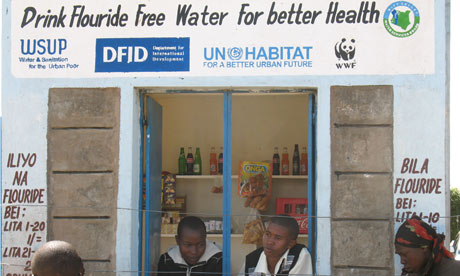
WSUP invested in rehabilitating and equipping the private boreholes, constructing storage, fluoride treatment, distribution and a network of water kiosks. Private operators have been selected amongst the existing borehole owners, to manage the operations covering about 15,000 people per commercial zone. Agreements are in place for the private borehole owners to sell water in bulk to the central system, where it is treated and sold by the private operator through a network of kiosks evenly distributed throughout the settlements.
As a result, the cost of water to consumers at kiosks in Karagita and Kamere has been reduced from 250 to 50 Kenya Shillings per cubic metre. Illegal water vending has ended, and with it, the exorbitant prices. The savings can be spent on other essentials such as education and more food. Water supply is reliable and available 24 hours a day. Employment has been created for kiosk operators and community associations exist to oversee the quality of services by the operator, and this in turn is checked by the utility. As flower-growers adapt their business to ever competing demands for water in the valley, so too are the urban poor, through the water utility, well placed to receive their share of this vital resource.
Children who used to do water vending are back to school, and soon history will be made by a generation of children without brown teeth due to the availability of affordable fluoride-free drinking water.
Kariuki Mugo is the Kenya programme manager at Water & Sanitation for the Urban Poor (WSUP)
This content is brought to you by Guardian Professional. Become a GSB member to get more stories like this direct to your inbox