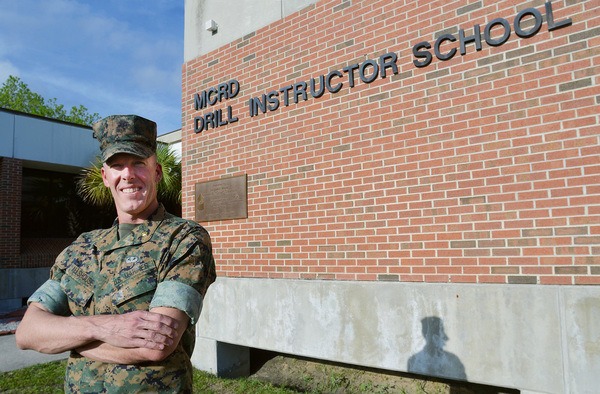
HILTON HEAD ISLAND, S.C. _ Rebekah Kind knew something was different when she tried to leave the classroom to refill her canteen.
Kind, then a 28-year-old trainee from Zion, Ill., at Marine Corps Recruit Depot Parris Island in summer 2016, was usually allowed to get water during lectures such as this one _ staying hydrated was encouraged.
Not this time, though: She was ordered to sit down, and moments later a male Marine with an official-looking folder entered the room, which halted the history lesson on the Korean War.
Her platoon, 4037, and sister unit 4036 _ about 120 recruits from Company O, 4th Recruit Training Battalion _ sat rigid in their desks, their backs straight, not touching the chair, their feet on the floor at 45-degree angles. Canteens rested on their desks, she remembers, along with some paper for note-taking. They wore camouflage blouses over green T-shirts.
Their drill instructors had earlier left the classroom, leaving them with an instructor and, now, the male Marine, who pulled a piece of paper from the folder and began to read.
As he did, she cried and heard others "quietly sobbing."
Four American cities had been attacked, likely by the Islamic State, Kind remembers the Marine saying. One of them was Chicago, just 50 or so miles south of her hometown.
"Because of my age, I remember 9/11 quite well," Kind recently told The Island Packet and The Beaufort Gazette. "So it's completely plausible ISIS could have attacked our country, so I didn't even question when they told us that."
What Kind says happened next _ what she calls "a trap" and now considers hazing _ shattered her trust in the people training her.
It was a surprise war-deployment scenario, one with a cruel twist, in Kind's view. Another former recruit told the newspapers that he experienced it, too, and it's an activity known to Parris Island officials.
When done correctly, former 4th Battalion Commander Kate Germano said, it can be an effective teaching tool. But done incorrectly, Germano said, it can be considered hazing.
Yet the activity _ at least its Korean War manifestation _ has, according to Parris Island spokesman Capt. Greg Carroll, never been part of the recruit training curriculum. Nor is it currently used.
But it's important to consider its existence at a place like Parris Island, where the nature of military training creates a gray area in which hazing might be more difficult to identify _ especially in the moment _ and thus report.
At a time when the depot is being scrutinized for its treatment of recruits _ following Raheel Siddiqui's March 2016 death and recently obtained depot-wide hazing investigations _ Kind's and others' experiences raise questions about what is acceptable, and what might cross the line.