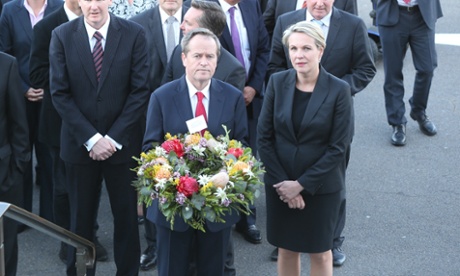
Good night
I think that will do us for today. Thanks as always for your company. Special thanks to Daniel Hurst, for minding the shop; and enduring thanks of course to Mike Bowers.
Today, Wednesday:
- Red tape was put on notice ahead of another repeal day next week. Though it be springtime, red tape duly shivered in its productivity stifling boots.
- Defence confirmed that the RAAF had flown 56 missions in Iraq, with three engagements. Senior military folks avoided questions about the precise terms of our legal agreement with Iraq underpinning the imminent deployment of Australian special forces.
- PUP senator Jacqui Lambie thought terrorists might strike our shores with ebola. The defence establishment thought on balance probably not.
- The Coalition flagged terms of a negotiation around the future of the RET. Labor and the renewables industry promptly said no way, thanks.
- Social services minister Kevin Andrews said he was open to offers about controversial budget measures in his portfolio. Labor said nup and see you at the election, Kevin.
There was more, but that’s the main busines of the day.
Have a lovely evening. See you tomorrow.
Back to foreign fighters, briefly. Sky News Laura Jayes has spotted a wrinkle.
The Govt won't be implementing ALL recommendations. Intel Committee will NOT be granted oversight of AFP #terrorlaws pic.twitter.com/xXLPyR6S5r
— Laura Jayes (@ljayes) October 22, 2014
When the prime minister said today he’d support all the committee recommendations, apparently not quite all of them.
I should note at this point, my colleague Lenore Taylor, spoke to the social security minister Kevin Andrews earlier today about the fate of these bills. There is clearly no deal in the senate. He told Lenore he was open to offers. Andrews said pushing through this legislation tonight was an effort to focus the minds of senators.
Shorten says the government will get no help from Labor on this proposal.
Not today, not tomorrow, not ever. We will fight your changes and we will defeat your changes and at the next election, there will be a reckoning between you and the people.
I think Alicia Silverstone will play Greg Hunt in the movie Clueless.
Still cranky, Shorten.
I bet they are high fiving each other over in blue carpet land.
Shorten.
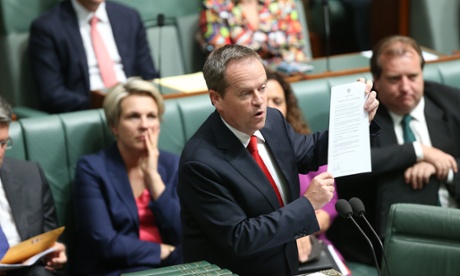
With a great deal of arm waving.
What has happened to the so called small ‘L” Liberal party? Labor dissents from the bleak and sterile vision of this country that this government gives us.
Down in the House, Labor’s Bill Shorten (currently thundering against the social services bills) has declared we’ve reached peak absurdity.
Sadly, I suspect we are not even close to peak absurdity.
The question is that the question be put.
Yes, that’s your House of Representatives. Meta as anything.
The government is pushing through contentious legislation this afternoon, including the social services bills.
I neglected to mention that Labor has said again this afternoon – after the meeting with government ministers – that the “real 20%” is just not a goer when it comes to the RET. Whether or not this stand off can be resolved depends on how pragmatic the Abbott government is prepared to be. I can’t really see what’s in it for Labor to fold on this issue: this is a mess entirely of the government’s making, and folding will give the Greens another stick with which to beat ALP members in contested seats – although, of course, stranger things have happened at sea.
Tony Abbott has had a couple of conversations with international counterparts today. He’s expressed Australia’s sorrow to the Canadian prime minister Stephen Harper.
Today I spoke w/ @pmharper & expressed our condolences & solidarity w/ Canada, following the horrific murder of a Canadian soldier overnight
— Tony Abbott (@TonyAbbottMHR) October 22, 2014
He’s also had a word to the US president Barack Obama. The G20 meeting is coming up in Brisbane. Abbott’s spokeswoman says the following:
Prime minister Abbott spoke to president Obama for around half an hour earlier today. They discussed the situation in Iraq, the ebola epidemic and the upcoming G20 summit in Brisbane. The president thanked Australia for its efforts in Iraq and continued commitment to disrupting and degrading ISIL. They agreed that the international community needed to act swiftly to arrest the ebola epidemic and the president thanked the prime minister for Australia’s contribution to date. The US and Australia will continue to coordinate closely on both these matters and other national security priorities. The prime minister said he looked forward to welcoming the president to Brisbane in November for the G20.
What brain dead person did that?
We’ve had a bit of time shifting going on today. Why leave time travel to politicians and Dr Who? I might do a little of it as well.
Today, as we’ve flagged, is red tape reduction day. By way of illustration, government figures today have raised one positive example of sweeping away pointless regulations – removing a requirement that all imported motorbikes be fitted with rear mud guards. This has saved big bucks and made life better, according to the official rationale. With that milestone in mind, let’s roll back briefly to Monday, and transport estimates. Labor was having a small poke about the mud guard issue, wanting to know how $14m could be saved by whipping off a small piece of metal.
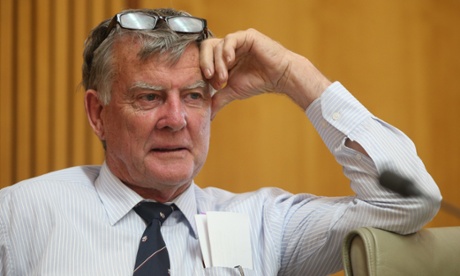
The mud guard revolution was clearly news to the committee chairman, Liberal Bill Heffernan.
Heffernan:
Shouldn’t they have a standard, like you have with brakes? Have you ever ridden behind a motor bike without a rear mud guard? You get sprayed with crap and stones. Why would we agree to remove them? What brain dead person did that?
Labor’s Stephen Conroy:
I think his name was Frydenberg.
Heffernan:
What a load of crap.
Updated
Not sure if that took the wind out of someone’s sails, but Young has now been excused from the brief sideshow.
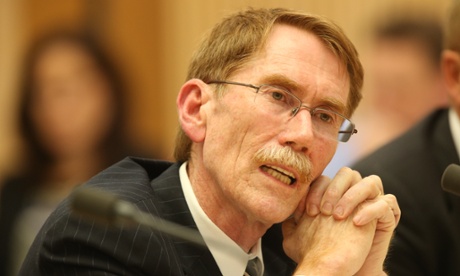
Young is asked why he didn’t particpate in the development of the ANU’s ethical investment policy. He said he stepped back from the process at the university because he was concerned about a perception about conflict of interest. Young, an engineer, is a consultant to the oil and gas industry.
Updated
The committee is back after its break. Leyonhjelm is still unhappy.
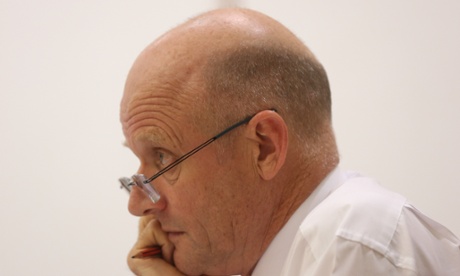
Young is plodding on trying to explain the divestment is simply prudent risk management, not grandstanding. He thinks climate change is a significant issue which people should be concerned about, but this isn’t about the optics.
The university has not gone out there to make a statement about the climate.
Updated
LNP senator Matthew Canavan is sticking up for Santos, one of the companies dropped by the ANU. Young says at no point has he argued that gas isn’t a significant part of Australia’s future for decades to come. He says ANU has not sold off all of its resources assets. David Leyonhjelm – the LDP senator – is also clearly unhappy with Young, a disposition somewhat at odds with his libertarian philosophy.
A reprieve for now though, there’s a short tea break.
Ian Young, the vice chancellor of ANU, is before estimates to give evidence about his university’s decision to divest some of its investments in the resources sector. A straightforward bit of risk management has blown up into a thought crime. I sense a brief star chamber is about to ensue.
Updated
Before I track over the education estimates for a bit, just a little piece of superb here, from Mike Bowers.
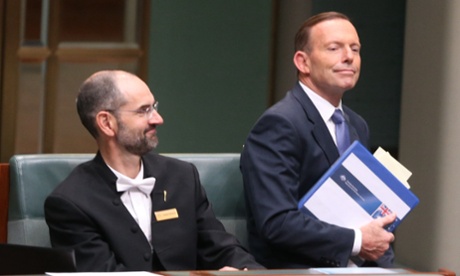
The Greens have issued a statement on the foreign fighters legislation – which is now a done deal, given the prime minister has accepted the intelligence committee amendments. Senator Penny Wright:
The recommendations of the Liberal-Labor committee are not enough to save this from being a very bad bill that will trample on long-held civil liberties and democratic rights. The committee’s recommendations are just tweaking around the edges – they do not fix the substantive problems of this bill. The Australian Greens are particularly concerned about the no-go zones, preventative detention orders and biometric data and we will be moving much more substantive amendments when the bill is debated next week. Trashing legal protections and freedoms will not make Australians safer. The Labor party needs to realise this and stop waving through draconian laws without proper scrutiny.
Catching up on various things before I have a poke around the estimates hearings once again – my colleague Lenore Taylor says the renewables industry has rejected the industry minister’s opening gambit on the RET (let’s have the “real 20%) before the talks scheduled for this afternoon get underway.
With further questions on the notice paper, here’s a selection of chamber pictures from Mike Bowers.
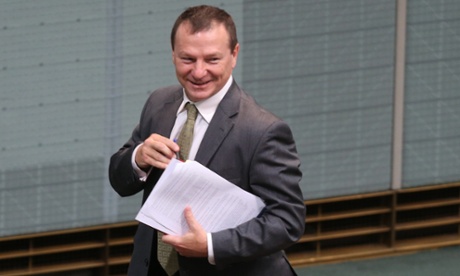
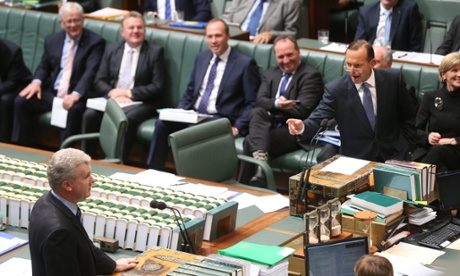
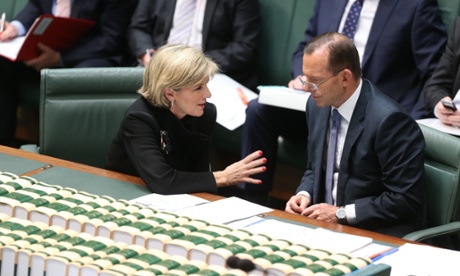
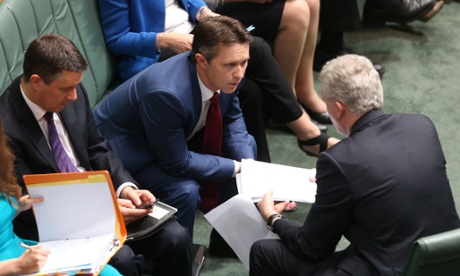
Labor is seeking that the agriculture minister correct the record for an answer he gave in Question Time on Monday concerning drought assistance. The opposition infers the answer was misleading. Madam Speaker is bouncing the question because it was not put within the required time. Labor’s Joel Fitzgibbon is going the full cranky pants. The manager of opposition business Tony Burke would also like an answer. He won’t be getting one.
Updated
Nice frame from Mr Bowers, from today’s session.
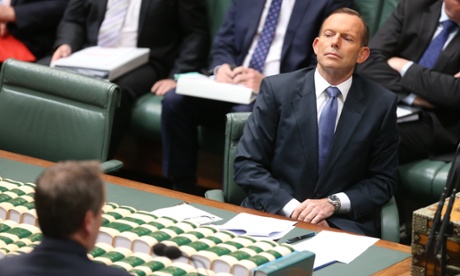
Communications minister Malcolm Turnbull has put red tape with red underpants and Fifty Shades of Grey. It’s too much.
Shorten is still trying to table a document from the diagnostic imaging association. Is the prime minister seriously not aware of the consequences of the decisions he has made – or just doesn’t he care?
Abbott:
The propositions that are being put by members operates are simply false. They are simply false. At the moment, diagnostic providers that bulk bill receive 95% of the rebate and the bulk billing incentive. Under our proposal, if they charge a $7 co-payment, they will receive 95% of the rebate and the low gap incentive which is exactly the same. Exactly the same.
Shorten begs to differ. Abbott won’t allow tabling of the document.
Ok, we are in The Matrix.
Labor deputy leader Tanya Plibersek is on the upfront costs of diagnostic imaging courtesy of the budget changes. Why is the prime minister determined to destroy Medicare and slug Australians more to have their thyroid cancer diagnosed?
Abbott:
Why is the leader of the opposition accusing Bob Hawke of wanting to destroy Medicare? It was Bob Hawke who first suggested a Medicare co-payment.
Abbott says the government is replacing the bulk billing incentive with a low gap incentive – so Labor’s arguments don’t stack up.
There has been another tussle about diagnostic imaging. The shadow health minister Cathy King would like to table a document from the Australian Diagnostic Imaging Association. The prime minister would like King to look less sanctimonious.
Can you have a reverse echo?
The small business minister, Bruce Billson.
When we were in Mount Gambier we heard from the small businesses and family farming enterprises and told us about the burden of red tape, how this was burdening them and taking their eye off the business of running their businesses.
In fact they very much echoed what the prime minister today where he said it’s government’s job to serve people, it’s not the people’s job to serve government.
Perhaps reverse anticipation. I feel like we are in The Matrix.
Shorten, on the budget.
Q: According to the Australian diagnostic imaging association, the prime minister’s decision to abolish bulk billing incentives will mean women who were previously bulk billed will now be charged $712 to diagnose breast cancer. Why will it cost women more to have their breast cancer diagnosed?
The prime minister doesn’t engage with diagnostic imaging. He speaks about the GP copayment.
The only change that the government is proposing is a $7 co-payment. That’s all we are proposing.
Fact(oid)s. With the environment minister, Greg Hunt.
At 11am today the Australian Bureau of Statistics announced the largest quarterly fall in electricity prices in Australian history – the largest quarterly fall in the 34 years of records for which statistics had been kept.
It’s likely it isn’t just a 34-year record, it’s likely it stretches back to the Second World War.
Maybe stretches back further.
May-be. Maybe back to when electricity wasn’t invented. Someone should look into that.
Very cheeky question from Labor’s Joel Fitzgibbon to Barnaby Joyce.
Q: My question is to the minister for agriculture. Can the minister explain why it’s so important that biosecurity remains part of his portfolio responsibilities within the Department of Agriculture?
The question is a reference to a story in The Australian Financial Review today by Phil Coorey which reports Joyce is resisting a push by the immigration minister Scott Morrison “to incorporate biosecurity, or quarantine, into Australian Border Force – the agency created to co-ordinate the operations of Customs, Border Protection and Immigration personnel.”
Joyce’s reply to Fitzgibbon is essentially, I’m good at agriculture – Scott is tops at stopping the boats.
SOMEBODY NEEDS TO TELL THE IMMIGRATION MINISTER THERE IS A MICROPHONE SO HE DOESN’T NEED TO HOLLER.
Sorry. Someone had to say it.
Greens deputy leader, Adam Bandt, to Abbott.
Q: Isn’t it the case that by getting Australia more involved in the war in the Middle East, your government is increasing the risk of an Australian being taken hostage or a terrorist attack occurring on home soil?
Abbott:
Madam Speaker, I would respectfully say to the member who asked the question that passivity in the face of the ISIL death cult would be the thing that was most likely to increase the risk of terrorist attacks here in Australia.
Labor has been back on the pensioners; the government has been back on Iraq. The foreign minister has shared particulars concerning her recent visit to Baghdad.
Now, its Labor’s Jason Clare.
Q: According to NATSEM modelling, families in the prime minister’s electorate are $144 worse off every year because of his unfair budget, but families in my electorate, Blaxland, which is the hardest hit by this unfair budget, will be $990 worse off every year. Does the prime minister think that families in my electorate are leaners?
Abbott:
I thank the Member for Blaxland for his question and I respectfully put it to him that there is nothing fair about saddling Australians with debt and deficit for generation its to come.
The prime minister does his patter on repeal, stopping the boats, building the roads. Then he’s irritated that noone is listening. He concludes his answer.
Question time
Labor opens Wednesday on the budget.
Q: My question is to the prime minister. Prime minister, how much worse off will seniors be after the government axes the seniors supplement?
Abbott says seniors are better off because the government has scrapped the carbon “tax” and kept the household compensation. He’s pulled the $550 figure off the shelf. That’s how much they’ll be better off. Apparently.
The Coalition opens on the foreign fighters legislation. Abbott deploys all the buzz words, but he also delivers some news.
The government will adopt all the recommendations of the recent joint intelligence committee report on the foreign fighters legislation, which is due to be debated next week. All 37 of them. And Abbott gives another little shout out to Shorten.
Madam Speaker, I do thank the leader of the opposition for his steady and consistent support on national security. We do disagree on many things and I daresay our disagreement will be evident again in 36 seconds time but on national security, it’s best that the government and the opposition stand shoulder to shoulder together as we have thus far.
(Shorten is battling a couple of break outs on national security – one from Anthony Albanese and another from Melissa Parke.)
Jared Owens at The Australian is reporting out of senate estimates hearings on the health portfolio this morning that the chief health officer Chris Baggoley has told the hearing “that Australian Medical Assistance Teams (AUSMAT) were not being provided the specialist training required to manage an ebola outbreak, typically comprising weeks of lectures, hands-on training and mentoring in the field.”
The point of the evidence seems to be that we are not very prepared for an ebola outbreak. Which seems slighly worrying.
Question time, very shortly.
Updated
Sooo pretty.
#Parliamentcourtyards #sospring @murpharoo @GuardianAus http://t.co/92HbyuWHnk pic.twitter.com/Xi0V7htot5
— Mike Bowers (@mpbowers) October 22, 2014
More questions on the RET. Journalists at the club want to know whether Macfarlane is actually serious when he says the starting point for the talks is the real 20% (given Labor has already said no and the renewables industry has said a cut of that magnitude will cripple the sector.) He says he is serious about that being the starting point. The industry minister says the Coalition did not sign up to a 27% RET (which it effectively is now, largely due to a fall in demand for energy) – it signed up to a 20% RET. He’s also pressed on why he’s keeping the household scheme. Macfarlane says that’s where the government sees the growth.
Macfarlane is asked by a journalist from China’s Xinhua news agency about what he wants out of the looming free trade agreement with Beijing. He says in portfolio terms, he wants more access for processed food, componentary and services.
Macfarlane is also in reassurance mode about submarines. He’s arguing that whatever decision ultimately gets made – there will be more jobs in South Australia.
There haven’t been submarines built in South Australia for almost 15 years, so there aren’t jobs that are going to disappear as a result of a decision being made to buy a submarine overseas.
In fact, there will be new jobs in South Australia, highly paid jobs, because wherever those submarines are built, one thing is for sure that the highly skilled, highly sophisticated requirements in terms of weapons systems and defence systems and all the electronics that go into it have to be fitted in Australia.
Most of those systems, if not all of them, will be sourced from America, and the only place they will be able to be fitted will be in SA – so there will be long-term new highly paid jobs, both in terms of maintenance, about you also in terms of fitout.
The government reveals its negotiating stance on the RET
Where would any of us be without Daniel Hurst? I’m in his debt. I’d be more effusive but we need to track back to the industry minister at the National Press Club, because Macfarlane is outlining the government’s standing start position in negotiating with the ALP to try and strike a compromise on the future of the renewable energy target.
Politics Live readers probably know that negotiations are about to begin to try and mop up the mess the Abbott government created for itself when it asked a self-declared climate sceptic to review the RET.
Macfarlane is using his NPC outing to announce some of the terms of engagement.
I can say, but I have today, along with Greg Hunt, delivered a letter to the opposition outlining the basis to our negotiation which will start at 3.30 this afternoon, and that basis is that we will maintain RET at 20% real.
Secondly, there will be no change to the household photovoltaic scheme. That is they will be able to continue as they can under the legislation, and that we will exempt from the target all energy intensive trade-exposed industries as currently defined in the act, and that that includes, of course, aluminium, but a number of other industries with I are under pressure and the jobs in those industries are under pressure, from costs overall and so maintaining pressure on those industries by maintaining them in the RET is illogical.
We will also be asking that as a result of these negotiations that the two-yearly reviews cease.
(Labor has already agreed to exempt aluminium. But it has been clear over the past few weeks that it will not cop a real 20%. In an interview with me recently, Shorten said: “A real 20% would be a massive cut. The renewable energy industry has made it very clear that it wouldn’t have a future under a real 20%.” If you click through to that Shorten interview, it will give you some context on the real 20% if you haven’t been following this particular issue.)
And that’s the point at which my brief blog tenure ends.
Katharine Murphy, as promised, has returned to return to the chair, to furnish you with calm, methodical and consultative blog posts.
-Daniel Hurst
At least one MP has noticed a marked deterioration in the the tone of political debate today:
So far today in Canberra we've had "Dickheads", allegations of "grave robbing", and questions on "Ebola laden suicide bombers" #pleeeeez!
— Craig Laundy (@LaundyCraigMP) October 22, 2014
(These are references to LDP senator David Leyonhjelm’s description of an Australian teenager’s appearance in a threatening Isis video; a Labor MP’s outburst when a caucus meeting was told of the Greens’ use of Gough Whitlam’s image; and Jacqui Lambie’s line of questioning at defence estimates.)
Updated
Ian Macfarlane is now addressing the National Press Club.
The industry minister pauses to offer sympathies over the death of Gough Whitlam - an “extraordinary figure” and advocate. Macfarlane also notes that Whitlam:
spent two weeks in this portfolio
Updated
Shorten answers a question about today’s inflation numbers:
We’re always pleased if numbers are lower rather than higher but I live in the real world and I talk to real Australians. Real Australians are concerned that their cost of living is going up, not down.
For the record, the real statisticians at the Australian Bureau of Statistics today reported that the consumer price index rose 0.5% in the September quarter, following a rise of 0.5% in the June quarter. The year-on-year figure is 2.3%, down from 3% previously.
Here is a breakdown from the ABS:
The most significant price rises this quarter were for fruit (+14.7%), new dwelling purchase by owner-occupiers (+1.1%), property rates and charges (+6.3%) and other services in respect of motor vehicles (+5.8%). These rises were partially offset by falls in electricity (-5.1%) and automotive fuel (-2.5%).
The Consumer Price Index (CPI) measures price change for consumption goods and services acquired by Australian resident households. The Australian Government repealed carbon pricing with effect from 1 July 2014. It is not possible to quantify the impact of removing the carbon price on the price change measured by the CPI.
Cost of living is still a potent political issue, according to an Essential poll published yesterday. Two-thirds of respondents to that survey felt electricity costs had worsened in the past year.
Updated
The opposition leader, Bill Shorten, fronting reporters in Canberra, refers to the outpouring of national grief after the death of Labor luminary Gough Whitlam yesterday.
But it’s clear that the political ceasefire from yesterday is over. Shorten says his Labor opposition is fighting the Liberals on the same issues that Whitlam’s “pioneering” government did four decades ago. He says the Abbott government is trying to push through billions of dollars of cuts to welfare payments.
They say that the more things change the more things stay the same...
Forty years on from the Whitlam era, once again Labor is in the trenches defending the vulnerable, the low-paid and ordinary Australian families.
Updated
Blessed are the hyphens and commas.
Tony Burke has another go at the routine housekeeping done on the government’s last repeal day.
My colleague, Lenore Taylor, documented some of the curious elements of the Statute Law Revision Bill (No 1) in March. Here are some highlights from her list:
Schedule one, part 27, corrects a punctuation error in the Fair Work Act 2009 to insert a comma in between the words “aircraft” and “ship”.
Schedule one, part 39, corrects a spelling error in the Great Barrier Reef Marine Park Act so that the word “committing” has the requisite two “t”s.
Updated
Labor’s Tony Burke, responding to Tony Abbott’s red tape cuts, says he hopes this repeal day “goes better than the last one”.
Burke is mocking the practical impact of the outdated regulations axed earlier in the year. Exhibit A: an owner of a mule or bullock required for military purposes should furnish it for such purposes.
Updated
A message to the working mothers of Australia:
Where we can make it easier for people to spend their time as they choose, rather than waste it filling out forms, we should.
A working mother, for example, who doesn’t want to be contacted by telemarketers during her spare time will be able to register both her home and her mobile phone numbers on the ‘do not call’ register. We’re now also making sure she doesn’t have to remember to re-register every eight years by keeping her numbers on the list in definitely.
This same mother could also benefit from the roll-out of the MyTax online portal that prefills individuals’ returns.
Over in the House, Tony Abbott is talking red tape.
And despite the irresistible popping joy of bubble wrap, the prime minister employs a metaphor:
Bubble-wrapping our creative minds in red tape stifles innovation and flexibility.
Updated
I’ve been keeping my eye on the education estimates committee hearing this morning.
There was a healthy serve of dill, care of a procedural skirmish between Labor’s Kim Carr and the LNP senator Barry O’Sullivan.
O’Sullivan:
I take offence to being referred to as a dill. I’m not a member of the ALP. And I want it withdrawn.
But turning to matters of substance:
Professor Barry Spurr - who is now embroiled in controversy over emails containing racist and sexist language - was paid $8,250 for his input into the national curriculum review, officials revealed.
The whole review cost $283,000, but officials were at pains to point out that Spurr was one of about 15 subject experts appointed by the two curriculum reviewers Kevin Donnelly and Ken Wiltshire - not directly by the government. The education department was not involved in watching over Spurr’s participation.
The Greens senator Penny Wright suggested that Spurr’s emails put a question mark over his views about Indigenous literature.
The Liberal senator Marise Payne said the education minister, Christopher Pyne, had repudiated the views expressed in the emails:
I think the minister and I’m sure those who are going to look at the recommendations are more than capable of discerning the value of those recommendations and considering them in the appropriate way.
Updated
Good morning readers. Daniel Hurst here, taking over the blog for an hour or so. Don’t worry: Katharine Murphy will be back to steer us through question time.
A series of estimates committee hearings are under way, including questioning of the ADF leadership over Iraq and Ebola. We also expect to hear from the industry minister, Ian Macfarlane, at the National Press Club at lunch time.
Just a heads up, shortly I’ll be handing over Politics Live to my lovely colleague Daniel Hurst – apologies, but I have to attend to a prior appointment for an hour or so.
I know you’ll make Daniel very welcome as he minds the shop.
Back to defence estimates for a moment. It has been quite amusing to watch the locked jaws of the defence folks fielding questions from PUP senator Jacqui Lambie. Currently Lambie wants to know whether terrorists might enter the country bearing Ebola. The officials at the table are pretty confident that won’t happen.
Updated
Interesting too, given the theme of the last post, in the Labor caucus meeting this morning a handful of Labor MPs raised concerns about the next big issue in the national security space: mandatory data retention.
Albanese:
This is opportunism of the worst kind.
Let’s translate this episode a bit. Albo is bruised and upset because Whitlam has died. Many Labor people are deeply upset. I can absolutely understand this intervention this morning from the Labor perspective, this is cheeky from the Greens; and Albanese here is just saying what he thinks, not running some cute tactic.
But the episode also gives us a neat little insight into just how hard the combat is in the inner city for progressive votes between Labor and the Greens. The Greens are taking no prisoners when it comes to courting disaffected Labor types. And the disaffected types are there for the taking, given Bill Shorten’s determination to project and pitch to the political centre on issues like national security and military engagement in Iraq. Testing times for Labor left wingers.
I suspect, given the reaction, the Greens will conclude that artful little bit of trolling is mission accomplished.
To Anthony Albanese, blowing a gasket about Greens absconding with Gough.
The Greens political party put up, authorised by Lee Rhiannon on a website, an image of Gough Whitlam, “Vale Gough Whitlam,” next to the Greens party political logo.
I think that that is cheap, opportunistic and offensive, given that Gough Whitlam was a Labor man his entire life.
Gough Whitlam understood that you needed to seize power and be in Government to make a difference to this nation and he did just that between 1972 and 1975. He understood and said very explicitly on so many occasions that he didn’t want to be just a party of protest, he wanted to be a party of government.
I’d say to Christine Milne and to the Greens, including Lee Rhiannon who authorised this, the Senator from NSW, and Adam Bandt, just do the right thing, pull it down and admit that it was an error of judgment. That the appropriate thing to do, that’s the respectful thing to do.
Q: What do you find so offensive, the fact they used it with their party logo?
They clearly are trying to appropriate Gough Whitlam’s legacy for the Greens.
Gough Whitlam, not only was not a member of the Greens’ political party, he campaigned against them.
Updated
Back to Andrew Wilkie and the ICC:
I have today made a formal request to the prosecutor at the international criminal court in the Hague in the Netherlands asking her to investigate specific individuals and in particular that they might have contravened article 7 of the Rome statute, and committed crimes against humanity, by the way they have treated asylum seekers attempting to come to Australia over a number of years.
The way the ICC works, I need to name specific individuals and I have named the prime minister, Tony Abbott, and all 19 members of his Cabinet, including the immigration minister, Scott Morrison. In my application to the prosecutor, I have specifically identified offences, crimes against humanity such as the forced relocation of people, obviously to the Republic of Nauru and to Papua New Guinea but also there have been repeated instances of forced relocation of people back to areas from which they claim to be fleeing persecution and in particular Sri Lanka. I’ve also identified the inhuman conditions within detention centres and other matters that I ask her to look into.
What the prosecutor does from here remains to be seen. The ball’s very much in her court but I hope that she will respond to this request and will promptly investigate these matters and will ultimately make a recommendation that the names be given to the pretrial chamber and that the International Criminal Court commence proceedings against the prime minister and the 19 members of his Cabinet.
Fury is also building elsewhere over a decision by Greens deputy leader Adam Bandt to use an image of Gough Whitlam with Greens branding on Greens material.
A fact worth remembering #ThankYouGough pic.twitter.com/qHVCows3BT
— Adam Bandt (@AdamBandt) October 21, 2014
Labor’s Anthony Albanese will shortly blow a gasket on this front.
Defence is on a short break. While the good folks sip tea, the Tasmanian MP Andrew Wilkie is telling journalists that he has written to the International Criminal Court asking it to investigate Tony Abbott, his cabinet and the immigration minister Scott Morrison to investigate Australia’s policy on asylum seekers.
Speaking as we were out activity outside the lines – lines have been drawn in this hearing. This far photographers, and no further.
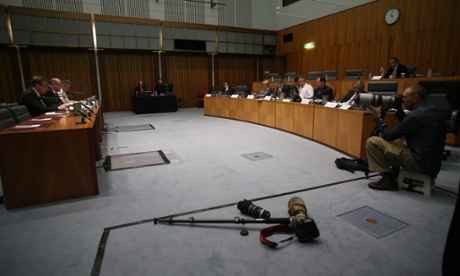
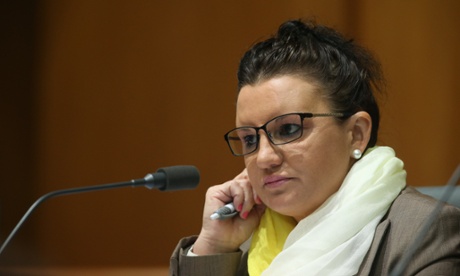
PUP senator Jacqui Lambie wants to know what percentage of our SAS that we are “risking” in Iraq. Her point appears to be if a number of special forces are killed in the conflict that’s bad for security at home. She thinks commandos might be better at home protecting Australians from a terror attack.
Lieutenant General David Morrison reckons we are good. He declines to get into percentages within the deployment.
Lambie is asking questions now about multiple tours and the impact on personnel. How many of these men have done three years in a war zone?
Griggs:
I don’t know senator.
She’s concerned about personnel being given anti-psychotic drugs and sent back into combat. Are in any people in this deployment on drugs?
An official says seven personnel have been deployed while on mental health related medications. The medications are for maintenance. They have been cleared as medically fit. Lambie wants to know why we are sending “damaged” people into conflict. The official says mental health conditions are treatable conditions not permanent impairments.
Q: Are these members carrying weapons?
Will we be training Iraqi forces in our advise and assist role?
Johnston:
We are not even on the ground yet.
Conroy asks about a recent comment from the prime minister indicating that Australian forces would fire back. What does this mean, exactly?
Griggs:
Everyone of our people has the inherent right to self defence.
Conroy asks David Johnston whether we have used an exchange of letters for an ADF deployment before? Isn’t the convention a status of force agreement?
Johnston won’t even call it an exchange of letters.
Let’s just call it the arrangement.
Griggs says the arrangement isn’t quite finalised yet.
Australian special forces have not yet been deployed into Iraq.
Updated
Repeat after me. G-r-i-g-g-s.
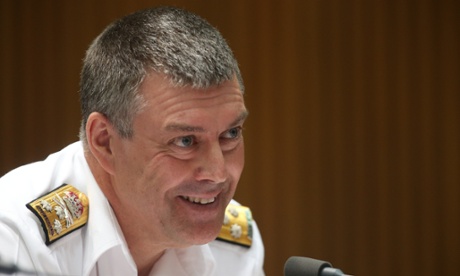
First recorded incidence of blogue brain for today – a colleague has just very kindly pointed out I’ve been calling Ray Griggs ‘Ray Briggs’ for an hour or so.
I don’t know why really, given I know he’s not Briggs.
In any case it’s corrected now. Apologies. Shocker.
Vice-Admiral Griggs: Iraq will be a long campaign
Conroy asks about the very first combat mission over Iraq, where no targets were engaged. Griggs says there is a senior Australian defence person embedded in the chain of command who ensures Australian contributions are in the national interest. It was decided in that particular instance that the risk of collateral damage was too great, and the Australian official invoked a red card. Of 56 missions – three thus far have involved engaging targets.
How does this red card system work? Griggs says it’s a process ensuring Australians remain within the rules of engagement and avoid collateral damage. Conroy asks whether Australia’s attitude to collateral damage is reflected commonly across the coalition group or whether we have a higher threshold. Griggs declines to answer that.
Conroy wants particulars on the legal authority. Are we operating on a template legal arrangement or do we have our own?
Griggs:
We have been invited to operate and we have clearance to operate. Broadly, it’s the same (as other partners in the coalition).
Griggs does not want to address details. He says the legal authority is a sensitive issue with the Iraqis, so he’d prefer not to comment. He says the ADF is satisfied Australian personnel will have all the necessary immunities and protections before deployment. Conroy asks whether the legal protections will stand in Iraqi law.
Griggs:
We are satisfied.
Conroy then asks how long this mission is expected to continue. Griggs flicks that to the minister, David Johnston. He says speculation about duration is unhelpful.
Q: What will be defined as success in degrading and disrupting ISIS?
Griggs says this will be a long campaign.
It’s not something that will be quick and decisive.
Updated
The shadow defence minister Stephen Conroy wants to know about security in Baghdad, and elsewhere on the ground where Islamic State militants are active.
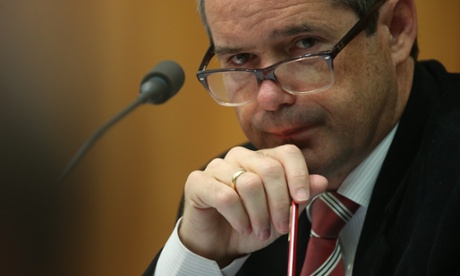
Vice Admiral Griggs says broadly, Iraq is currently under the influence of three military organisations. The Peshmerga, the Iraqi security forces, and ISIS – active in the west and north west, through the Euphrates Valley.
There is ongoing heavy fighting in that area.
Griggs says the air campaign is having a significant effect on how ISIS does its business. He says the air campaign has curtailed the freedom of movement of the militants. They are not making progress. They are now contracting into urban areas.
That complicates the targeting of the air campaign. It’s a challenge if they contract into urban areas.
Q: Is Baghdad in danger of falling? Or is that a media beat-up?
Griggs:
I think for about five months now people have been saying Baghdad will fall next week.
I think it’s overblown. The disposition around Baghdad is relatively stable and has been for some time.
Griggs says militants are in the west but not in the central area of Baghdad.
Updated
Given we are participating in combat in the Middle East, I reckon it’s prudent if I listen-in first today to defence estimates. Evidence just now from Vice Admiral Ray Griggs indicates that Australian special forces will go “outside the wire” if called to do so in their advise and assist role in Iraq – but will not embark on independent combat operations.
Updated
Failing any left field developments, my expectation is estimates hearings resume today, with treasury and defence among the folks reclining under the grill.
Updated
Just while we’ve got time, here’s the full Essential work on ebola. Australians support giving aid, but are concerned about deploying medical personnel.
- 58% of respondents think Australia is doing enough to assist the international efforts to fight ebola and 21% think we are not doing enough.
- 74% of Liberal/National voters and 54% of Labor voters think we are doing enough but 42% of Greens voters think we are not doing enough.
- 62% of women think we are doing enough compared to 54% of men.
- A majority – 53% – would support Australia increasing funding to aid the fight against ebola in West Africa.
- However less than 50% support sending medical personnel (44%), troops (36%) or other workers (48%).
- Those most likely to support sending medical personnel were Greens voters (62%) and those with university education (52%).
Updated
Uhlmann also asks Shorten about ebola, and the Abbott government’s approach to the issue.
Shorten:
What leaves a lot of ordinary Australians scratching their heads is this. The government has been willing to lean forward on international matters on other occasions but it doesn’t take a Rhodes scholarship to work out if you don’t deal with this deadly disease at the pount of outbreak and if it is allowed to spread we will need more costly solutions down the track.
The idea that Ebola is no challenge for Australia and if it is we just wait until it reaches Papua New Guinea to deal with it, to me, is a very dangerous idea. To me, this is a clear case where you should help do what you can now to avoid it being a much bigger problem down the track.
Q: And do you believe that immigration should have a greater hand in the border protection of this? It seems to be a bit of a tussle going on in cabinet over the moment over who has responsibility?
Well, I’ve read about a split emerging in the government about biosecurity. It seems to me that the insiders would say this was another Scott Morrison land grab at the expense of his colleagues. For me though, the real issue here is biosecurity, which helps protect our agricultural industries, for example, has a scientific role as well as a compliance role. I’m not sure that just moving everything into Customs would help our farming communities be secure from international diseases.
(Just for the record, the weekly Essential poll released yesterday afternoon found that 58% of voters believe the government is currently doing enough to help fight ebola. Only 21% think it’s not doing enough.)
With the day still finding its feet, the Labor leader Bill Shorten has called by the ABC studios to reflect on Whitlam. Shorten’s host, Chris Uhlmann, would prefer to hear something more than generalities.
Shorten is asked about lessons from the Whitlam period.
He did his homework. He spent years and years preparing his and Labor’s ideas for government. I think that is one of the big lessons. He used his years in opposition. So my challenge, and the lesson for me, from Gough Whitlam the opposition leader, is let us use this time now between now and the next election to have a view of Australia not just at the next election but what sort of country we want to be in 2024.
Q: Do you think that Tony Abbott would disagree with any of those things? Aren’t all of those things really motherhood statements? How do you make those real?
Well there’s about three questions in that. First of all, whether or not Tony Abbott rhetorically agrees or disagrees you have to look at his actions. We are not moving the country forward when we’re cutting access to healthcare. We are not moving the country forward when we’re making it harder for kids to go to university. We’re not moving the country forward when we’re turning our back in terms of building modern infrastructure, the NBN, which allows this country to engage more with the rest of the world.
Q: When will you put meat on the bones of these statements? When will we see the policies that will take you into the next election?
We will reveal our policies well before the next election.
Good morning everyone, and welcome to Wednesday in the national capital. Wednesday is still gradually unwinding from Tuesday. The former Labor prime minister Gough Whitlam died yesterday, at 98. The newspapers and news websites this morning are still dominated by tributes and analysis of a politician who divided national affairs in life, and united it in death. Lots of good pieces around examining both the very best and the very worst of EGW.
As for politics today –
- The Coalition is planning more red tape reduction. According to The Australian, which has been briefed on the proposed bonfire of the semi-colons and square brackets, the savings to be booked from the Abbott government’s red tape reduction seem to be increasing. They seem to be now more than $2bn. The prime minister will make a statement to the House this morning on the enduring desirability of letting businesses develop things without having to deal with pesky governments. After that, eleven bills will be introduced to repeal other bills. Proper debate on this issue will occur next week. Apparently there is to be a spring repeal day, bring Zyrtec and a packed lunch.
- There are a couple of stories around this morning in the national papers concerning the proposed free trade agreement with China. Whomever is briefing The Australian and the The Australian Financial Review says Australia has now secured a deal for zero tariffs on coal exports. The Australian also says the prime minister will delay imposing additional curbs on foreign investment in farmland until after the agreement is signed. Perhaps I’m very thick but I don’t quite grasp that last point: free trade deals generally cover exhaustively all elements of foreign investment. I’m not sure how this gets addressed later on. But I’m sure all will be revealed in the fullness of time.
If you want to reveal something, by all means. clamber on to the Politics Live comments thread, which is now open for your business. If you want to say hello on Twitter, by all means. I’m @murpharoo and he’s @mpbowers